
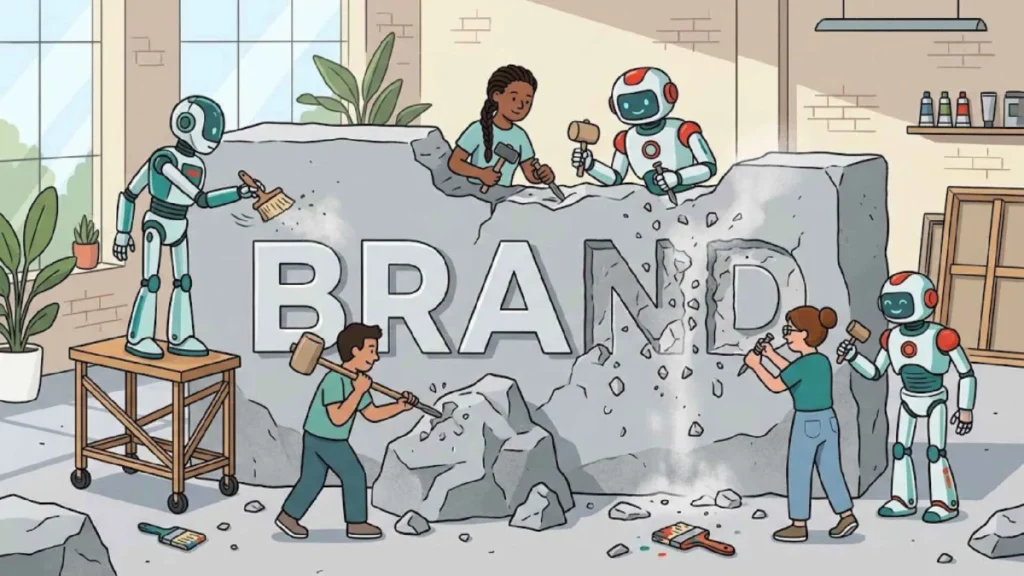
The AI Brand Crisis: Why Adjectives No Longer Protect Your Corporate Identity
By MarTech Industry Desk
Published: October 24, 2023
Main Facts
Traditional corporate brand guidelines—built over decades on abstract adjectives, subjective tone-of-voice descriptors, and visual mood boards—are fundamentally failing in the age of generative and autonomous artificial intelligence. Historically, brand consistency relied heavily on human "middleware": long-tenured employees who intuitively understood unwritten company values, historical exceptions, and contextual nuances.
When handed to humans, a vague instruction like “be premium yet approachable” resulted in minor, manageable variations known as brand drift. However, when deployed inside autonomous AI agents, machine learning algorithms, and automated customer-service models, these same ambiguous directives can propagate a single unresolved assumption across tens of thousands of customer interactions in mere seconds.
Consequently, modern marketing and brand strategy must evolve from passive expression (logos, taglines, color palettes) to active behavior (decision-making rules, ethical boundaries, and real-time operational logic). Organizations are now forced to extract the implicit judgment previously locked inside the heads of veteran staff and codify it into explicit machine-readable frameworks.
Chronology: The Evolution of Brand Management
To understand why AI breaks modern brand strategy, it is necessary to examine how brand governance has evolved over the last century.
1. The Era of Print and Mass Media (1950s–1990s)
- The Static Standard: Brand guidelines were thick physical manuals (and later PDFs) focused almost entirely on visual identity: Pantone color codes, minimum logo sizes, and typography hierarchies.
- Controlled Output: Because publishing collateral required human designers, print houses, and marketing directors, the speed of execution was inherently slow. This friction acted as a natural quality-control gate, catching deviations before they reached the public.
2. The Digital and Cloud Software Boom (2000s–2010s)
- The Multi-Channel Expansion: Websites, mobile apps, and social media channels decentralized content creation. Suddenly, dozens of agencies and internal teams were generating assets simultaneously.
- The Rise of "Brand Rails": Tools like Canva emerged to solve the scaling problem for visual assets. Companies uploaded logos, brand kits, and color palettes so non-designers could produce on-brand graphics without requesting approval for every single banner.
- The Invisible Gap: While visual assets were successfully decentralized, verbal tone and behavioral judgment remained subjective. Companies relied on corporate culture, onboarding training, and experienced managers to bridge the gap between abstract brand values and daily customer interactions.
3. The Generative AI Inflection Point (2022–Present)
- Autonomous Execution: AI systems stopped waiting to be clicked and started acting. Large language models (LLMs) and automated agentic workflows began writing emails, recommending products, issuing refunds, and resolving disputes in real time.
- The Scale of Drift: Without human intuition to interpret guidelines in context, AI systems began exposing the deep flaws in traditional brand frameworks. An unstated assumption in a brand deck could now be misinterpreted 10,000 times before lunch, scaling reputational risk to unprecedented levels.
Supporting Data and Industry Observations
The shift from human-mediated branding to autonomous AI execution is supported by structural observations across enterprise marketing, customer experience (CX), and operations:
- The "Sarah" Factor: In most mid-to-large enterprises, consistency was maintained by institutional knowledge holders (informally dubbed "Sarah"). These individuals intuitively understood how to balance competing brand directives—such as “be empathetic yet efficient”—when handling a furious customer versus a confused one.
- The Speed Differential: Human employees typically process a complex customer dispute over minutes or hours, applying institutional memory and discretionary judgment. Modern enterprise AI models must resolve similar operational dilemmas in under 400 milliseconds, leaving zero room for ad-hoc human mediation.
- The Failure of Adjectives: A content audit of typical Fortune 500 brand strategy decks reveals heavy reliance on unmeasurable qualities: bold, premium, customer-first, innovative, authentic, family-friendly, and approachable. These descriptors lack operational definitions, making them mathematically useless for programmatic decision-making systems.
- The Expansion of Touchpoints: Historically, brand strategy governed marketing communications heavily, grew fuzzy during sales processes, and virtually disappeared inside billing, logistics, and dispute resolution. AI integrates these back-end operations into the brand experience, meaning behavior has officially replaced expression as the primary frontline of brand identity.
Official Perspectives and Industry Expert Responses
As enterprises rush to deploy generative AI across customer-facing workflows, marketing leaders, brand strategists, and technologists are voicing urgent concerns regarding governance and brand safety.
On the limits of legacy brand guidelines:
"Your brand guidelines were built for humans. AI changes that. Good organizations used to reduce brand drift through training, culture, creative direction, reviews, and long-tenured people who know what the brand is supposed to feel like. Even then, brand drift was still in the mix. That’s because the guidelines were only part of the operating system. The rest lived in people."
— Enterprise Marketing Analysts
On the shift from passive expression to active behavior:
"For most of brand strategy’s history, the artifact was passive. A logo sits on a page. A tagline sits on a billboard… AI doesn’t wait. It recommends, adapts, escalates, personalizes, and commits. It takes an action before a human reviews it. A brand only described in adjectives has no answer for a machine that has to act in the next 400 milliseconds."
— MarTech Strategy Contributors
On extracting institutional judgment:
"The goal is not to make AI interpret brand as humans always did, because humans have a gift for inconsistency. The opportunity is to extract the judgment that lived in the heads of a handful of people, make the important parts explicit, and build systems capable of carrying that judgment."
— Industry Governance Experts
Implications for Modern Enterprises
The collision between autonomous AI and legacy brand management carries profound implications for CMOs, Chief Product Officers, and enterprise technologists. Organizations that fail to adapt risk severe brand erosion, customer alienation, and regulatory compliance failures.
1. The Death of Ambiguity in Strategy
Enterprises can no longer afford poetic, evocative brand strategy decks that rely on reader interpretation. Words like “innovative” or “transparent” must be broken down into explicit operational rules. For example, a brand guideline can no longer simply state “be transparent during product updates.” It must explicitly define: At what hour does transparency become a reckless disclosure during a cybersecurity incident? What specific data fields are restricted?
2. Behavioral Branding Replaces Visual Styling
While color palettes and typography remain foundational, they no longer represent the frontier of brand consistency. Brand management must now encompass business logic and operational policies:
- What do we do when a customer makes an unreasonable demand?
- What do we refuse to do even if it secures a short-term sale?
- Who (or what algorithmic ruleset) decides what happens in a high-stakes situation that the original brand guidelines never anticipated?
3. Codifying Institutional Knowledge
Companies must transition from relying on tribal knowledge—the tenure of veteran employees—to building structured "judgment repositories." This involves interviewing top-performing customer service leads, compliance officers, and sales directors to document how decisions are actually made under pressure. These qualitative insights must then be translated into decision trees, prompt guardrails, and programmatic logic layers that AI agents can execute safely.
4. Extending the "Canva Principle" to Judgment
Just as Canva democratized visual design by baking design rules directly into software rails, enterprise AI demands that operational judgment be embedded directly into execution workflows. By transforming brand values into hard constraints and scenario-based decision frameworks, organizations can empower automated systems to move fast without sacrificing brand integrity.
Conclusion
The rise of enterprise artificial intelligence does not render brand strategy obsolete; rather, it exposes its historical shortcuts. By forcing organizations to abandon vague adjectives and confront unstated assumptions, AI provides the ultimate catalyst to build rigorous, scalable, and behaviorally sound brand infrastructures for the digital future.
