
The Great Disintermediation: How Artificial Intelligence is Redefining the Battleground for Consumer Financial Trust
For decades, the traditional banking paradigm was built on a foundation of proprietary real estate and controlled channels. Whether a customer sought to open a savings account, apply for a mortgage, or simply understand how compounding interest worked, they did so within boundaries carefully erected and maintained by financial institutions. Banks invested billions of dollars perfecting this digital and physical estate, pouring capital into sleek brick-and-mortar branches, robust call centers, highly optimized websites, and feature-rich mobile applications. The underlying assumption was simple: while banks might compete fiercely against one another for market share, the customer journey—from initial curiosity to transaction execution—would always take place on turf owned and operated by the bank.
Today, that foundational assumption is fracturing. A silent revolution is sweeping across the consumer financial landscape, driven not by traditional fintech upstarts or neo-banks, but by conversational artificial intelligence. Consumers across the globe are increasingly seeking financial guidance, modeling complex fiscal scenarios, and evaluating banking products outside the traditional bank ecosystem entirely. As artificial intelligence evolves from a novelty into an indispensable daily interface, traditional financial institutions find themselves facing an existential question: When a consumer’s primary financial advisor lives inside a third-party large language model rather than a banking app, what happens to the bank?
Main Facts: The Shift from Bank-Owned Apps to Third-Party AI
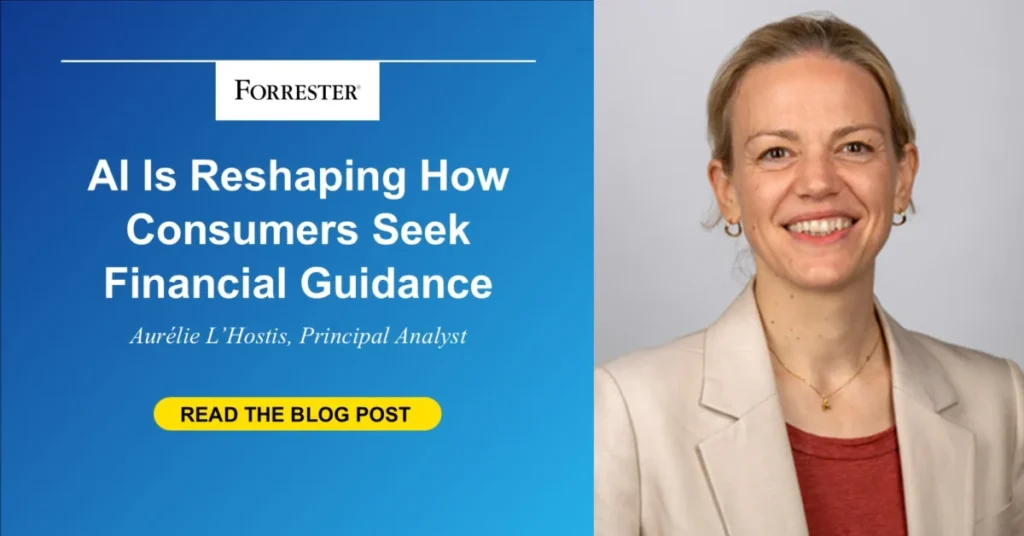
The core reality confronting the financial services sector is that the gateway to consumer financial decision-making has fundamentally shifted. According to landmark research from Forrester, entitled Consumers Use AI For Personal Finance, But Not Necessarily From Their Bank, nearly one-third of all consumers across the United States, the United Kingdom, and Canada now regularly utilize conversational AI for personal finance inquiries.
Rather than opening their bank’s proprietary mobile app to parse complex financial concepts, compare credit card offerings, evaluate investment options, or monitor their day-to-day spending, these consumers are opening general-purpose AI platforms. The implications of this behavior shift are staggering. While approximately 25% of consumers report using their own bank’s native AI assistant over the past year, a remarkably close 24% have turned to third-party AI platforms—such as OpenAI’s ChatGPT, Google’s Gemini, Anthropic’s Claude, or Apple’s Siri—to handle sensitive, personal financial questions.
This development shatters the historical walled garden of banking. Consumers are increasingly initiating their financial journeys on neutral or third-party terrain. They rely on these external AI assistants to model financial scenarios, synthesize recommendations, and compare competing financial products across different institutions. Perhaps most alarming for traditional banking executives is a growing qualitative sentiment revealed in consumer surveys: a significant portion of users find third-party AI assistants to be more helpful, intuitive, and objective than the AI tools provided by their own financial institutions.
As these AI systems become more sophisticated, context-aware, and proactive, they are poised to exert unprecedented influence over how consumers discover, evaluate, and ultimately select financial products. Banks are no longer merely competing against rival financial institutions for consumer deposits and loan originations; they are competing for influence over the foundational guidance that shapes a customer’s choices long before a transaction ever takes place.
Chronology: The Evolution of Digital Banking to Conversational Intelligence
To understand how the financial industry arrived at this critical juncture, it is helpful to trace the evolution of digital banking channels over the past twenty years:
- The Era of Digitization (Late 1990s – 2010s): Banks focused heavily on migrating routine transactions from physical branches to digital channels. Websites and early online banking portals allowed consumers to check balances and pay bills asynchronously, reducing operational costs for banks while offering convenience to users.
- The Mobile-First Revolution (2010s – Early 2020s): The proliferation of smartphones sparked an intense race among financial institutions to build the best mobile applications. Banks treated their apps as the ultimate destination for everything from check deposits to personal financial management tools, successfully keeping the customer engaged within a closed ecosystem.
- The Rise of Basic Self-Service AI (Early 2020s): Recognizing the need to scale customer service and reduce contact center overhead, banks began deploying foundational conversational AI—mostly rule-based chatbots and rudimentary natural language processing tools designed to handle basic service inquiries, password resets, and simple payment execution.
- The Generative AI Disruption (Present Day): The public democratization of generative artificial intelligence and large language models fundamentally changed consumer expectations. Consumers quickly grew accustomed to hyper-personalized, context-rich, conversational interactions across various non-financial apps. Consequently, their patience for rigid, siloed, and transactional bank chatbots evaporated, driving them toward more versatile third-party AI interfaces for complex financial guidance.
Supporting Data: Adoption Metrics and the Trust Gap
A granular look at the data underscores both the massive momentum behind AI-driven finance and the profound psychological hurdles that still remain. The Forrester research highlights a compelling dichotomy in consumer behavior: while adoption rates are climbing rapidly, they are routinely outpacing consumer trust.
Key Data Insights:
- 33% of consumers in the US, UK, and Canada actively use conversational AI for personal finance queries.
- 25% of consumers have utilized their bank’s proprietary AI assistant over the past year.
- 24% of consumers bypass their banks entirely, leveraging third-party platforms like ChatGPT, Gemini, Claude, or Siri for financial decision-making support.
- The Trust Cliff: While consumers readily embrace AI for informational tasks—such as researching definitions, learning about tax strategies, or monitoring high-level spending patterns—trust drops off precipitously when the interaction moves from passive information to active recommendations, automated decision-making, or autonomous financial actions.
This trust gap is rooted in legitimate consumer concerns surrounding data privacy, algorithmic bias, systemic security, and factual accuracy (often referred to in AI circles as "hallucinations"). Consumers desperately want intelligent guidance to help them navigate complex economic lives, but the vast majority are not yet willing to completely surrender control or delegate actual financial decisions to autonomous digital agents.
For retail banks, credit unions, and wealth management firms, this reality establishes an immediate strategic mandate: the primary near-term opportunity does not lie in fully autonomous, hands-off finance, but rather in the deliberate cultivation of trusted financial guidance.
Official Responses and Industry Perspectives
Financial executives and industry analysts are grappling with the structural threat posed by third-party conversational interfaces. Reactions across the sector range from urgent calls for technological transformation to cautious defense of legacy advisory models.
Industry thought leaders point out that conversational banking can no longer be treated as an ancillary feature or a glorified customer service deflection tool. According to supplementary research on the state of conversational banking, leading institutions are already expanding the mandate of bank-provided AI—moving past simple inquiries and payments into the realms of proactive product discovery and comprehensive financial wellness coaching.
However, many traditional bankers have historically suffered from an "insulator mindset," believing that the stickiness of a checking account or a mortgage will perpetually bind the customer to the bank’s proprietary app. Technology strategists emphasize that this mindset is rapidly becoming obsolete.
"The next challenge for banks is not merely deploying conversational AI at scale, but winning the battle for consumer trust," notes industry analysis from enterprise research firms. Financial institutions must deliberately architect conversational experiences that are transparent, explainable, and deeply secure. They must demonstrate unyielding data stewardship and regulatory compliance—areas where third-party tech giants often face intense public skepticism. Banks that successfully bridge the gap between algorithmic convenience and human-backed reassurance will retain their central role in the consumer’s financial life; those that fail will find themselves relegated to invisible back-end utilities.
Implications: Strategic Imperatives for the Modern Bank
As conversational, proactive, and eventually agentic AI experiences mature across the broader technological landscape, the center of gravity in financial services is shifting. Control over the customer interaction layer will increasingly belong to whichever entity—whether it is a multinational retail bank or a silicon valley tech conglomerate—best helps the customer achieve superior financial outcomes. Ownership of the underlying financial product (the loan, the savings account, the investment vehicle) will no longer guarantee ownership of the customer relationship.
To avoid being marginalized into invisible infrastructure providers, banks must confront several critical strategic questions and implement targeted initiatives:
1. Shift from Self-Service to Proactive Advisory
Banks must stop treating AI merely as an operational cost-cutter designed to answer FAQs. Instead, conversational AI must be elevated to an intelligent financial advisor capable of educating, guiding, and proactively alerting customers to financial opportunities and risks before they ask.
2. Radical Transparency and Explainability
To close the trust gap, banks must build AI models that can clearly explain why a particular financial product or recommendation is being made. By combining the data security and regulatory compliance of a traditional institution with the conversational fluidity of modern AI, banks can offer a level of reassurance that third-party platforms struggle to match.
3. Owning the Moment of Decision
If consumers continue to use third-party AI assistants to compare mortgage rates, evaluate investment portfolios, and model retirement scenarios, banks must find innovative ways to integrate their offerings into those third-party ecosystems via secure APIs and open banking frameworks, while simultaneously improving their own native conversational interfaces to capture the initial search intent.
Conclusion
The strategic question facing banking executives is no longer whether consumers will use artificial intelligence for personal finance—the market has already answered that with a resounding yes. The true question is whether banks will remain the trusted primary source of financial guidance as conversational interfaces redefine consumer behavior. Institutions that build robust, transparent, and empathetic AI assistants will strengthen their bonds with customers, cementing their relevance for decades to come. Those that view AI as a simple self-service novelty risk watching their customers drift away, one conversation at a time, into the waiting arms of third-party platforms.
