
Navigating the Perpetual Rollercoaster: Generative AI and the Future of MarTech
The Gartner Hype Cycle—that iconic, bell-shaped curve representing the trajectory of emerging technologies—has long been a polarizing fixture in the tech industry. It is simultaneously revered as a roadmap for innovation and reviled for its perceived oversimplification of complex market dynamics. Yet, as generative AI (GenAI) reshapes the marketing landscape, the Hype Cycle is experiencing a renaissance. The reality, however, is far more nuanced than a single line on a graph.
For marketing technologists, the current moment is characterized by a "perpetual motion" effect. We are not witnessing a single technology moving toward maturity; rather, we are navigating a series of overlapping waves, each at a different stage of development. To truly understand where we stand, we must dissect the mechanics of this acceleration and look at the empirical data currently defining the sector.
Main Facts: The Multi-Layered Reality of AI Adoption
The primary fallacy in analyzing AI today is the assumption that "GenAI" is a monolithic entity. It is not. It is an umbrella term for a vast array of applications—from automated email copywriting and customer service chatbots to predictive analytics and complex content orchestration.
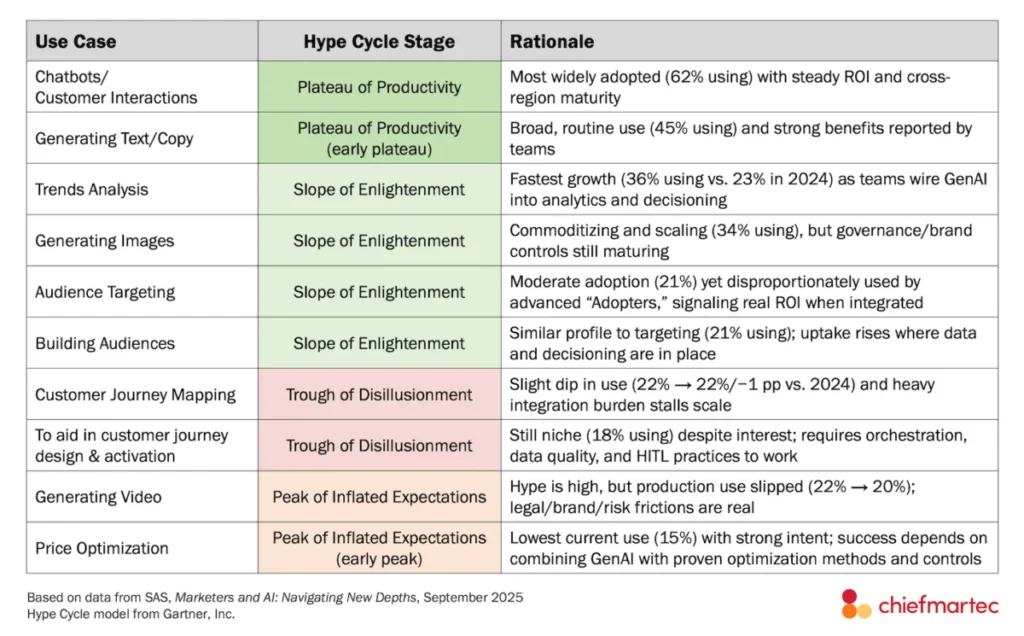
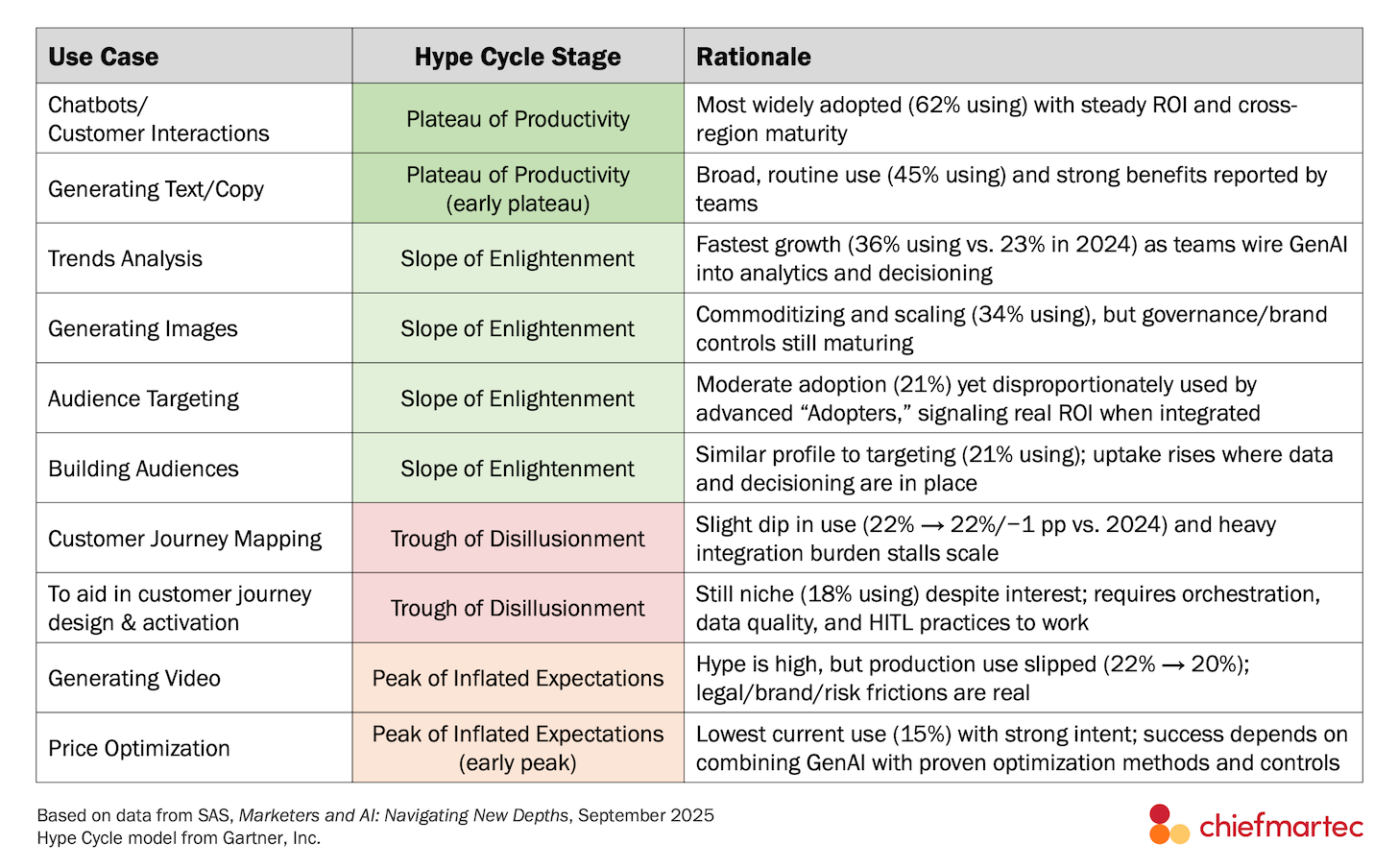
The central thesis for modern marketers is that different use cases are traversing the Hype Cycle at different speeds and trajectories. While basic content generation tools may have already reached the "Plateau of Productivity," more advanced, agentic AI systems—capable of executing complex, multi-step marketing workflows—are currently hovering at the "Peak of Inflated Expectations."
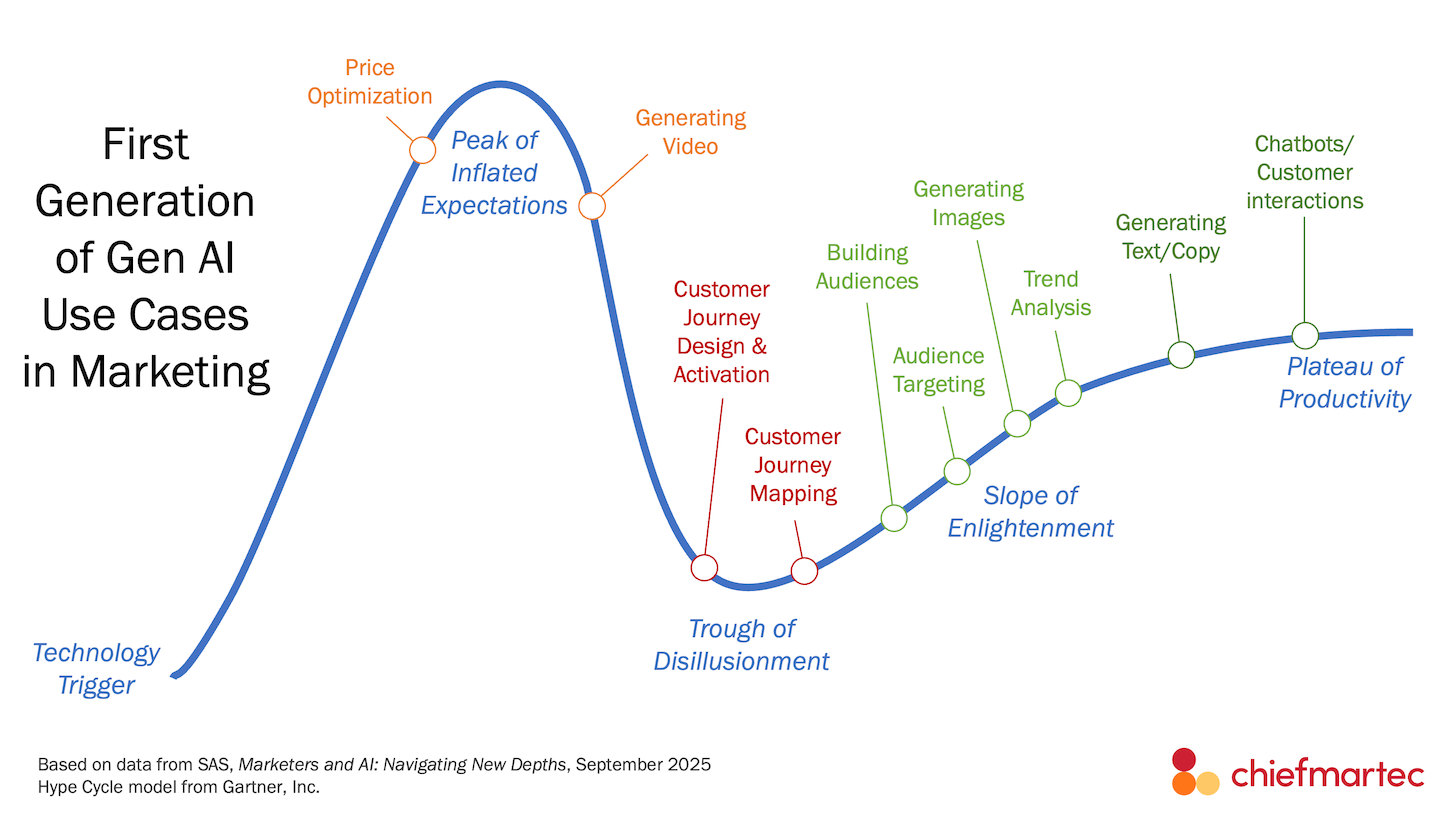
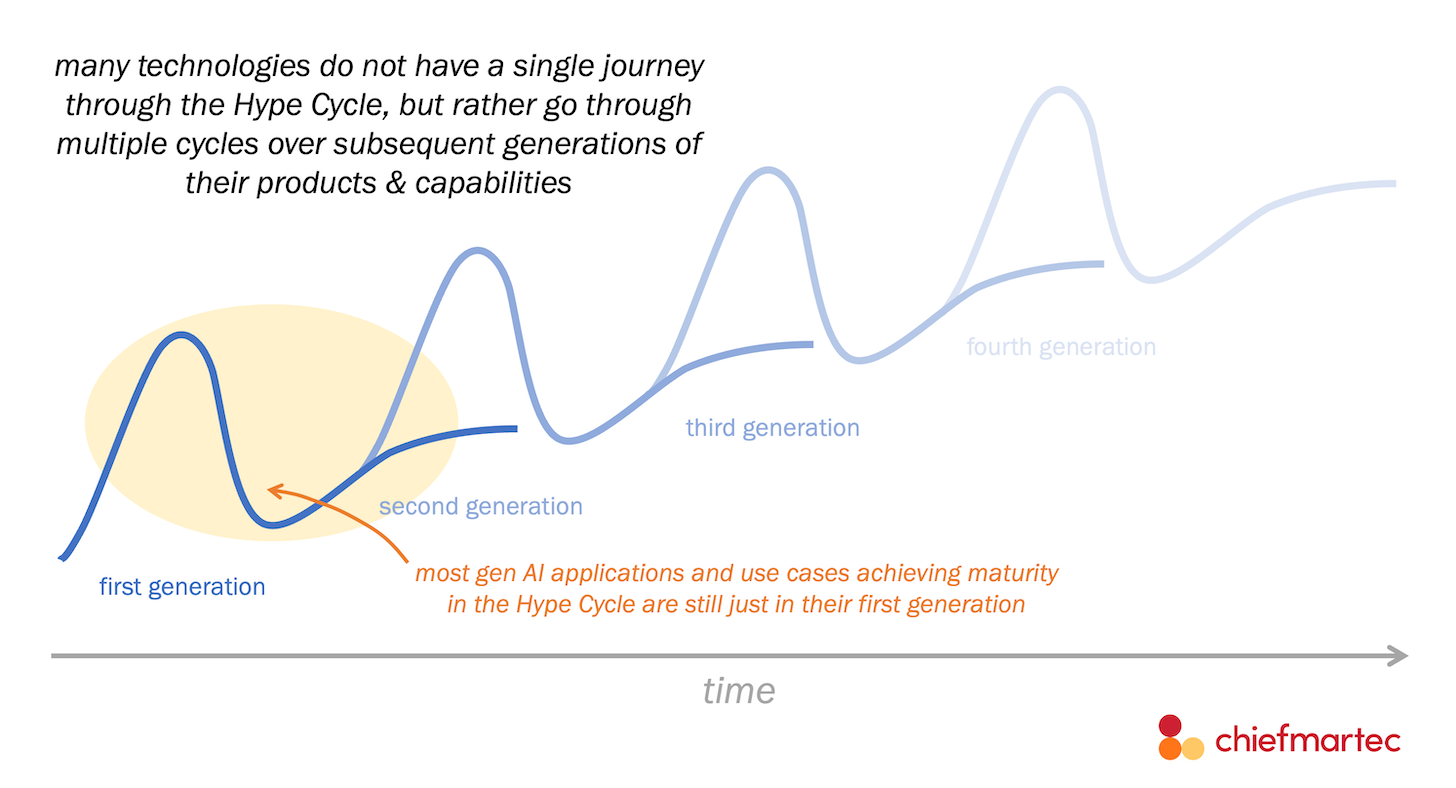
Furthermore, we are witnessing the emergence of generational shifts. Just as we reach a point of maturity with a first-generation tool, a second or third generation arrives, triggering an entirely new, fresh Hype Cycle. This creates a state of cognitive dissonance: an organization may be experiencing the operational benefits of a mature chatbot (Plateau of Productivity) while simultaneously grappling with the hype surrounding the next, more autonomous version of that same technology (Peak of Inflated Expectations).
Chronology: The Acceleration of Innovation
In the pre-AI era, the journey from a technology’s "Innovation Trigger" to its "Plateau of Productivity" typically spanned a decade or more. That timeline has been shattered. Today, the cycle from inception to widespread implementation is measured in months, not years.
The past 12 to 24 months have been defined by a frantic "land grab" for AI capabilities. 2024 saw the initial shock and awe of generative AI, where organizations scrambled to integrate LLMs into any process that involved text or image generation. By 2025, the conversation shifted from "Can we do this?" to "Is this actually driving revenue?"
This rapid maturation cycle means that before the dust settles on one generation of AI, the next is already being introduced. We are effectively living in a state of permanent "Beta," where marketers must balance the pursuit of cutting-edge tools with the need for stable, reliable systems. This accelerated chronology is not merely a technical challenge; it is a fundamental shift in how marketing departments allocate budget, hire talent, and define success.
Supporting Data: The SAS "Marketers and AI" Report
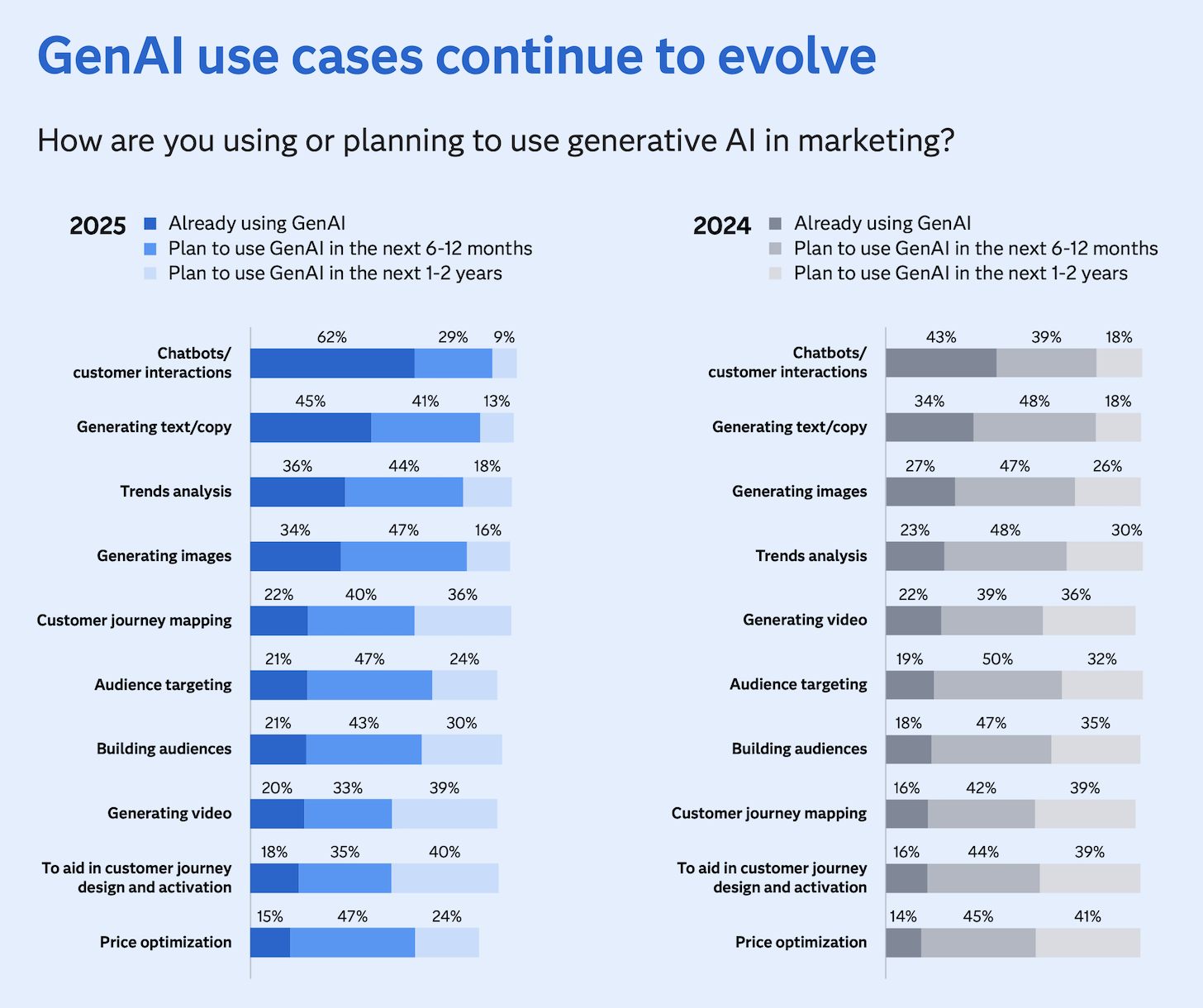
To move beyond anecdotal evidence, we must turn to data. A recent report from SAS, Marketers and AI: Navigating New Depths, provides a crucial look at how sentiment and adoption have evolved between 2024 and 2025. Based on a survey of 300 professionals, the data confirms the rapid maturation of specific marketing use cases.
The report reveals that the most accelerated use cases are not necessarily the most "exciting" ones, but the ones that provide the most immediate, measurable ROI. Content generation, while frequently hyped, has seen a massive surge in practical, daily adoption.
Key takeaways from the SAS data include:
- The Leaders: Practical applications like automated content creation and basic customer service interactions have moved firmly into the "Plateau of Productivity," as organizations have integrated these into standard operating procedures.
- The Reversals: Interestingly, some use cases that saw massive hype in 2024 have shown a cooling off in 2025. This suggests that as organizations move past the "wow" factor, they are trimming back tools that fail to provide tangible, scalable value, pushing those specific applications into the "Trough of Disillusionment."
- The Planning Gap: There remains a significant delta between companies that are planning to use AI and those that have successfully integrated it. The data indicates that while intent is near-universal, the execution phase is where the most significant challenges—data governance, ethical considerations, and integration with legacy tech stacks—arise.
Official Responses and Expert Perspectives
Industry analysts and practitioners are increasingly vocal about the need for a more disciplined approach to AI adoption. The prevailing consensus is that "hype-chasing" is a recipe for fiscal disaster. Instead, firms are being encouraged to map their specific AI investments onto their own versions of the Hype Cycle.
By acknowledging that a specific tool might be in the "Trough of Disillusionment," a CMO can make the strategic decision to wait for the next iteration or pivot to a more stable solution. This "intelligent skepticism" is becoming a core competency for modern leadership.
The SAS report itself serves as a call to action for marketers to stop viewing AI as a "magic button" and start viewing it as a component of a larger, data-driven architecture. The inclusion of topics like quantum computing in the report further underscores the reality that while GenAI is the current protagonist, it is merely one chapter in a much longer narrative of disruptive technological change.
Implications for the Future of MarTech
What does this mean for the future of the marketing profession?
- From Execution to Orchestration: As AI handles the "execution" of tasks (writing, coding, image generation), the marketer’s role shifts toward "orchestration." The value lies not in the creation of the content, but in the strategy, intent, and oversight of the AI agents executing the work.
- The Death of the "One-Size-Fits-All" Strategy: Because different applications exist at different stages of the Hype Cycle, companies must adopt a portfolio approach. They should treat their AI stack like a venture capital portfolio: invest heavily in the proven "Plateau" performers, experiment cautiously with the "Peak" candidates, and cut ties quickly with those failing in the "Trough."
- The Talent Pivot: The demand for "prompt engineers" may be short-lived, but the demand for "AI architects"—individuals who understand how to connect data, logic, and business goals—is skyrocketing. Organizations that prioritize internal training and literacy will have a distinct advantage over those that rely solely on external vendors.
- Resilience in the Face of Disruption: The most important takeaway from the current climate is the necessity of building an adaptable, modular tech stack. When technology cycles move this fast, the ability to "plug and play" new solutions while deprecating old ones is the difference between a market leader and a company left behind.
Conclusion: Embracing the Exhilarating Chaos
The landscape of marketing technology is currently more chaotic and exhilarating than at any point in the last two decades. While the Hype Cycle may feel like a dizzying ride, it provides the necessary framework to categorize, analyze, and eventually master the tools at our disposal.
We must accept that we will never reach a final "destination." The plateau of today is simply the launchpad for the peak of tomorrow. By grounding our strategies in empirical data—as provided by reports like those from SAS—and maintaining a clear-eyed perspective on the developmental stage of each AI application, we can move beyond the hype and begin to harness the true, transformative potential of this era.
The future of marketing is not a destination; it is a process of constant iteration, learning, and refinement. And for those willing to engage with that process, the opportunities are, quite literally, limitless.
