

Fourthwall vs. Spring (Teespring): The Ultimate 2026 Creator Commerce Showdown
For digital creators, influencers, and online entrepreneurs, monetizing an audience has never been easier—or more complex. Choosing the right e-commerce engine can mean the difference between a thriving digital empire and a frustrating side hustle.
Two of the most prominent players in the creator economy space are Fourthwall and Spring (formerly known as Teespring). While both platforms allow users to launch custom merchandise and digital products with zero upfront costs, they have evolved along drastically different trajectories.
This comprehensive analysis examines the core differences, pricing models, product ecosystems, and strategic implications of choosing between Spring and Fourthwall.
Main Facts: At a Glance
At their core, both Spring and Fourthwall cater to content creators looking to monetize their influence through print-on-demand (POD) merchandise and digital downloads. However, their structural DNA sets them apart:
- Spring is fundamentally a hosted social storefront. It is optimized for speed, offering a lightweight setup designed to push merchandise directly to existing YouTube, Twitch, or TikTok audiences with minimal friction.
- Fourthwall is an all-in-one brand-building ecosystem. It functions as a comprehensive e-commerce platform, enabling creators to build fully customized storefronts, manage multi-tier memberships, accept donations, sell self-fulfilled stock, and offer retail-grade print-on-demand products.
- Merchant of Record (MoR) Status: Both platforms act as the Merchant of Record, meaning they handle complex international sales tax liabilities, compliance, and VAT remittance on behalf of the creator.
- Pricing: Both offer robust free tiers, charging zero monthly subscription fees for their basic plans, though they monetize through base product manufacturing costs or transaction fees on digital goods.
Chronology: The Evolution of Creator Commerce Platforms
Understanding where these platforms stand today requires looking at how they arrived here.

The Spring (Teespring) Trajectory
Founded originally as Teespring, the platform pioneered the crowd-funded apparel model. Creators would design a shirt, set a goal, and if enough people pre-ordered, Teespring would print and ship them.
Over the years, the company rebranded simply to "Spring," expanded its catalog to include accessories, home goods, and a "Digital Launcher" for ebooks and audio files, and deeply integrated itself into social media monetization tools like the YouTube Shopping shelf. Recent updates have focused on backend stability, multi-factor authentication (MFA), bulk-editing tools for listings, and optimizing checkout speed with Apple Pay, PayPal, and crypto options.
The Fourthwall Rise
Fourthwall entered the market later, built specifically to address the limitations traditional print-on-demand networks placed on creators trying to build sustainable, long-term brands. Instead of just offering a basic catalog of blank t-shirts, Fourthwall prioritized a curated, retail-grade product line.
Over the past few years, Fourthwall has aggressively expanded its feature set. It introduced native membership tiers, video/livestream streaming perks, deep integrations with email marketing tools like Kit (formerly ConvertKit) and Klaviyo, an AI-powered assistant named "Eli" to help scale product lines, and strategic partnerships for financial management and community fundraising (such as integrations with Throne and Karat).
Supporting Data: Pricing, Fees, Margins, and Capabilities
When evaluating the bottom line, creators must look past the "free to use" banner and analyze how each platform extracts its margins.
Financial Models Compared
| Feature / Metric | Fourthwall | Spring |
|---|---|---|
| Primary Focus | Comprehensive creator brand & multi-stream income | Social-first merch drops & digital downloads |
| Storefront | Custom domain with full HTML/CSS site builder | Hosted social storefront with basic layout controls |
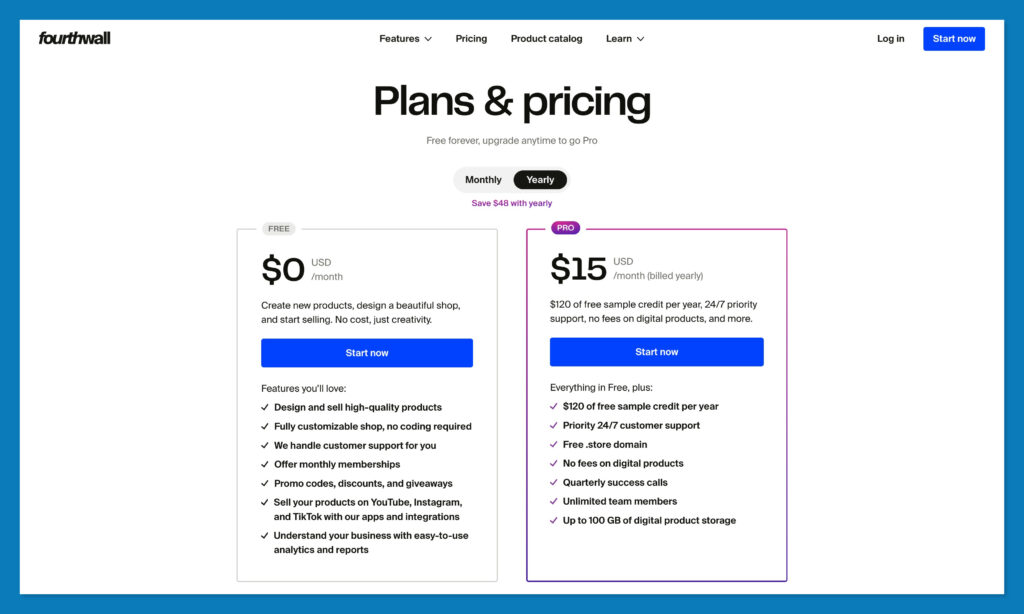
| Free Plan Fees | 0% on physical products (+ payment processing); 5% on digital goods/memberships | Free to use; variable base costs set per item |
| Paid Plan | $19/mo ($180/yr) removes digital fees, adds 500-product limit, team members & sample credits | None (Single free-tier model) |
| Digital Product Fees | 5% (Free plan) / 0% (Paid plan) | 20% + $1.70 per sale |
| Tax Handling | Merchant of Record | Merchant of Record |
Analyzing the Margins
- Physical Merchandise: Spring typically offers slightly lower base manufacturing costs on standard items, but the material and print quality can occasionally be inconsistent. Fourthwall leans heavily into a quality-first approach, utilizing premium blanks and Signature collections that command higher retail price points.
- Digital Downloads: This is where the financial gap widens significantly. Spring charges a steep 20% plus $1.70 per sale on digital downloads. For a $10 ebook, the creator only pockets $6.30. Fourthwall charges a modest 5% fee on its free tier, which is entirely eliminated if the user upgrades to the $19/month professional plan.
Store Building, Integrations, and Customization
The operational workflow and creative freedom differ dramatically between the two platforms.
Spring: Speed Over Customization
Spring’s store builder is intentionally minimalist. Creators can add a logo, a hero banner, custom brand colors, social media links, and a selection of featured products to a pre-set template. It connects seamlessly to a custom domain, but the architectural ceiling is low.
You cannot run a traditional blog for content marketing or easily build complex category structures. However, Spring excels at lightning-fast integrations with social platforms, plugging directly into YouTube Product Shelves, Twitch extensions, and Linktree.
Fourthwall: True Brand Ownership
Fourthwall provides a fully realized e-commerce engine. Creators gain access to a comprehensive site builder with complete control over themes, page layouts, product collections, and custom domains. Developers can even leverage the Storefront API or inject custom HTML/CSS.
Furthermore, Fourthwall bridges the gap between e-commerce and audience relationship management (CRM). It integrates directly with advanced email marketing software like Klaviyo, Mailchimp, and Kit, allowing creators to automatically segment buyers, trigger welcome sequences, and launch targeted membership campaigns based on purchasing history.
Product Ecosystems: What Can You Actually Sell?
The scope of what a creator can offer dictates how quickly their business can scale.
- Spring is great for single-item drops. You create a hoodie, push the link to your social media followers, and close the campaign. While it supports basic digital downloads and a decent array of ~200 print-on-demand items (apparel, accessories, lifestyle goods), it completely lacks support for recurring memberships, physical self-fulfilled inventory, or accepting direct fan donations.
- Fourthwall is an all-in-one ecosystem. Beyond its curated, high-end print-on-demand catalog, it allows creators to:
- Sell self-sourced, self-fulfilled physical stock alongside POD items.
- Launch recurring monthly membership tiers with exclusive video posts and community perks.
- Accept direct financial donations and tips.
- Sell instantly delivered digital gift cards that never expire.
- Bundle multiple offers together (e.g., selling an audiobook bundled with a physical vinyl record).
Additionally, Fourthwall’s AI assistant, Eli, drastically reduces administrative friction. Creators can feed a single graphic to Eli, which can automatically generate matching designs across an entire collection of products, optimize pricing structures, and handle inventory tweaks.
Official Responses and Platform Updates
Recent product rollouts highlight the divergent philosophies of both companies:
- Spring’s Strategy (Frictionless Transactions & Security): Spring’s recent updates show a heavy emphasis on tightening checkout security and administrative controls. By introducing multi-factor authentication (MFA), a dedicated Creator Experience team, and streamlined bulk-editing tools for inventory management, Spring is doubling down on making baseline merch drops as secure and painless as possible.
- Fourthwall’s Strategy (Retention & Ecosystem Expansion): Fourthwall is investing heavily in tools designed to turn casual buyers into repeat, loyal community members. Between the deep Kit CRM integration, the Throne wishlist partnership, enhanced analytics for Twitch gifting, and access to a designer marketplace for commissioning custom artwork, Fourthwall is positioning itself as a legitimate alternative to Shopify for modern creators.
Strategic Implications: Which Platform Should You Choose?
Deciding between Fourthwall and Spring boils down to your long-term business goals:
Choose Spring If:
- You want simplicity above all else: You have an established social audience on YouTube, Twitch, or TikTok and want to drop a limited-edition t-shirt or hoodie with zero technical overhead.
- You primarily do quick drops: Your business model relies on releasing a piece of merch tied to a specific viral video or streaming milestone, rather than maintaining a permanent, evolving storefront.
Choose Fourthwall If:
- You are building a long-term brand: You view merchandise as just one pillar of a broader digital media business that will eventually include memberships, digital courses, custom physical products, and donations.
- You value product quality and customer retention: You want retail-grade apparel that reflects premium branding, and you need advanced email marketing tools (like Kit or Klaviyo) to nurture your customer base over time.
- You want to avoid platform migration later: Starting with Fourthwall ensures that as your business grows, you won’t outgrow your software stack or be forced into a stressful data migration down the road.
