
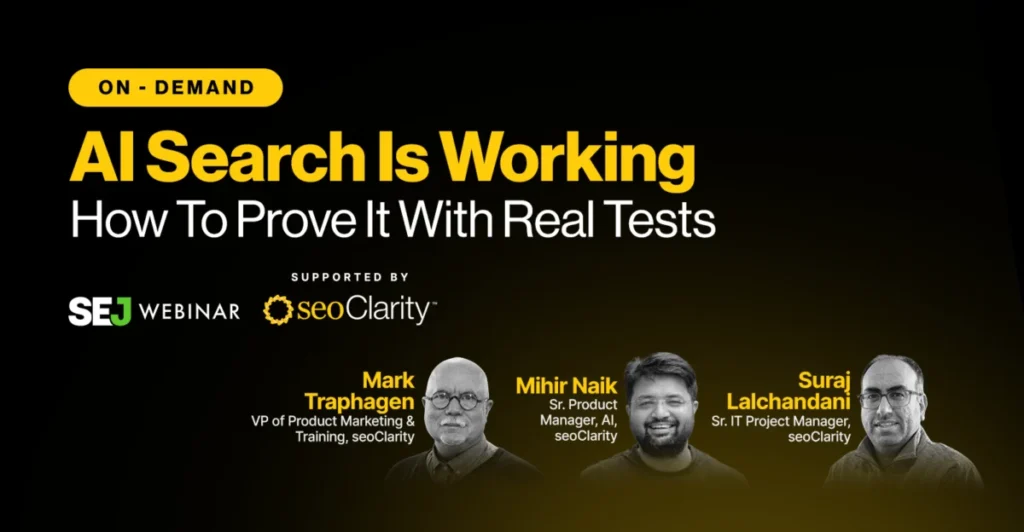
Beyond Correlation: How Split Testing is Cracking the Code of AI Search Visibility
In the rapidly evolving landscape of Search Engine Optimization (SEO), the emergence of Artificial Intelligence (AI) search—often referred to as Answer Engine Optimization (AEO)—has left many digital marketers grasping for reliable metrics. For years, the industry has relied on "visibility scores" and "share of voice" to estimate performance. However, a recent industry-defining webinar hosted by Search Engine Journal (SEJ) featuring experts from seoClarity has signaled a paradigm shift.
The core message from the session was clear: visibility scores tell you if you showed up, but only page-level performance and rigorous split testing can tell you if your actions actually mattered. By applying the scientific method to AI citations, the team demonstrated how to move past mere correlation and achieve a definitive understanding of causation in the age of ChatGPT, Gemini, and Google’s AI Overviews.
Main Facts: The Scientific Breakthrough in AI Citations
The cornerstone of the webinar, led by Mark Traphagen (VP of Product Marketing & Training), Mihir Naik (Senior Product Manager, AI), and Suraj Lalchandani (Sr. IT Project Manager), was a breakthrough experiment involving FAQ sections.
The seoClarity team conducted a massive study involving approximately 1,000 prompts across various test pages. They discovered that adding FAQ sections to these pages resulted in a measurable lift in AI citations. However, the true "standard of proof" came from the second phase of the experiment: when the FAQ sections were removed, the citations dropped back to their original levels.
"That reversion is the difference between correlation and causation," the team noted. In a field where most marketers only look at upward trends and claim victory, the ability to prove that a specific change caused the gain by observing its loss upon removal is a level of measurement rigor that few teams currently possess.
Key Takeaways from the Study:
- FAQ Sections Matter: Well-structured FAQs are one of the most potent triggers for AI engine citations.
- Causation vs. Correlation: Upward trends can be coincidental (algorithmic shifts); reversions prove the specific tactic worked.
- Cross-Platform Consistency: The methodology was tested across a "golden set" of prompts spanning ChatGPT, Claude, Perplexity, Gemini, and Google’s AI surfaces.
Chronology: Building a Methodology for the LLM Era
The webinar outlined a chronological framework for brands looking to move from guesswork to a structured testing program. Unlike traditional SEO, where Google is the primary arbiter, AEO requires a multi-model approach.
1. The Development of the "Golden Set" of Prompts
The process begins by building a funnel-spanning "golden set" of prompts. This isn’t just a list of keywords; it is a collection of natural language queries that cover the entire customer journey, from awareness and consideration to conversion and retention. Each prompt is tagged by its stage in the funnel and paired with the exact URL the brand wishes to see cited.
2. Tiering and Prioritization
Not all prompts are created equal. The seoClarity team introduced a tiered system to manage resources:
- Tier 1 (The Easy Wins): These are prompts where the brand is already relevant to the topic, but the AI simply hasn’t been provided with a URL "worth linking to." These are the primary targets for initial testing.
- Tier 2 (The Heavy Lift): These require more significant content overhauls or authority building.
- The "Dropped" Bucket: Interestingly, the team revealed that they discard a certain segment of prompts entirely—those where the brand has no realistic path to authority—to focus efforts where they can actually move the needle.
3. Establishing the Control Group
Because Large Language Models (LLMs) do not allow for traditional A/B testing (where 50% of users see one version and 50% see another), the team utilizes a "correlated control group." This involves selecting a set of pages that behave similarly to the test pages. These pages act as a "noise filter," allowing the team to distinguish between a successful optimization and a general update to the AI model’s algorithm.
4. The Timing Discipline
The team emphasized a strict chronological window for testing. This includes a baseline period (to measure existing performance) followed by a minimum test window after changes go live. Unlike traditional SEO, which can sometimes reflect changes overnight, AI search engines may take weeks to crawl, process, and update their internal representations of a site.
Supporting Data: First-Party vs. Third-Party Metrics
A major turning point in AI measurement occurred on June 3, when Google launched dedicated Search Console (GSC) reports for AI Overviews and AI Mode. This move was described by Lalchandani as "the biggest measurement upgrade AI search testing has received."
The New Data Landscape:
- Google Search Console (First-Party): Provides page-by-page data on how often URLs appear in Google’s AI features. This data carries a high level of trust because it comes directly from the source.
- Third-Party Tracking: While GSC is a leap forward, it only covers Google. For engines like ChatGPT, Claude, and Perplexity, marketers must still rely on structured third-party tracking tools to get a holistic view of their "AI Authority."
Results from Real-World Client Tests:
The webinar shared results from three distinct tests, proving that not every "best practice" works for every site:
- The FAQ Test: A clear win that proved causation.
- Meta Description Test: Surprisingly, optimizing meta descriptions specifically for AI did not produce the predicted lift in citations, suggesting that LLMs are looking deeper into the body content than previously thought.
- Listicle Formatting Test: This test also yielded unexpected results, highlighting the fact that what works for "Google Featured Snippets" does not always translate directly to AI Overviews.
Official Responses: Expert Insights and Q&A
During the session, the experts addressed some of the most pressing questions from the SEO community regarding the ROI and technicalities of AEO.
On "AI Authority"
When asked how to measure authority in a world without a "Domain Authority" equivalent for AI, Lalchandani suggested stacking four signals:
- Citation Share: How often are you the primary source for your top prompts?
- Cross-Engine Consistency: If ChatGPT, Gemini, and Perplexity all cite you for the same query, you have reached a high level of category authority.
- Content Depth: The ability of the model to synthesize your content into complex answers.
- Technical Health: The crawlability of the site by AI bots.
On the "Zero-Click" Problem
A common concern is the ROI of an AI citation that doesn’t drive traffic. Mihir Naik countered this by focusing on Brand Representation. "You want to be cited because you are controlling the answer that is actually showing up," Naik explained. In comparison queries (e.g., "Brand A vs. Brand B"), being the cited source allows a company to ensure its Unique Selling Propositions (USPs) are highlighted correctly. Without a citation, the brand leaves its narrative in the hands of the AI’s training data, which may be outdated or inaccurate.
On Technical Implementation (Collapsible Content)
A technical question arose regarding whether AI bots can read FAQs hidden behind "read more" toggles. The response was a cautionary "it depends." While some implementations keep the text in the HTML (readable by bots), others load it dynamically only upon a click. Since "even Google will not click around on your site," the team advised that all critical AEO content should be visible in the source code or, better yet, tested through their split-testing methodology.
Implications: The Future of AEO and Traditional SEO
The webinar concluded with a vital reminder: AI search optimization is not a replacement for traditional SEO; it is an evolution of it.
The Foundation remains Technical SEO
Mark Traphagen noted that the clients performing best in AI search are those who have spent years maintaining technically healthy, well-optimized sites. "When we run tests… we’ve rarely found a situation where something works for SEO and does not work for AI search," Lalchandani added. Traditional SEO provides the "foundation," while AEO acts as the "extra layer" that ensures content is structured for machine synthesis.
The Shift to Evidence-Based Strategy
The broader implication for the industry is the death of the "guess and check" method. As AI search engines become more sophisticated and their "black box" algorithms more complex, the only way for enterprise brands to justify spend is through the scientific rigor of split testing.
Actionable Next Steps for Brands:
- Audit Search Console: Immediately check for the new AI Overviews reports to establish a baseline of current visibility.
- Define Your Golden Set: Move beyond keywords and identify the natural language prompts that define your business.
- Implement a Control Group: Before launching site-wide changes (like adding FAQs to 10,000 pages), run a split test on a correlated subset to ensure the change produces a positive result.
- Focus on Narrative Control: View AI citations not just as traffic drivers, but as "Digital PR" that shapes how your brand is perceived by AI-driven consumers.
In summary, the era of "showing up" is over. As the seoClarity team proved, the future of digital marketing belongs to those who can prove why they are there—and what happens if they aren’t. Through rigorous testing, the "black box" of AI search is finally starting to become transparent.
