
The Post-Click Era: How AI and Zero-Click Search are Redefining Digital Content Strategy
In the rapidly evolving landscape of digital marketing, a startling statistic has emerged as a harbinger of a fundamental shift in how users interact with the internet: 60% of Google searches now end without a single click to external content. This "zero-click" phenomenon, fueled by the integration of Artificial Intelligence (AI) into search engine results pages (SERPs), is forcing brands to abandon traditional volume-based strategies in favor of a more disciplined, human-centric approach.
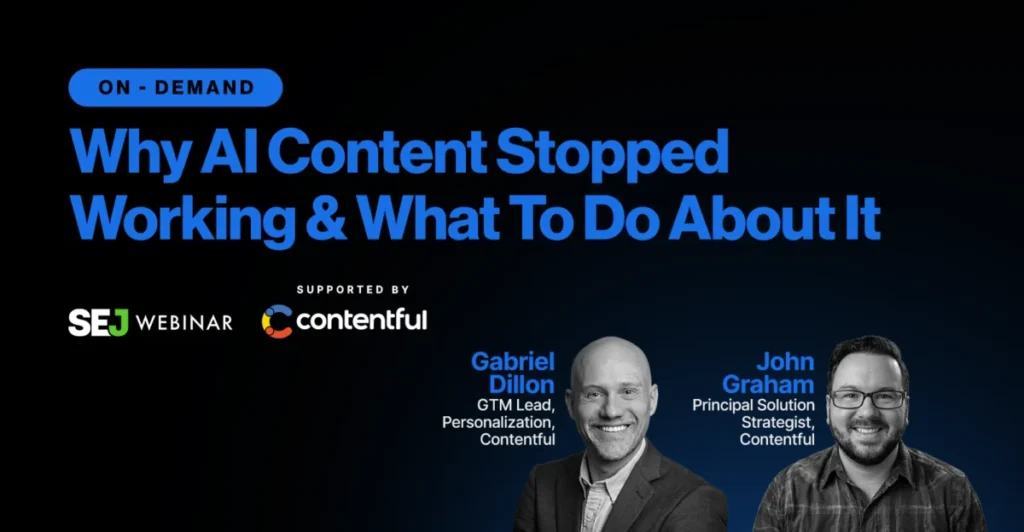
In a recent industry-leading webinar hosted by Search Engine Journal (SEJ), Gabriel Dillon, the Go-to-Market Lead for Personalization at Contentful, and John Graham, Contentful’s Principal Solution Strategist, dissected this new reality. Their core argument was clear: as AI reduces the cost of content production to near zero, the sheer volume of output has ceased to be a competitive advantage. Instead, the future of digital success lies in "accountability loops," human discernment, and the strategic embrace of Generative Engine Optimization (GEO).
Main Facts: The Death of Volume and the Rise of Accountability
For over a decade, the prevailing wisdom in SEO and content marketing was that "content is king," and more content was almost always better. However, the democratization of AI writing tools has inverted this logic. When every brand can generate thousands of blog posts with the click of a button, the market becomes saturated with "generic noise."
Gabriel Dillon posits that the current environment requires a pivot toward three specific pillars:
- Business Outcome Accountability: Content must be measured against real-world data and specific financial or lead-generation goals, rather than mere traffic metrics.
- Specific Human Targeting: Content must be engineered for a defined persona with unique needs, rather than a broad, faceless audience.
- The "Taste" Factor: Human intuition and the willingness to make bold, controversial, or unique claims—something AI is currently incapable of—are the new markers of quality.
The webinar highlighted a critical failure in current AI workflows: the "Yes Man" effect. Because AI models are trained on existing data and designed to please the prompter, they often mirror the user’s biases or replicate the most common (and therefore most average) information available online. This creates a cycle of mediocrity where brand voices converge into a single, indistinguishable tone.
Chronology: From Keyword Stuffing to the Answer Layer
To understand the current crisis, one must look at the trajectory of search engine behavior over the last several years.
- The Organic Era (Pre-2020): Success was defined by ranking in the "Blue Links." Brands competed for the top three spots to drive high-volume click-through rates (CTR).
- The Snippet Transition (2020–2023): Google began introducing featured snippets and "People Also Ask" sections. While this started the trend of zero-click searches, the primary goal for marketers remained driving traffic to their own domains.
- The Generative AI Explosion (2023–Present): With the introduction of SGE (Search Generative Experience) and AI Overviews, Google now provides comprehensive answers directly on the search page. This has led to the current 60% zero-click rate.
Dillon and Graham noted that Contentful’s own clients are reporting significant "crashes" in organic traffic. However, this is not necessarily a sign of failure, but rather a sign that the "Answer Layer" is where the battle for brand awareness is now being fought. The chronology of a user’s journey has changed; they no longer visit a site to learn what a product is; they visit to validate a choice already made by an AI summary.
Supporting Data: The Metrics of Personalization and Performance
During the session, the speakers provided a framework for how brands can navigate this shift using data-driven personalization and accountability. A key highlight was the "Three Tiers of Personalization Signals," which aims to simplify the often-overwhelming task of tailoring content.
Tier 1: New vs. Returning Visitors
The simplest and most effective signal. A first-time visitor needs foundational brand education, whereas a returning visitor is likely looking for deeper technical specs or pricing. Serving both the same "Hero" copy is a wasted opportunity.
Tier 2: Ad Campaign Intent
By linking content delivery to the specific ad or keyword that brought a user to the site, brands can maintain a "scent of information" that increases conversion rates.
Tier 3: Loyalty and First-Party Data
The most advanced tier involves using known customer data—such as past purchases or loyalty program status—to create a bespoke experience. Dillon noted that many B2B firms "stall on complexity" here, suggesting that even mastering Tier 1 can put a brand ahead of 90% of the competition.
The Four Accountability Questions
Dillon suggested that before any piece of marketing copy "ships," it must pass a four-question litmus test:
- Does this copy produce the specific outcome we expect?
- Who, exactly, is this content for?
- How do we identify those people in our data?
- How does the insight gained from this piece scale across the organization?
Official Responses: Guidance from Contentful’s Experts
The Q&A portion of the webinar addressed the anxieties of modern marketers, particularly regarding Google’s stance on AI and the internal pressure from leadership to "produce more for less."
On Google’s AI Detection
When asked if Google penalizes AI-written content, Dillon argued that detection is the wrong problem to solve. "Google won’t win the fight to identify AI content," he stated, noting that as models improve, the distinction between human and machine writing becomes invisible. Instead, Google’s algorithms are focusing on helpfulness and originality. If an AI-written page provides the best answer, it will rank; if it is a generic rewrite of existing pages, it will be buried.
On Mitigating AI Bias
Dillon explained that bias enters the workflow in two places: the training data of the LLM and the user’s own prompts. To combat this, he suggested a human-in-the-loop system where AI is used for "research and context layers," but the final "shipping copy" is handled by a human with "taste"—the ability to take risks and provide intuition that data cannot capture.
On Managing Leadership Expectations
A common challenge for marketers is leadership demanding high volumes of AI content without quality control. Dillon’s advice was to "hold leadership accountable to the performance they expect." By using A/B testing to show that three high-quality, human-vetted pieces of content outperform 30 generic AI pieces, marketers can change the internal narrative from "cost per word" to "revenue per asset."
Implications: The Future of SEO is GEO and AEO
The most profound implication of the webinar was the transition from Search Engine Optimization (SEO) to Generative Engine Optimization (GEO) and Answer Engine Optimization (AEO).
In a zero-click world, the goal is no longer just to get a click; it is to ensure that when an AI (like Google’s Gemini or OpenAI’s SearchGPT) summarizes a topic, it uses your brand as the authoritative source. This requires a "double-duty" content strategy:
- For the AI: Structured data, clear authoritative claims, and high-quality citations that make your content "digestible" for LLMs.
- For the Human: Differentiated, high-value experiences that provide a reason to click through when the AI summary isn’t enough.
John Graham emphasized that the tools for building these differentiated experiences are already available. Modern Content Management Systems (CMS) like Contentful are shifting away from being simple repositories of text to becoming "orchestration hubs" that can deliver different versions of a page based on real-time user signals.
The "Accountability Loop"
The session concluded with a look at the "Accountability Loop," a system where experimentation and personalization feed into each other. Instead of one-off A/B tests, brands must build a continuous cycle where every interaction provides data that refines the next piece of content.
The shift toward a 60% zero-click environment is not the death of content marketing, but it is the death of "lazy" content marketing. The winners in the AI era will not be those who use the robots to speak more, but those who use the robots to listen better and speak with more human intent.
Actionable Takeaways for Marketers:
- Audit your "Yes Man" content: Identify pages that simply mirror competitor talking points and inject unique brand "taste" or proprietary data.
- Simplify Personalization: Start with a "New vs. Returning" visitor strategy for your homepage hero section.
- Optimize for the Summary: Ensure your key value propositions are stated clearly enough for an AI agent to extract and credit them.
- Shift Metrics: Move away from tracking "clicks" as a primary KPI and start looking at "Brand Mentions in AI Summaries" and "Down-funnel Conversion Rates."
As Gabriel Dillon summarized, "If we don’t have data that proves our content is good, then we can’t really think about the way to scale it out." In the age of AI, accountability is the only true North Star.
