
The Conversion Gap: Why Your Influencer Traffic is Landing Cold—and How to Fix It
In the high-stakes world of influencer marketing, brand managers often operate under a persistent, gnawing anxiety: Why is this campaign not converting?
When a partnership underperforms, the immediate reflex is to audit the talent. Brands analyze the creator’s engagement rate, scrutinize the creative brief, or re-negotiate commission structures in hopes of incentivizing better performance. However, according to a recent analysis of thousands of creator programs over the past 18 months, this diagnostic approach is fundamentally flawed. The problem isn’t the creator; it’s the destination.
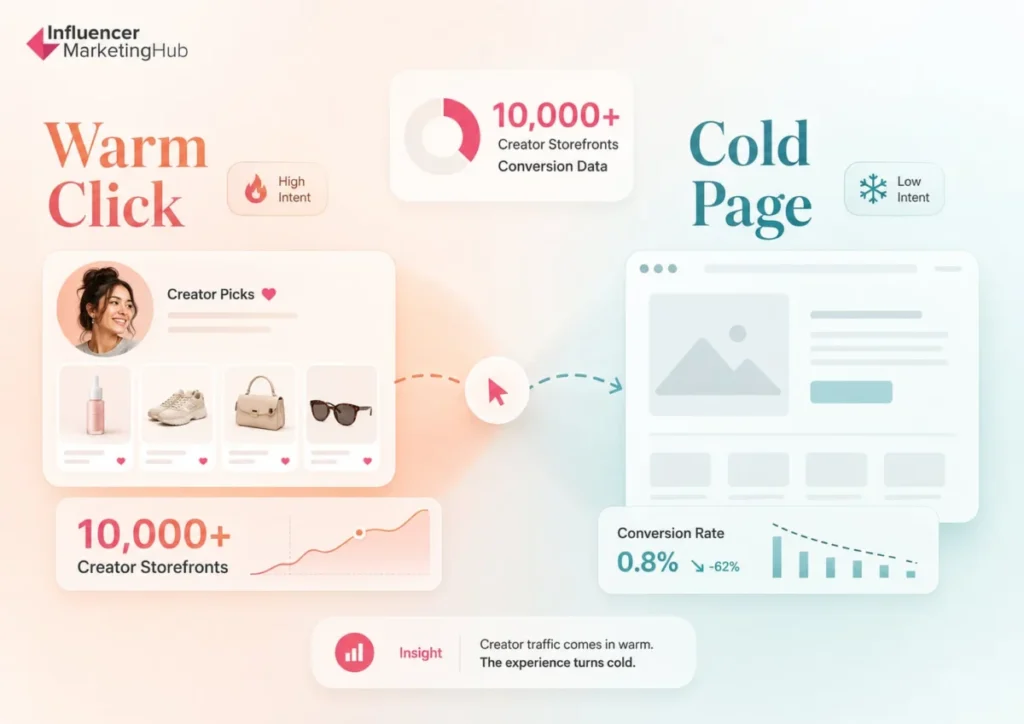
The evidence suggests that the "conversion gap" in modern influencer marketing is a structural failure of the landing experience. Brands are successfully generating "warm clicks"—traffic driven by authentic, long-term trust—only to send that traffic to "cold pages" that effectively neutralize the creator’s influence the moment the user arrives.
The Anatomy of a Warm Click, Cold Page Problem
To understand the failure, one must look at the user journey. A creator—be it a skincare enthusiast, a fitness expert, or a culinary influencer—spends years curating a specific context for their audience. When they endorse a product, the follower clicks the link not just to buy a commodity, but to adopt a recommendation from a trusted source.
The click is "warm" because it is fueled by an existing relationship. But what happens next is often a total breakdown of that relationship.
Most brands route this high-intent traffic to a generic homepage, a cluttered product page, or a static discount-code landing page. These pages are "cold." They do not recognize the visitor as a referral from a specific creator. They do not carry over the context of the recommendation. To the website, the user is just another anonymous visitor who could have arrived via a Google search or a cold email blast.
The creator’s context, the very element that bridged the gap between curiosity and intent, is stripped away at the point of arrival. This is the "cold handoff." In digital commerce, cold handoffs rarely result in conversion; they result in bounce rates.
![What Conversion Data From 10,000+ Creator Storefronts Reveals [Warm Click, Cold Page Problem]](https://influencermarketinghub.com/wp-content/uploads/2026/07/5a619d4d-chatgpt-image-jul-3-2026-12_33_04-pm.jpg)
The Evolution of Creator Commerce: A Chronological Shift
The trajectory of influencer marketing has moved from simple product placement to complex ecosystem integration.
- Phase 1 (The Wild West): Early influencer marketing relied on vanity metrics. Brands focused on reach and follower count, directing traffic to general store landing pages. Attribution was messy, and "conversion" was secondary to awareness.
- Phase 2 (The Affiliate Era): Brands introduced tracking pixels and unique discount codes. While this improved ROI measurement, it didn’t improve the user experience. Traffic was still funneled into a one-size-fits-all sales funnel.
- Phase 3 (The Contextual Commerce Revolution): We are currently in the midst of a shift where the "destination" is finally being recognized as the primary variable in the conversion equation. Leading brands are no longer asking, "Which influencer should we hire?" but rather, "How can we extend the influencer’s narrative to the point of purchase?"
The Evidence: Quantifying the Impact of Context
The data supporting this shift is overwhelming. Across multiple verticals, the implementation of creator-specific landing pages—often called "storefronts"—has produced dramatic upticks in performance metrics.
Cozy Earth: The 214% Lift
Cozy Earth serves as the gold standard for this structural pivot. By transitioning creator-referred traffic from standard affiliate links to dedicated, co-branded creator pages on their own domain, they observed a staggering 214% increase in conversion rates. Perhaps even more impressively, their average order value (AOV) climbed by 67%. The takeaway is clear: when the landing page matches the creator’s aesthetic and narrative, the customer is more willing to invest in a larger basket size.
Healf: The Power of Scale
The UK-based health and wellness marketplace, Healf, has scaled this model to encompass over 1,700 creator partnerships. Their results are staggering: a 40.8% conversion rate on creator-referred traffic. Their internal team noted that the move to personalized creator pages actually solved an acquisition problem. Creators were more eager to partner with a brand that provided them with a high-quality, professional "digital storefront" they could be proud to pin to their social media bios.
Buttah Skin and Electro
Beauty brand Buttah Skin reported a 30% jump in conversion and a 78% increase in AOV when moving away from standard product pages. Meanwhile, electrolyte brand Electro has reached a point where creator storefronts account for 81% of their total ecommerce revenue. This shift didn’t require massive increases in influencer spend; it required a fundamental shift in where that spend was being directed.
The Two Pillars of High-Converting Creator Pages
Why do some pages convert while others stagnate? Analysis of successful programs reveals two non-negotiable patterns.
1. Curation Depth Beats Catalog Size
There is a temptation to display the entire brand catalog on a creator’s landing page. This is a mistake. Data shows that pages featuring 6–15 curated products outperform pages that mirror the full catalog by a factor of two or three.
![What Conversion Data From 10,000+ Creator Storefronts Reveals [Warm Click, Cold Page Problem]](https://s.influencermarketinghub.com/imaginary/convert?type=webp&url=https://influencermarketinghub.com/wp-content/uploads/2026/07/d15fc009-image3-1024x490.jpg)
The user arrives with the creator’s taste in mind. They don’t want to be overwhelmed by 200 options; they want to see the "editor’s picks." The landing page should confirm the creator’s recommendation, not restart the consideration process. By narrowing the selection, the brand allows the creator’s authority to do the heavy lifting.
2. Trust Continuity: Keeping the Creator Visible
The most successful pages are those where the creator’s identity—their name, their image, and their specific voice—remains present through the checkout process. If the creator disappears once the user clicks, the trust disappears with them. When the creator’s presence is maintained through the final transaction, the psychological context is preserved. This is "trust continuity," and it is the secret engine of modern high-conversion influencer campaigns.
Implementing the 30-Day Diagnostic Test
Brands do not need a complete technical overhaul to begin testing this hypothesis. A simple 30-day "pilot" can reveal the potential for growth.
- Select a Cohort: Choose 5–10 active, high-performing creator relationships.
- Build the Experience: Create dedicated landing pages for each of these creators. Ensure these pages feature their curated selections, their branding, and a frictionless checkout on the brand’s own domain.
- Track the Metrics:
- Conversion Rate: If there isn’t a 20–30% lift, the page is likely still too generic.
- Average Order Value (AOV): If AOV remains flat, the page lacks the "editorial layer"—the creator’s own words describing the products.
- 30-Day Repeat Rate: This is the ultimate test of audience fit. If the repeat rate is low, the landing experience may have converted a curious visitor, but failed to deliver the value proposition the creator promised.
Implications for the Future of Brand Operations
The operational challenge is, of course, scale. How can a brand with 500 or 1,000 creators maintain this level of personalization without an army of web developers?
The answer lies in modular infrastructure. The brands winning in the current environment are those that have adopted "creator-led storefront" technology. This allows them to generate unique, branded, and optimized landing pages in seconds, turning the "cold handoff" into a warm, integrated sales experience.
For brands still routing traffic to a generic homepage, the message is stark: you are leaving revenue on the table. The influencer has done their job. They have moved the audience from apathy to intent. The failure to capture that intent is not a failure of marketing; it is a failure of architecture.
As creator programs mature, the brands that thrive will be those that treat the landing experience not as an IT ticket, but as a critical component of the creator relationship itself. The future of ecommerce isn’t just about getting the click; it’s about ensuring that the moment the customer lands, they feel exactly like they are still in the creator’s world. That is where the conversion happens.
