
The Structural Metamorphosis of Global Finance: How Real-Time Orchestration and AI are Redefining Banking
Commercial banking is currently navigating a profound structural metamorphosis. For decades, the industry has relied upon rigid, batch-processed legacy systems—architectures that, while stable, have become bottlenecks in an era of hyper-connected global supply chains. As we move through 2026, the financial services sector is transitioning toward a model of autonomous, event-native finance. This shift is not merely an incremental improvement in speed; it is a fundamental reimagining of how capital moves, how fraud is mitigated, and how the banking ledger itself serves as an intelligent engine for commercial growth.
The New Financial Architecture: Moving Beyond Batch Processing
The traditional banking model was built on the concept of "windows"—specific times of day when transactions were cleared and settled. In the modern global economy, where commerce occurs 24/7 across multiple time zones, these windows have become liabilities.
The convergence of ISO 20022-native data fabrics and agentic AI is transforming payments from simple, one-dimensional capital transfers into high-fidelity data signals. These signals are now the lifeblood of corporate decision-making. By leveraging sidecar cores and programmable liquidity, forward-thinking financial institutions are achieving the "always-on" agility required to keep pace with modern supply chains.
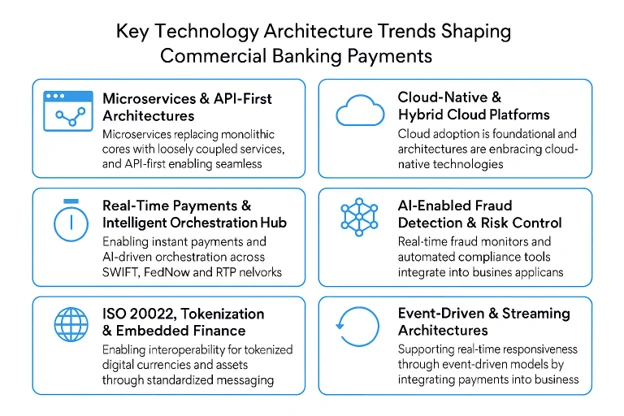
The banking ledger is no longer a passive record of historical transactions. Instead, it is evolving into an active, embedded engine that predicts, routes, and secures value in real-time. This structural change requires a departure from monolithic core systems toward modular, cloud-native architectures that can handle the sheer velocity of data inherent in modern finance.
Chronology of the Shift: From Legacy to Autonomous Finance
The journey toward this autonomous model has been defined by three distinct phases over the past several years:
- The Digitization Phase (2018–2021): The initial focus was on "digital transformation," which largely involved moving paper-based processes to digital interfaces. While this improved user experience, the underlying backend remained rooted in batch-processed legacy systems.
- The Interoperability Phase (2022–2024): The industry saw the adoption of ISO 20022 standards. This allowed for richer data payloads to accompany payments, though true real-time orchestration remained elusive as banks struggled to integrate these new standards into antiquated mainframe cores.
- The Autonomous Era (2025–Present): We are now in the age of agentic AI and programmable liquidity. Financial institutions are deploying "sidecar cores"—supplementary processing layers that sit alongside legacy systems to handle real-time traffic without requiring a risky, full-scale rip-and-replace of the core ledger.
Supporting Data: The Efficiency Gains of Intelligent Routing
The transition to real-time payments (RTP) and intelligent orchestration is backed by significant efficiency metrics. Research indicates that institutions utilizing AI-driven payment orchestration layers see a 30% reduction in liquidity buffer requirements. By using "smart routing"—where an orchestration engine dynamically selects the most efficient rail (e.g., FedNow, RTP, or private ledger networks) based on cost, speed, and counterparty risk—banks can maintain lower idle capital balances.
Furthermore, the integration of AI-based fraud detection has shifted the paradigm from "detect and block" to "predict and prevent." Traditional fraud systems relied on static rules that often resulted in high false-positive rates, stalling legitimate commercial payments. Modern AI models analyze behavioral patterns and contextual data in milliseconds, allowing for a frictionless transaction flow that protects the ecosystem without hindering business velocity.
Tokenized Deposits and Digital Assets: The 24/7 Catalyst
One of the most significant developments in this evolution is the rise of tokenized deposits and regulated digital assets. These assets are fundamentally rewriting the mechanics of settlement.
In a traditional environment, settlement risk is managed through delays—the "wait time" between a payment initiation and its finality. Tokenized deposits eliminate this friction. By representing value on a programmable ledger, these assets allow for "atomic settlement"—where the transfer of assets and the transfer of cash happen simultaneously and instantaneously. This is not just a benefit for high-frequency traders; it is a game-changer for corporate treasurers who can now optimize working capital with unprecedented precision.
The regulatory landscape is also shifting to accommodate this. Central banks and regulators globally are increasingly providing frameworks for stablecoins and tokenized commercial bank money, signaling that the move to 24/7, programmable, and autonomous settlement is not just a technological trend but a regulatory priority.
The "Trust at Scale" Challenge: Official Industry Perspectives
While the technology for a fully autonomous financial system is largely available, the primary barrier to adoption remains trust. As industry leaders noted during the recent Money20/20 conference in Amsterdam, "trust" has become the central currency of the 2026 banking landscape.
Key Demands for Trust
Banking executives are currently grappling with three concrete demands that must be satisfied before full-scale autonomous systems can be activated:
- Algorithmic Reliability: Can banks rely on AI models they did not build? As institutions integrate third-party agentic AI, they require robust governance frameworks to audit these models for bias and hallucinations.
- Data Sovereignty: In a world where financial data acts as a signal for the broader supply chain, keeping client data and identities secure is paramount. The industry is moving toward decentralized identity and zero-knowledge proofs to ensure that data can be verified without being exposed.
- Operational Resilience: The "always-on" nature of real-time finance means that system outages can have catastrophic, instantaneous consequences. The industry is responding with a shift toward multi-cloud redundancy and automated disaster recovery protocols that can switch processing nodes without human intervention.
Implications for Corporate Strategy
The transition to autonomous, event-native finance has profound implications for businesses, particularly for CIOs and CFOs.
Rethinking IT Spend
As AI becomes embedded in the payment flow, IT departments face a new challenge: "runaway token spend." Much like the shift to cloud computing in the 2010s, AI-driven finance requires a disciplined approach to cost management. CIOs are increasingly turning to "rate variance analysis" to understand the consumption patterns of their AI agents. It is no longer enough to look at total spend; leaders must dissect whether their AI agents are providing a proportional return on investment in terms of speed, liquidity, or risk reduction.
The Rise of Agentic Commerce
The ultimate implication of this trend is the rise of "agentic commerce." We are moving toward a future where corporate AI agents conduct business with other corporate AI agents, negotiating terms and executing payments autonomously. This will require a new type of financial infrastructure—one that is not built for human speed, but for machine speed.
Conclusion: The Road Ahead
The structural metamorphosis of commercial banking is reaching a point of no return. The shift from batch-processed legacy systems to autonomous, event-native finance is not merely a technical upgrade; it is a fundamental shift in the nature of money itself. By combining real-time payment rails, intelligent orchestration, and agentic AI, institutions are creating a financial ecosystem that is faster, more efficient, and more responsive to the needs of the global economy.
However, the success of this transition hinges on the industry’s ability to solve the "trust at scale" equation. As we look toward the remainder of the year and into 2027, the focus will shift from the possibility of these technologies to the governance of them. The banking ledger of the future will be an intelligent, embedded engine—but its success will depend entirely on whether the systems powering it can be trusted to act autonomously in the best interest of the global commercial ecosystem.
For institutions that can navigate this shift, the rewards are clear: a more agile, resilient, and growth-oriented financial infrastructure that turns every transaction into a strategic asset. For those who remain tethered to the legacy of batch processing, the cost of inaction will only continue to rise.
