
Peak Martech: Has the Industry Finally Reached a Plateau?
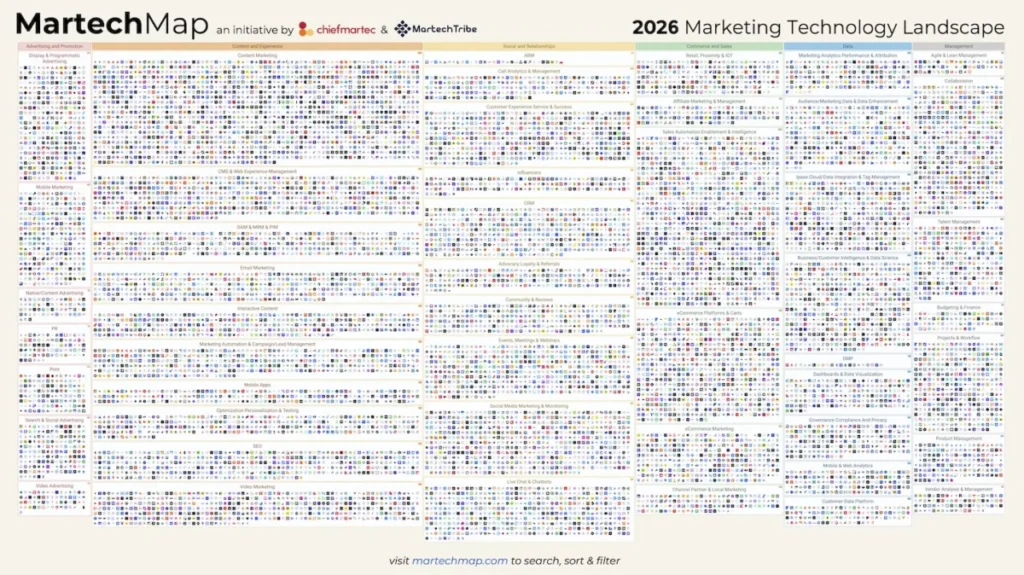
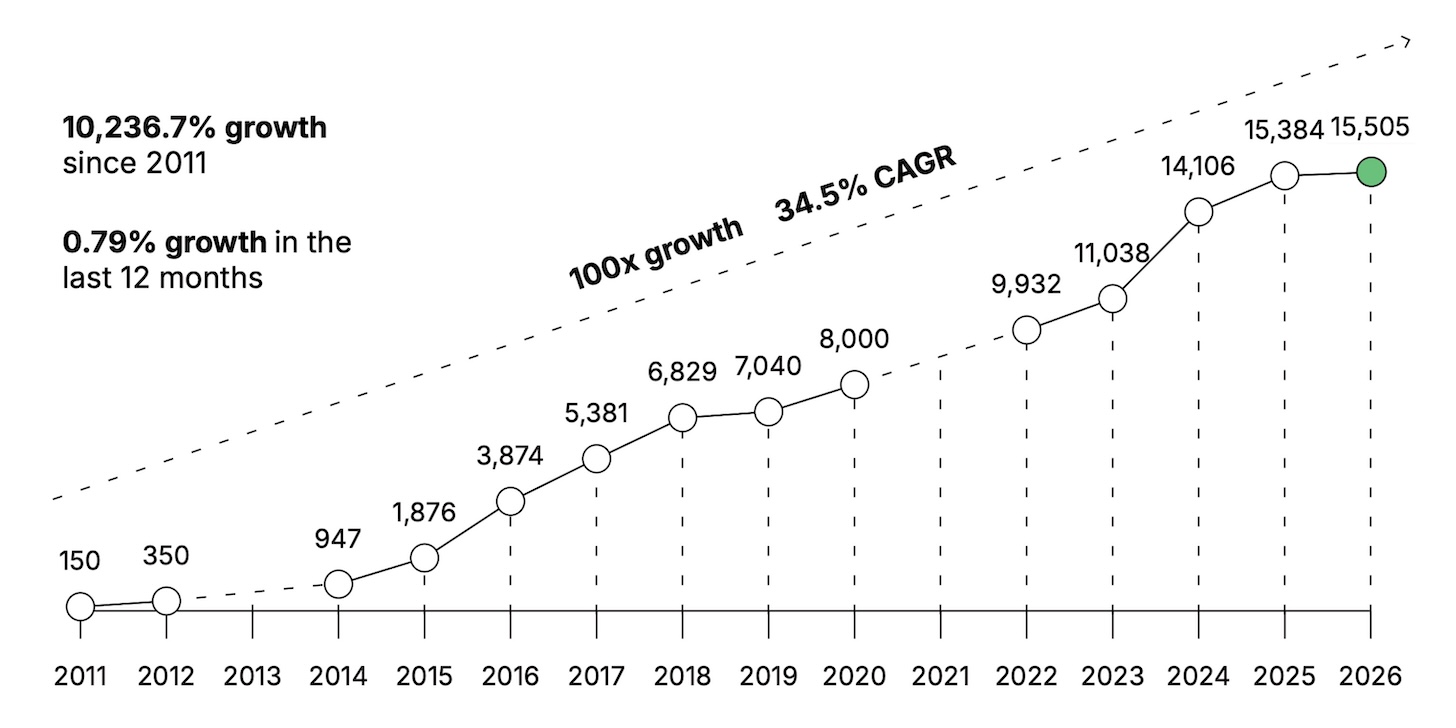
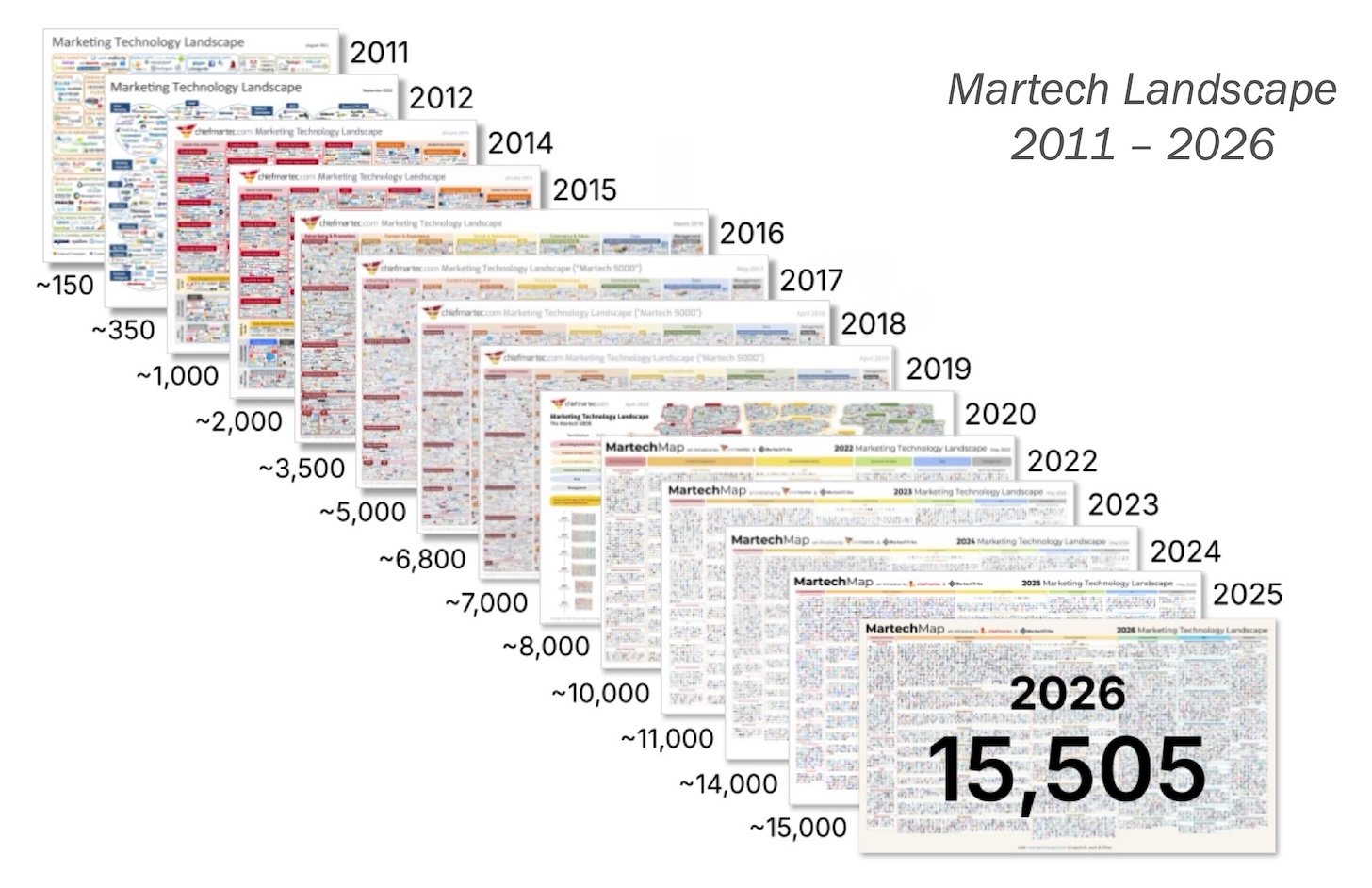
For fifteen years, the annual release of the Marketing Technology Landscape has been the industry’s version of the Super Bowl—a sprawling, chaotic, and ever-expanding visual testament to the digital transformation of the marketing profession. Since 2011, when the landscape featured a modest 150 products, the chart has grown with relentless, almost aggressive momentum. Each year, the central question was never if the landscape would expand, but by what magnitude.
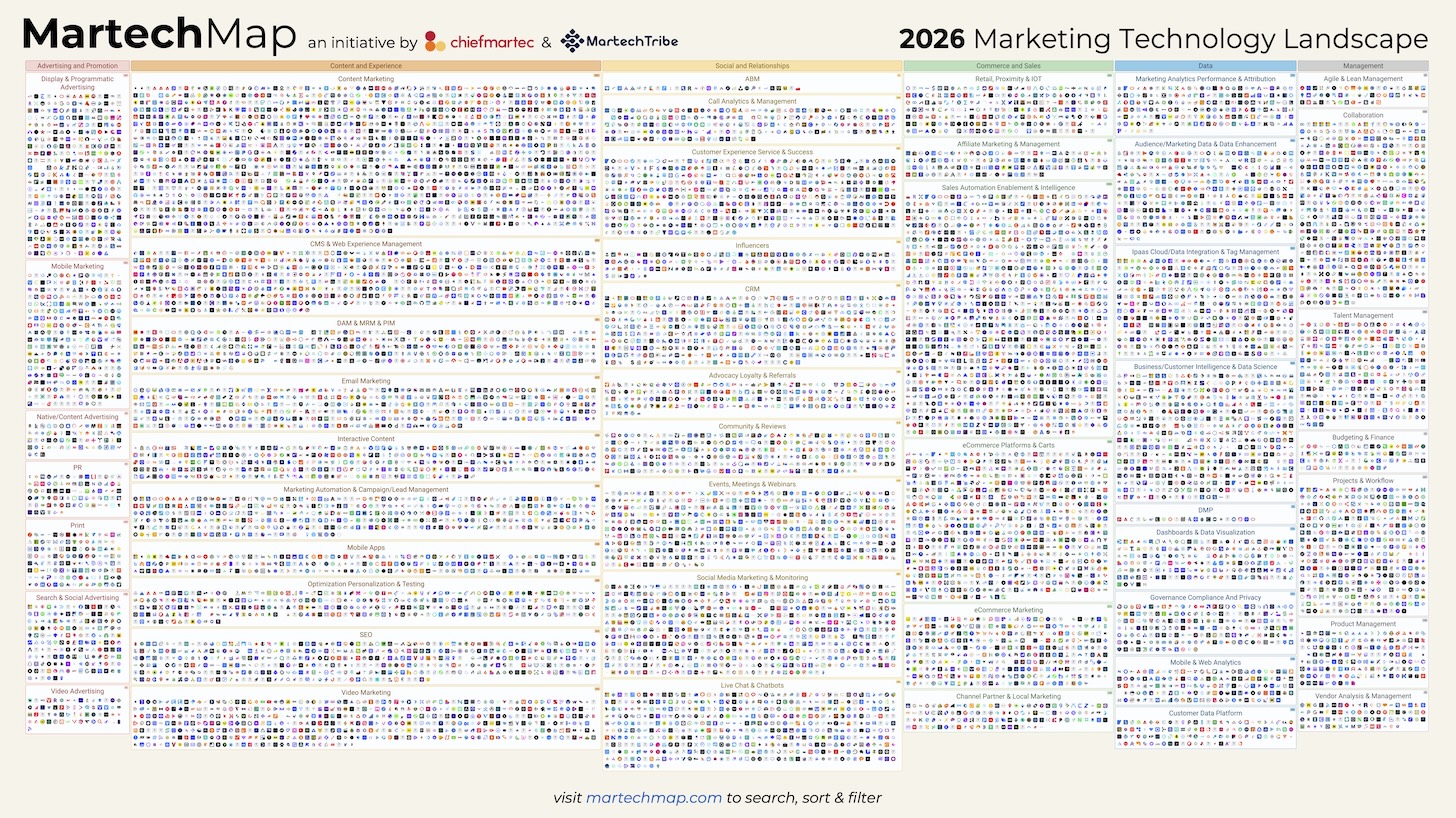
However, the 2026 edition, released this week, signals a profound shift. With a total of 15,505 products, the landscape has grown by a mere 0.79% since 2025. In a field that has seen 100x growth over the last decade and a half, this stagnation is not just a statistical anomaly—it is a clear indicator that the industry has finally hit "Peak Martech."
The State of the Landscape: A Statistical Overview
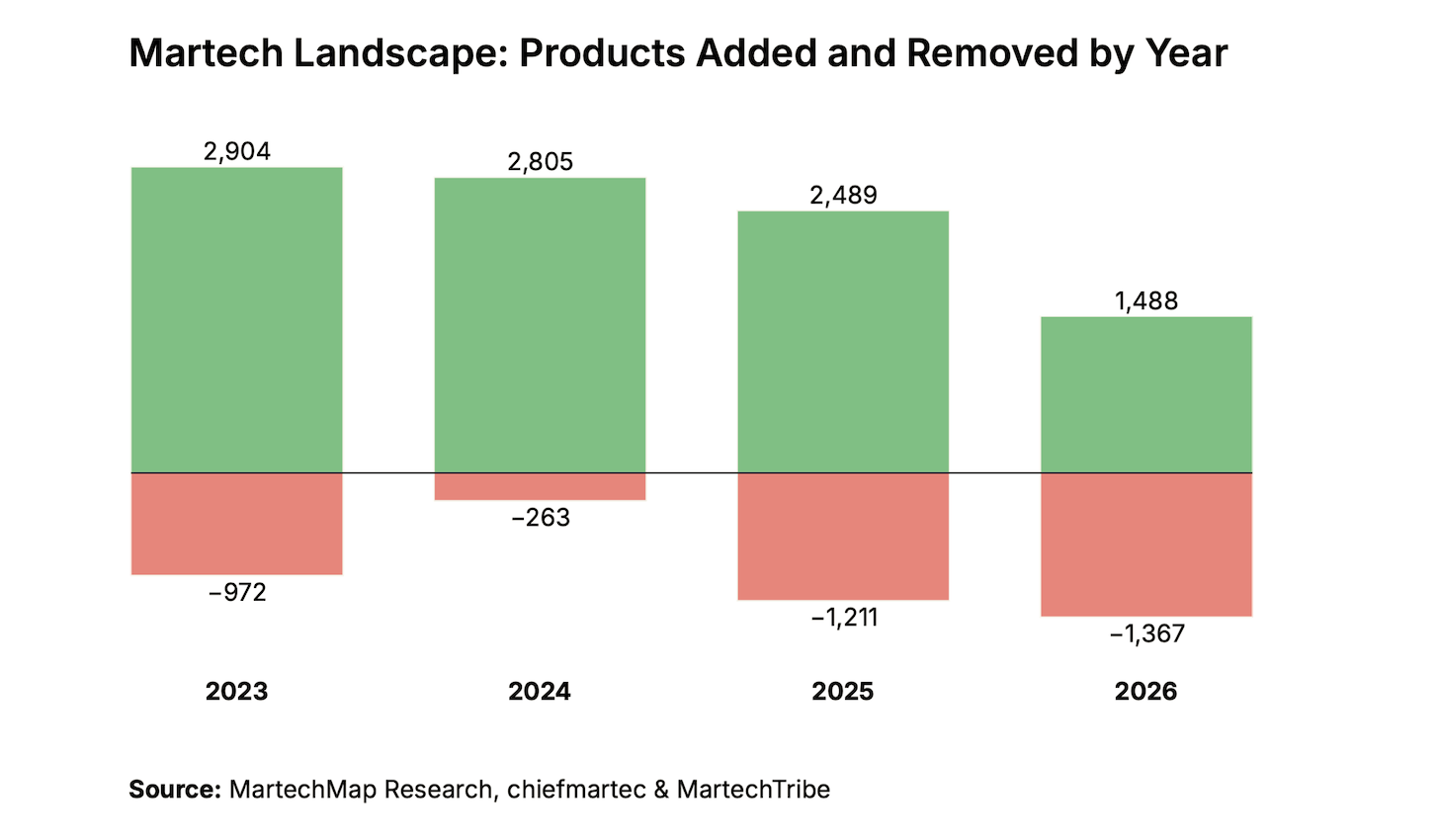
The headline numbers for 2026 are deceptively simple: the industry added just 121 net products. But to interpret this as a static market would be a mistake. Beneath the surface, the martech ecosystem is undergoing a violent and necessary transformation.
This year, 1,488 new products were introduced to the landscape, representing a 40% decline in new entrants compared to the previous year. Simultaneously, 1,367 products were removed, a 13% increase in market attrition. The growth of the ecosystem has effectively flatlined, not because innovation has ceased, but because the rate of "churn"—the life and death of software products—has reached a state of near-perfect equilibrium.
The sheer volume of exits is particularly telling. Over 51% of the products removed this year originated from the 2010–2019 "SaaS boom" era. This suggests that the current shakeout is not merely a pruning of low-quality "AI wrappers" that flooded the market following the generative AI explosion, but a fundamental culling of the first generation of modern martech.
A Chronology of Expansion and Equilibrium
To understand where we are, we must look at where we came from.
- 2011–2015: The Dawn of Proliferation. The landscape began as a manageable infographic, reflecting the early adoption of cloud-based marketing tools.
- 2016–2020: The Exponential Surge. As marketing moved toward data-driven strategies, the landscape exploded. Every niche—from social media listening to predictive analytics—became a distinct category.
- 2021–2024: The AI Gold Rush. The infusion of generative AI fueled a massive influx of new, specialized startups, pushing the total count toward the 15,000 mark.
- 2025–2026: The Great Rationalization. The market has reached a point of saturation. With incumbent platforms bundling AI capabilities and corporate budgets tightening, the "middle-class" of martech—firms with $1M–$10M in revenue—is finding it increasingly difficult to defend their market share.
Data from the 2026 analysis reveals that 45.5% of the departed products were mid-sized, while roughly 80% of exiting companies had fewer than 50 employees. These firms, which once found enough traction to survive, are now being squeezed by large, incumbent platforms integrating AI from above and nimble, AI-native startups attacking from below.
The Resurrection of Mature Categories
While the overall landscape has plateaued, the internal composition is shifting rapidly. The most significant growth is not occurring in "brand new" AI categories, but in the revitalization of legacy sectors.
CMS and Web Experience Management
The Content Management System (CMS) category grew by 21.4% this year. For two decades, websites were built for humans and search engines. Today, a third, critical audience has arrived: the machine. As AI search assistants, agentic browsers, and "answer engines" become the primary way consumers interact with the web, companies are re-architecting their CMS to feed these agents structured, high-quality data.
Ecommerce and Transactional Platforms
Similarly, ecommerce platforms saw a 19.9% surge. This growth is driven by the demand for "context engineering." Companies are no longer just selling products; they are deploying AI concierges that require clean, machine-readable product data to compare trade-offs, explain technical specifications, and guide customers through complex purchasing decisions.
Supporting Data and Integration
Growth in iPaaS (Integration Platform as a Service) at 8% and Governance/Privacy at 7.1% highlights a new reality: when agents start acting on behalf of customers across multiple enterprise systems, the "connective tissue" between those systems becomes the most valuable asset in the stack.
Implications for the Modern CMO
The arrival of "Peak Martech" carries several critical implications for those managing technology budgets and digital strategies.
1. From "More" to "Better"
For years, the mandate for marketing operations was to aggregate a "best-of-breed" stack. In 2026, the mandate has shifted toward rationalization. CMOs are no longer looking for more logos; they are looking for higher utility. The era of the "bloated stack" is ending, replaced by a focus on orchestration and data governance.
2. The Rise of Context Engineering
The "State of Martech 2026" report emphasizes that the value of an AI model is directly proportional to the context it can access. Marketers must now prioritize the integration of their product data, customer history, and brand guidelines into a unified, agent-accessible format. The competitive advantage no longer lies in having the most AI tools, but in having the most "context-aware" ones.
3. The New Lifecycle of Marketing Software
The fact that long-standing SaaS products are being removed at record rates serves as a warning to procurement departments. Technical debt is no longer just about outdated code; it is about vendor viability. CMOs must conduct deeper due diligence on the long-term sustainability of their partners, as the market is clearly favoring scale and interoperability over niche, feature-specific applications.
Official Perspectives and Expert Analysis
Industry leaders have been quick to weigh in on these findings. The consensus among analysts is that this plateau represents a "maturing" rather than a "dying" market.
"We are seeing a transition from the ‘wild west’ of SaaS to an era of intelligent orchestration," noted industry observers involved in the report. "The growth isn’t gone; it has simply moved from the periphery to the core. We aren’t building more websites; we are building more intelligent interfaces."
The report, sponsored by industry stalwarts such as SAS, Pega, and Hightouch, provides a roadmap for this transition. It argues that the next phase of martech will be defined by "agentic" capabilities—tools that don’t just help humans create content or analyze data, but tools that perform tasks, negotiate, and execute campaigns autonomously, governed by rigorous compliance frameworks.
Conclusion: The Path Forward
After fifteen years of breathless expansion, the martech landscape has finally found its rhythm. The plateau of 2026 is not a sign of stagnation, but a necessary maturation.
As the industry enters this new chapter, the focus will move away from the sheer volume of software and toward the quality of the "connected experience." The companies that thrive in the coming years will be those that view their technology stack not as a collection of silos, but as a cohesive, intelligent nervous system capable of providing deep, relevant context to the AI agents of the future.
The 15,505 products on the 2026 landscape serve as a reminder of how far we have come. The next 15,000, should they ever arrive, will likely look very different. They will be less about features and more about agency; less about "marketing technology" and more about "intelligent interaction."
For those who have navigated the chaos of the last decade, the message is clear: the era of collecting tools is over. The era of architectural mastery has begun.
For a deeper dive into the data, including a full breakdown of the 70+ AI use cases currently reshaping the industry, you can download the full State of Martech 2026 report at MartechMap.com.
