
Print-on-Demand Face-off: A Comprehensive Analysis of Tapstitch vs. Printful
The print-on-demand (POD) industry has evolved from a niche service for hobbyists into a multi-billion-dollar engine powering global e-commerce. As the barrier to entry lowers, entrepreneurs are increasingly tasked with a critical decision: choosing a production partner that aligns with their brand vision. Two platforms have emerged as leaders in this space, albeit with vastly different philosophies: Printful, the industry titan with an expansive global footprint, and Tapstitch, the rising specialist focusing on premium apparel.
To determine which platform reigns supreme, we have spent hours in independent testing, evaluating everything from garment weight and ink saturation to API latency and shipping logistics. The following analysis breaks down the battle for the top spot in the POD ecosystem.
The Core Comparison: Two Different Philosophies
The fundamental difference between these two providers lies in their operational focus. Printful acts as a comprehensive logistics solution for the generalist merchant. It is a massive, multi-channel engine designed to turn any design into a sellable product—be it a ceramic mug, a framed poster, or a polyester backpack.
Tapstitch, conversely, is a surgical instrument. It is built for the "brand builder"—the fashion entrepreneur who prioritizes high-GSM (grams per square meter) fabrics, oversized silhouettes, and the specific aesthetic of streetwear. By limiting its catalog to apparel, Tapstitch achieves a level of quality control that broad-spectrum platforms often struggle to maintain at scale.
Chronology and Market Evolution
The Rise of Printful: The Standard-Bearer
Printful pioneered the modern POD model, launching in 2013 with a vision to democratize e-commerce. By building its own network of facilities rather than relying solely on third-party print houses, Printful established the industry benchmark for reliability. Over the last decade, they have aggressively expanded, securing a presence in North America, Europe, and Australia, and integrating with virtually every major marketplace, including Amazon and TikTok Shop.
The Entry of Tapstitch: The Fashion Disruptor
Tapstitch entered the scene as a direct response to the "generic" feel of traditional POD. Recognizing that many clothing brands were frustrated by thin fabrics and inconsistent print placement, Tapstitch invested in vertically integrated production lines specifically optimized for streetwear. By focusing on DTF (Direct-to-Film) and high-end DTG (Direct-to-Garment) technologies, they have quickly garnered a reputation among boutique brands looking for a higher-tier "retail-ready" feel.
Supporting Data: The Metrics of Performance
When analyzing performance, we categorized our testing into four key pillars: Product Range, Print Fidelity, Global Logistics, and Scalability.
1. Product Range and Versatility
Printful maintains a catalog of 479+ SKUs. Their ability to produce a diverse range of items—from embroidery-heavy hats to all-over print leggings—makes them the undisputed winner for businesses that want to expand into lifestyle products.
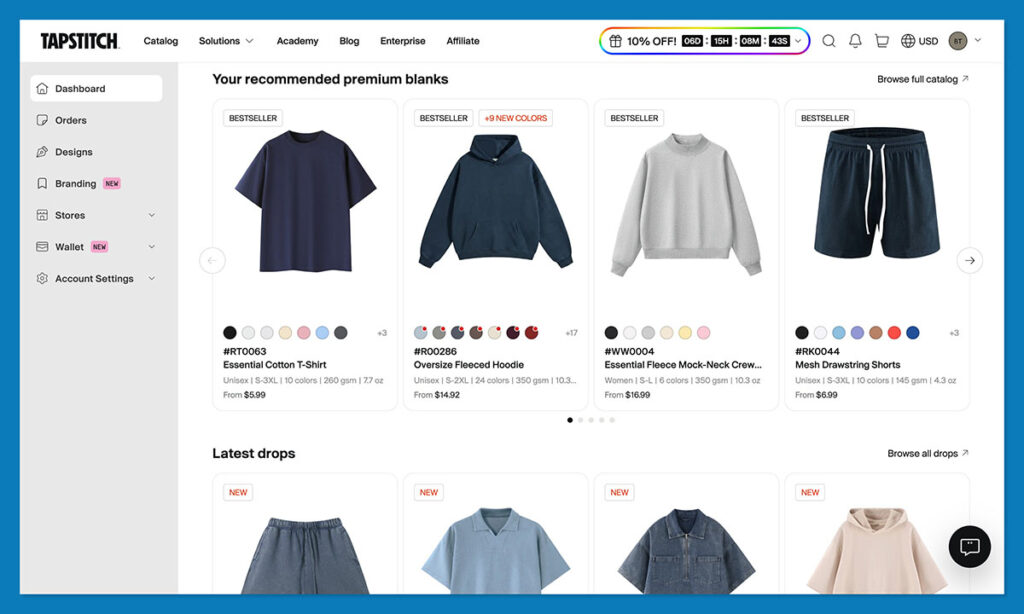
Tapstitch offers 400+ items, but they are exclusively apparel. While this seems like a limitation, it is a strategic choice. Their catalog includes heavy-duty hoodies, boxy-fit tees, and garment-dyed options that are currently trending in the fashion industry.
2. Print Quality and Precision
In our blind test, we printed identical designs on both platforms. Tapstitch excelled in "heavyweight" applications. Their white ink density on dark fabrics was superior, resulting in a vibrant, tactile finish that feels like a screen-printed product.
Printful’s output is remarkably consistent. However, as noted in various community forums, their automated production lines can occasionally suffer from a variance of 0.5 to 1 inch in placement. For a standard t-shirt, this is negligible; for a high-end streetwear brand with a precisely aligned back graphic, it can be a point of friction.
3. Global Fulfillment
Printful operates 12+ facilities worldwide. This allows for localized production, which is a massive advantage for reducing shipping costs and transit times. Tapstitch, with its dual-facility setup (Los Angeles and Guangzhou), is optimized for North American and specific international markets, but it lacks the granular, local-country production capacity that Printful offers in Europe and the UK.
Official Perspectives and Industry Implications
Both platforms have acknowledged the shifting needs of the creator economy.
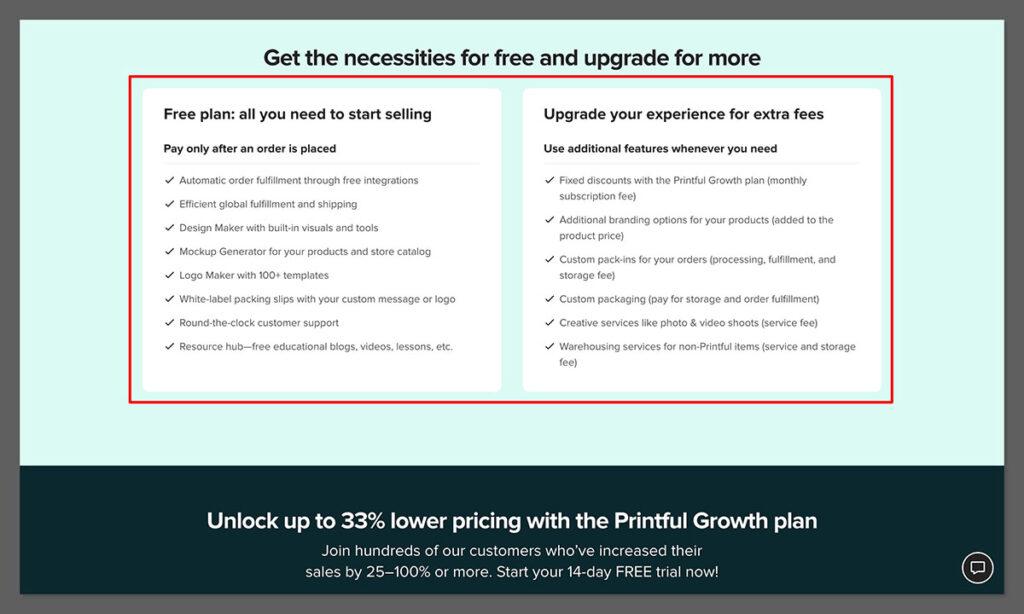
Printful’s stance has always been one of "growth through automation." Their recent introduction of the Growth plan ($24.99/mo) indicates they are doubling down on high-volume sellers who prioritize thin margins and fast, global shipping. Their representatives emphasize that the "POD business is a volume game," and their infrastructure is specifically engineered to handle the ebbs and flows of peak holiday seasons.
Tapstitch’s representatives focus on the "quality-first" narrative. Their marketing emphasizes the "blank" quality, often highlighting that they source specific textile compositions designed to endure the heavy wear-and-tear expected of streetwear. They position themselves not as a utility for dropshippers, but as a manufacturing partner for clothing lines.
Platform Integrations and Tools
Printful remains the clear leader in technical integrations. With 21+ platform connections, including complex setups like WooCommerce and custom API integrations, they are built for developers and agencies.
Tapstitch keeps its integration stack lean: Shopify, Etsy, and Wix. For a boutique brand, this is sufficient. Furthermore, Tapstitch’s built-in 3D mock-up generator is exceptionally user-friendly for designers who want to visualize their brand on oversized or streetwear-specific cuts without needing advanced software.
Economic Implications for the Seller
For the entrepreneur, the choice often comes down to the "Cost of Goods Sold" (COGS) vs. "Perceived Brand Value."
- The Low-Volume Seller: Both platforms are free to join. The cost of a branded tee (production + shipping) is roughly $21.73 for Printful and $22.95 for Tapstitch. At this scale, the difference is negligible.
- The Scaling Brand: Once a brand hits hundreds of orders per month, Printful’s Growth plan discounts become a massive advantage, potentially saving thousands in annual costs.
- The Fashion Brand: If your target audience is willing to pay $45–$60 for a premium hoodie, the extra $1–$2 per unit for Tapstitch’s superior fabric quality is a justified investment in brand equity.
Final Verdict: Which Path to Choose?
Choose Printful If:
- You are a generalist: You want to offer a wide array of products (mugs, stickers, hats, and clothes).
- You need global reach: Your customer base is international, and you need localized production to avoid customs delays and high shipping costs.
- You are a power user: You require complex integrations, such as TikTok Shop or Amazon, or you intend to scale into high-volume automation.
Choose Tapstitch If:
- You are a fashion label: Your brand lives and dies by the quality of the blank and the feel of the garment.
- Streetwear is your niche: You need oversized fits, heavyweight fabrics, and large, precise print areas that standard POD providers often compromise on.
- You value simplicity: You prefer a curated, high-quality catalog over a massive, overwhelming list of product options.
Summary Table: Quick Decision Guide
| Feature | Winner | Why? |
|---|---|---|
| Catalog Breadth | Printful | Massive variety of lifestyle products. |
| Apparel Quality | Tapstitch | Superior fabrics and premium streetwear cuts. |
| Global Shipping | Printful | 12+ facilities provide better local coverage. |
| Integrations | Printful | 21+ connections including major marketplaces. |
| Pricing Strategy | Tie | Both offer free-to-start models. |
| Brand Customization | Tapstitch | Better focus on neck labels and presentation. |
Ultimately, the best approach for any new seller is to order samples from both. Because both platforms have no mandatory subscription fees, the barrier to testing is low. Order a hoodie from Tapstitch and a standard tee from Printful; hold them in your hands, test the wash durability, and see which one better aligns with the brand you are building. In the modern era of e-commerce, the product is your most powerful marketing tool—choose the partner that helps you deliver the best version of that product.
