
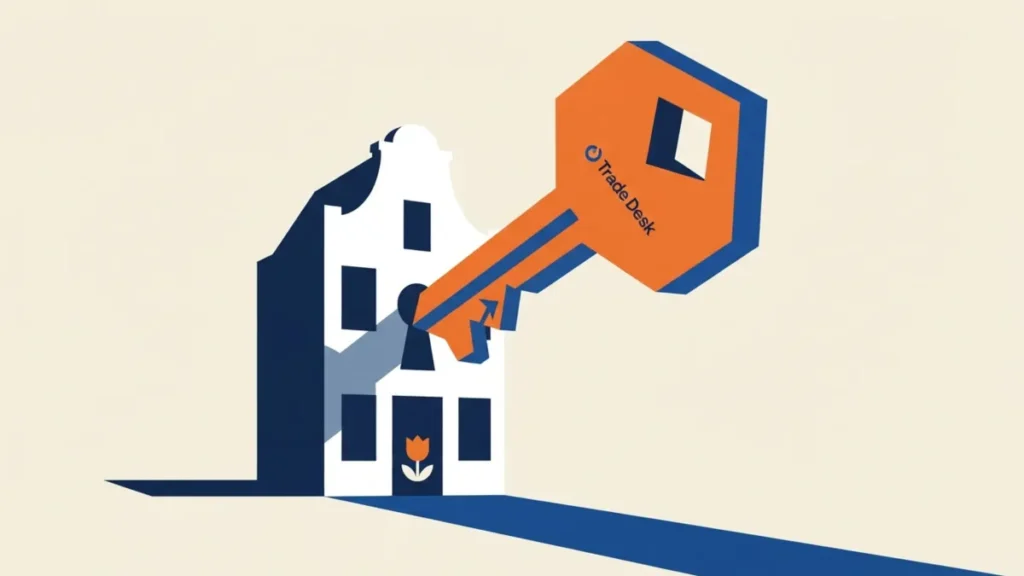
The Trade Desk Enters the Netherlands: A Strategic Deep-Dive into the Massarius-OpenPath Integration
In a move that signals the deepening footprint of programmatic infrastructure in Europe, The Trade Desk (TTD) has officially signed Massarius, an Amsterdam-based publisher house, as its inaugural Dutch partner for OpenPath. Reported on June 29, 2026, this strategic collaboration marks a significant milestone in the ongoing quest to streamline the digital advertising supply chain. By bypassing traditional intermediary layers—such as secondary exchanges and resellers—the partnership aims to inject transparency, efficiency, and objectivity into the transaction process for both advertisers and publishers.
For the Dutch market, this integration represents a shift toward more direct, “short-path” advertising models. As the programmatic ecosystem faces increasing pressure to justify costs and prove the value of every dollar spent, the partnership between a global demand-side platform (DSP) titan and an agile European publisher house provides a compelling case study on the future of supply-path optimization (SPO).
Chronology: The Evolution of OpenPath and the Dutch Expansion
The path to this partnership did not occur in a vacuum; it is the latest chapter in a broader, multi-year strategy by The Trade Desk to reconfigure how digital advertising is bought and sold.
- June 9, 2025: The Trade Desk launches "Deal Desk," a foundational pillar of its Kokai buying platform, designed to provide shared visibility into deal quality and performance.
- February 2026: In a parallel move to the Dutch strategy, three German supply-side platforms (SSPs)—Ströer, Virtual Minds, and YOC—integrate a Price Discovery and Provisioning API, setting the stage for European market automation.
- February 20, 2026: Major industry tension surfaces as reports indicate that global holding companies Dentsu and WPP have exited OpenPath, citing concerns over fee transparency and the actual routing of advertising traffic.
- March–June 2026: Publicis engages in a public dispute with The Trade Desk regarding audit findings from FirmDecisions, a conflict that reaches a resolution by mid-June 2026.
- June 29, 2026: The Trade Desk and Massarius announce their partnership, officially bringing OpenPath to the Netherlands.
This timeline underscores that the Massarius deal arrives during a period of intense scrutiny. While the technical integration was finalized following rigorous "Deal Desk" training, the political climate within the ad-tech industry regarding TTD’s transparency claims has arguably never been more complex.
Supporting Data: The Economics of the Supply Chain
The core value proposition of OpenPath is the removal of the "ad-tech tax." Research cited by the Interactive Advertising Bureau (IAB) and other industry analysts consistently highlights that between 42% and 49% of advertising budgets often evaporate before reaching the publisher, lost to a labyrinth of intermediary fees, technical overhead, and inefficient routing.
The Cost-Benefit Analysis
The Trade Desk operates on a flat 4.5% fee structure for OpenPath integrations. When compared to the traditional model—where multiple exchanges, wrappers, and resellers each take a slice of the pie—the 4.5% fee is designed to be highly competitive.
However, the efficacy of this model depends heavily on the publisher’s baseline.
- The "Complex" Publisher: For media outlets relying on five or six layers of technology to reach the buyer, a flat 4.5% is a significant net gain.
- The "Streamlined" Publisher: For those already operating with highly efficient, direct setups, the cost-benefit analysis is less binary.
The industry has seen proof of concept, albeit primarily among massive US media entities. Hearst Newspapers reported a 400% improvement in fill rates and a 23% revenue increase following OpenPath adoption. Similarly, The New York Post documented a 97% surge in programmatic display revenue. While these numbers are eye-watering, Massarius occupies a different tier of the market—a boutique publisher house with 11 to 50 employees. Whether such dramatic gains scale down to the mid-market remains the most significant open question in the Dutch rollout.
Official Perspectives: Aligning Vision with Execution
The leadership at both companies has positioned the deal as a natural evolution of market demands rather than a reactive measure.
The Trade Desk’s Stance
Phil Duffield, Vice President of Northern Europe at The Trade Desk, framed the collaboration as a foundational step for the company’s expansion in the Benelux region. "Our partnership with Massarius is an important step in our expansion into the Netherlands," Duffield noted. His commentary emphasizes a broader trend: the advertising market is moving away from black-box intermediation toward "glass-box" solutions where the path from the brand to the consumer is observable and measurable.
The Massarius Perspective
Bert Jan ten Kate, founder and owner of Massarius, highlighted the symbiotic nature of the deal. "This direct access effortlessly creates value for all parties involved," ten Kate stated. By focusing on "durable income" for content developers, Massarius is effectively pitching itself not just as a technology provider, but as a long-term sustainability partner for publishers who are currently fighting to compete with the sheer scale of platforms like Google or Meta.
Implications: A New Era for European Mid-Market Publishers
The implications of this deal extend far beyond the technical integration of two companies.
1. The Rise of the "Technology-Enabled" Publisher
Massarius is a prime example of the new breed of European publisher house. With expertise in Python, Google BigQuery, and machine learning, they operate with the technical sophistication of a software company. This partnership proves that the "publisher" role is shifting from content creation to data and yield management. The deal allows Massarius to offer advertisers better brand safety, viewability, and inventory quality, effectively "leveling the playing field" against dominant tech giants.
2. Navigating the Transparency Storm
It is impossible to discuss this partnership without acknowledging the friction between The Trade Desk and global agencies. While the concerns raised by Dentsu, WPP, and Publicis were focused on the "buy-side" disclosure of fees, the scrutiny has created a "trust deficit" that permeates all TTD products. By bringing a smaller, independent player like Massarius into the fold, The Trade Desk is attempting to demonstrate that OpenPath remains a viable, neutral, and efficient ecosystem for those outside the holding-company power structures.
3. The Signal vs. The Case Study
For the Dutch advertising community, the immediate impact of the Massarius deal is more symbolic than seismic. Massarius is not a national newspaper group; its inventory, while premium and high-quality, represents a smaller slice of the total Dutch programmatic pie.
However, the partnership acts as a "litmus test." If Massarius sees a significant uplift in fill rates and revenue similar to the US giants, it will provide a localized, credible roadmap for other European mid-market publishers. If the results are more modest, the lack of performance data—notably absent in this announcement compared to the high-profile US case studies—may lead the industry to question whether the "OpenPath effect" is truly universal or reserved for the largest scale players.
Conclusion: A Strategic Crossroads
The integration of Massarius into The Trade Desk’s OpenPath program is a microcosm of the current state of programmatic advertising. It reflects a desire for simplicity in an increasingly fractured, expensive, and opaque supply chain. As The Trade Desk continues to roll out its strategy market-by-market, the Dutch experiment will be closely watched.
For now, the deal stands as a clear signal: the push for direct, efficient, and transparent ad-tech infrastructure is moving beyond the boardrooms of New York and London, finding a home in the agile, tech-forward offices of Amsterdam. Whether this leads to a permanent industry shift or remains a niche utility for mid-sized publishers will depend on the tangible performance metrics that follow in the coming fiscal quarters. For the Dutch advertising market, the race to the "shortest path" has officially begun.
