
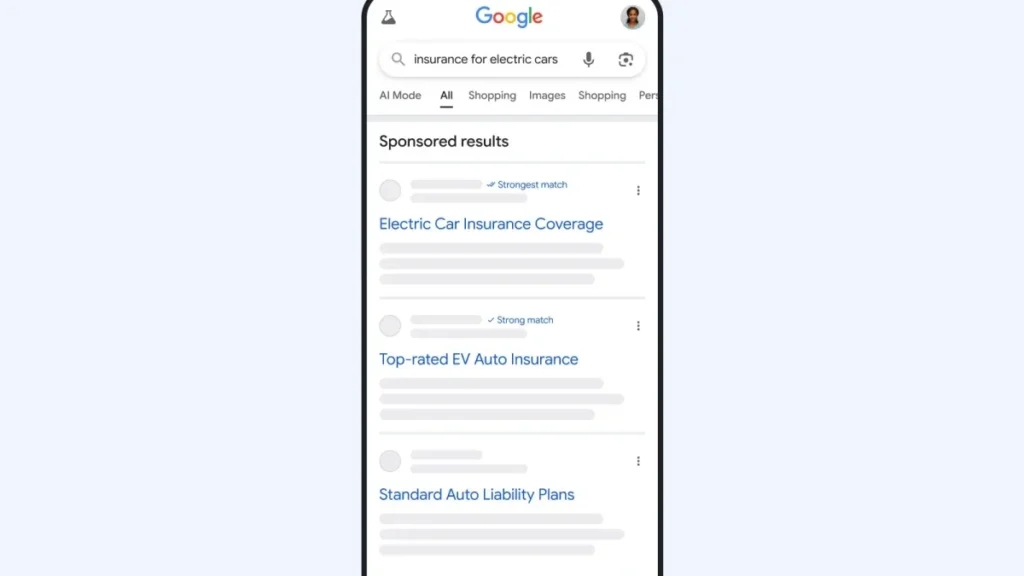
Google Tests “Strongest Match” Badging: A New Era of Transparency or a Signal for Shifted Ad Dynamics?
In an evolving digital landscape where artificial intelligence is increasingly mediating the relationship between user intent and search results, Google has launched a significant new experiment. As of June 24, 2026, a select segment of users in the United States began seeing “Strongest match” and “Strong match” labels appended to specific Search advertisements.
This initiative, confirmed by Google’s Ads Product Liaison, Ginny Marvin, represents a departure from the company’s traditional, relatively uniform presentation of sponsored content. By surfacing the "relevance" of an ad directly to the consumer, Google is attempting to bridge the gap between algorithmic ad-matching and user-perceived utility. However, for the professional digital marketing community, the experiment raises urgent questions about the opacity of modern campaign management and the shifting definitions of relevance in the age of AI.
The Mechanics of the Experiment: What We Know
The rollout, announced by Marvin via X on June 23, 2026, is currently categorized as a limited-scope UI experiment. It does not introduce new inventory categories or alter the fundamental auction mechanics—at least in its current state. Instead, it acts as a diagnostic "badge" applied to existing Search ads that pass a predetermined, high-threshold relevance check.
The Two-Tiered System
The experiment utilizes two distinct tiers to communicate confidence levels:
- “Strongest match”: The top-tier designation, indicating Google’s peak confidence that the ad is perfectly aligned with the user’s specific search intent.
- “Strong match”: A secondary tier signifying elevated relevance, though not the maximum confidence level identified by the system.
According to Google, these badges are not permanent fixtures of a campaign but are dynamic, context-dependent signals. They are calculated in real-time during the auction process based on established ad quality signals. Crucially, the labels do not change ad placement, eligibility, or the cost-per-click (CPC) dynamics as defined by the existing Ad Rank formula.
Chronology of Search Evolution
This experiment is the latest in a rapid-fire sequence of UI and structural changes that have defined the Google Search experience over the past 24 months.
- July 2025: Google removed the prominent "Sponsored" label from "Find Related Products" units, opting for smaller, less conspicuous footer text.
- September 2025: A major consolidation took place, grouping individual sponsored ads under a single "Sponsored results" header, simplifying the page layout.
- October 2025: The introduction of the "sticky" sponsored label that persists during scrolling, alongside a "Hide sponsored results" control for users.
- April 2026: Observers noted tests involving an "AI" label on mobile search ads, which lacked clear documentation, signaling Google’s intent to flag AI-mediated content.
- May 2026: The launch of "Conversational Discovery" ads and "Highlighted Answers" for AI Mode, which prioritized high-relevance and high-quality signals.
- June 2026: The current "Strongest match" rollout begins, continuing the trend of flagging ad quality for the end user.
Supporting Data: The Anatomy of Ad Quality
The "Strongest match" labels rely entirely on existing infrastructure. To understand why an ad might receive this badge, one must look at the three pillars of Google’s Quality Score:
- Expected Clickthrough Rate (CTR): A statistical projection based on historical performance for the given keyword.
- Ad Relevance: How closely the ad copy and assets align with the specific intent behind the user’s search.
- Landing Page Experience: The post-click reality—how useful, transparent, and navigable the destination page is for the user.
While these components determine the Quality Score (1–10), it is vital to remember that the Quality Score is a diagnostic tool, not a direct auction input. Ad Rank is the actual mechanism that determines placement, calculated at the moment of the query by combining the bid amount, the auction-time quality, and the expected impact of extensions and other ad formats.
The "Black Box" Problem
Critics in the advertising industry have pointed out a fundamental friction: if Responsive Search Ads (RSAs) are now the industry standard—requiring advertisers to provide 15 headlines and 4 descriptions that are then dynamically assembled by AI—how can an advertiser "optimize" for a "Strongest match" label?
As noted by industry practitioners like Anthony Higman, the lack of granular control in an AI-dominated asset-generation environment makes it difficult to pinpoint exactly which combination of headlines or descriptions triggered the "Strongest match" designation. This leads to a sense of lost agency for advertisers who are now essentially "managing" the system’s preferences rather than "creating" specific ad copy.
Official Stance and Community Reaction
Ginny Marvin’s communication regarding the experiment has been characterized by a push for transparency, though she has stopped short of providing a roadmap for full implementation. In her post on X, Marvin encouraged practitioners to consult the official Help Center documentation, framing the experiment as an effort to help users identify the "most relevant information" while assisting advertisers in connecting with "high-intent audiences."
The Practitioner’s Skepticism
The reaction among the digital marketing community has been decidedly mixed. On social media platforms, many experts have questioned the validity of the labels.
- Transparency concerns: Several professionals have argued that keyword matching has become increasingly "loose" due to AI-driven broad match updates, making the term "Strongest match" feel somewhat ironic.
- Operational questions: Advertisers are concerned that if these labels become a permanent feature, they will create a two-tiered system where ads lacking the badge suffer from a "relevance penalty" in the eyes of the user, regardless of their actual performance metrics.
Implications for the Future of Search
The "Strongest match" label does not exist in a vacuum; it is part of a broader shift toward AI-interpreted search.
The AI-Intent Shift
Google’s recent move to show "AI-interpreted intent" in Search Term reports—rather than the literal query the user typed—means that "relevance" is now a moving target. If a user performs a voice search or interacts with an AI Overview, the system is inferring the "best approximation" of intent. An ad labeled "Strongest match" in this environment is being validated by a machine’s interpretation of intent, not necessarily by the literal keywords.
Economic Consequences
The potential for a "performance floor" is significant. If users begin to trust the "Strongest match" label, click-through rates will inevitably concentrate on the badged ads. This creates a "rich-get-richer" scenario where well-optimized, high-budget campaigns receive more visibility, while newer or smaller advertisers struggle to gain traction—not because their products aren’t relevant, but because they haven’t yet signaled that relevance to the machine.
Furthermore, this aligns with Google’s new Limited Ad Serving Policy, which restricts the impressions of advertisers who receive frequent user complaints. If an advertiser is "high quality" in the eyes of the algorithm (earning the "Strongest match" badge) but "low quality" in the eyes of the user (generating complaints), the system is effectively creating a paradox that could see even "Strongest match" advertisers throttled if they fail to meet the platform’s increasingly stringent user-experience standards.
Conclusion: A Turning Point for Search Advertising
As of late June 2026, the "Strongest match" experiment is still in its infancy. For the average user, it may provide a minor signal of trust. For the search advertiser, it represents a profound change in the visibility of the "black box" that governs the auction.
If the experiment expands, Google will likely face pressure to provide more granular reporting on why certain ads receive the badge and others do not. Without that clarity, the "Strongest match" label may become another metric that advertisers are forced to chase, without the tools necessary to influence it directly.
As Google continues to integrate AI into every facet of the search experience, the definition of a "match" will continue to evolve from a keyword-based binary into a complex, intent-driven spectrum. Whether this creates a more efficient marketplace or simply increases the barrier to entry for advertisers remains the central question of the 2026 search cycle. For now, the industry watches, tests, and waits to see if these badges are the future of search or merely another ephemeral experiment in Google’s constant cycle of iteration.
