
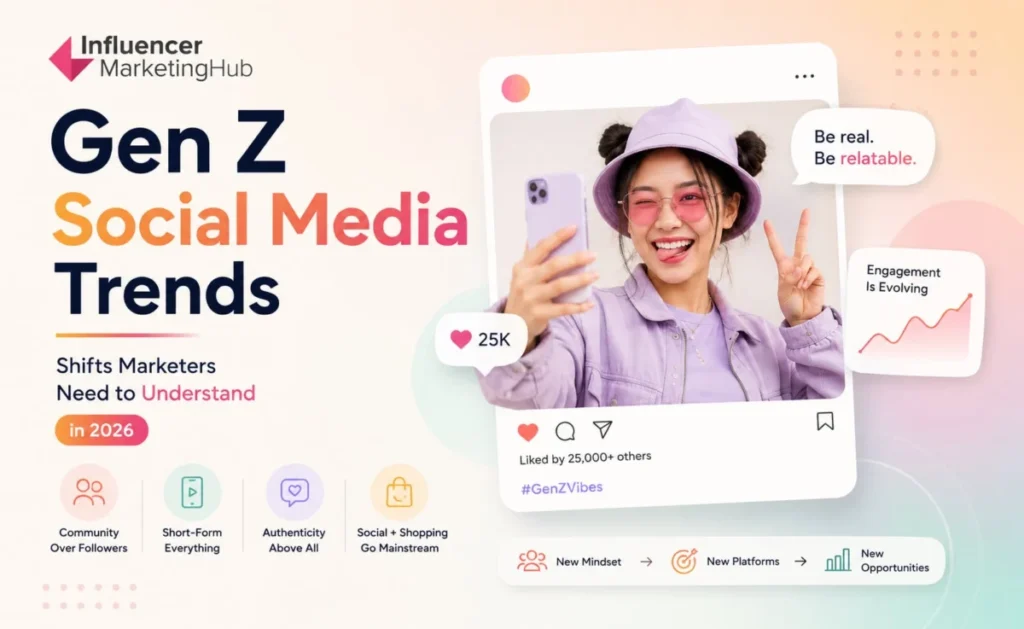
Gen Z Social Media Trends: 7 Shifts Marketers Need to Understand in 2026
By Kalin Anastasov
Updated: June 21, 2026
As we move through the mid-point of the decade, the digital landscape is undergoing a tectonic shift. Generation Z, now firmly established as the dominant consumer cohort, has moved beyond the "digital native" label to become the architects of a new social economy. For marketers, the playbook written in 2020—or even 2024—is rapidly becoming obsolete.
In 2026, Gen Z is no longer just "using" social media; they are curating it, decentralizing it, and demanding a level of authenticity that traditional advertising simply cannot manufacture. To succeed in this environment, brands must pivot from broadcast messaging to community-led co-creation. Here are the seven critical shifts defining the Gen Z social experience in 2026.
1. The Death of the "Polished" Feed: The Rise of Anti-Aesthetics
For years, Instagram was defined by high-production photography and curated lifestyle shots. By 2026, that era has effectively ended. Gen Z has pivoted sharply toward "Anti-Aesthetics"—a trend favoring raw, unfiltered, and low-fidelity content.
This shift is a psychological reaction to the perceived perfectionism of the early 2020s. Today, a shaky, 10-second smartphone video shot in a dimly lit room often outperforms a high-budget commercial. The implication for marketers is clear: if your content looks like an advertisement, it is ignored. The "lo-fi" look has become the new benchmark for trust.
2. The Decentralization of Influence: Micro-Communities Over Macro-Influencers
The era of the "mega-influencer" with 50 million followers is waning in terms of conversion power. Gen Z has migrated to "Dark Social"—private Discord servers, closed WhatsApp communities, and niche Reddit sub-forums.
These smaller, gated environments are where the real influence resides. In these spaces, recommendation flows are peer-to-peer rather than top-down. Brands are now finding that a campaign involving 500 micro-creators with highly engaged, niche followings is exponentially more effective than a single partnership with a celebrity influencer.
3. Social Search: The Google-to-TikTok Pipeline
Perhaps the most significant behavioral change in 2026 is the abandonment of traditional search engines for discovery. Gen Z treats TikTok, Instagram, and specialized AI-driven social tools as their primary search engines.
When a member of Gen Z wants to buy a product, find a restaurant, or research a career path, they don’t "Google it"—they search for it on social media to see real-world, video-first experiences. Marketers must now optimize their social content for "social SEO," ensuring that their brand presence appears in the search bars of these platforms through keywords, captions, and visual indexing.
4. The Integration of Generative AI as a Collaborative Partner
AI is no longer a futuristic concept; it is a creative tool Gen Z uses daily to enhance their social identity. From using AI filters to generate personalized avatars to leveraging LLMs to script short-form videos, Gen Z views AI as a creative collaborator.
The shift here is in expectations: Gen Z expects brands to use AI to provide personalized experiences. Whether it’s an interactive AI chatbot that acts as a brand persona or dynamic video editing that adapts to individual preferences, the expectation is that the content will be bespoke and interactive, not static.
5. Conscious Consumerism and Values-Driven Engagement
The "performative" activism of the early 2020s has been replaced by a deep, data-driven scrutiny of corporate values. Gen Z uses social media as a tool for "brand auditing." They are quick to mobilize against companies that engage in greenwashing or fail to support the social causes they claim to care about.
In 2026, silence is viewed as a stance. Brands that do not have a clearly articulated position on sustainability, labor rights, and inclusion—backed by tangible proof points accessible via their social profiles—are being systematically "canceled" or filtered out of the Gen Z purchase funnel.
6. The "Edutainment" Mandate
Social media is increasingly viewed as a classroom. From "financial literacyTok" to "DIY biohacking," the most successful content on social media in 2026 is rooted in utility.
Gen Z wants to learn something every time they open an app. Brands that move away from "selling" and toward "teaching" are seeing massive engagement spikes. Whether it’s explaining the supply chain behind a sustainable sneaker or providing a tutorial on how to style a garment for five different occasions, the value proposition must be educational. If you aren’t providing utility, you are merely noise.
7. The Rejection of Invasive Tracking and the Return to Contextual Targeting
With the total sunsetting of third-party cookies and the rise of privacy-first browser environments, the "stalking" style of digital advertising is effectively dead. Gen Z is hyper-aware of data privacy; they are more likely to block trackers and use VPNs than any other generation.
Marketers are forced to return to "contextual targeting"—placing ads based on the content being consumed rather than the identity of the user. This means building deep relationships with publishers and creators who inhabit the specific niches where your target audience lives, rather than relying on invasive behavioral data.
Supporting Data: The Digital Pulse of 2026
Recent surveys indicate that 78% of Gen Z users claim they are more likely to purchase from a brand that features "unpolished" or user-generated content compared to studio-shot imagery. Furthermore, internal platform data shows that search queries within social apps have grown by 42% year-over-year, firmly cementing the role of the "Social Engine" in the modern customer journey.
Official Responses and Industry Outlook
Marketing agencies are currently scrambling to reallocate budgets. A representative from a leading global digital agency noted: "We are seeing a massive shift in budget from high-production video sets to ‘Creator Labs,’ where we essentially hire teams of Gen Z creators to live within the brand ecosystem. We don’t direct them; we provide them with the brand goals, and they execute in their own voice. That is the only way to remain relevant in 2026."
Implications for the Future
The implications for brands are clear: the wall between the consumer and the corporation is crumbling. The 2026 landscape demands:
- Radical Transparency: Share the "how," the "where," and the "who" behind your products.
- Community Ownership: Give your fans a stake in your brand’s direction, whether through polls, co-creation, or exclusive digital access.
- Agility Over Perfection: Shift from long-term, rigid content calendars to real-time, responsive content creation.
As we look toward the remainder of 2026 and into 2027, the brands that win will be those that stop treating social media as a megaphone and start treating it as a conversation. Generation Z is not looking for a corporate voice; they are looking for a collaborator.
In this new era, the most successful brands will be those that have the courage to relinquish control of their narrative, allowing their audience to lead the conversation. The transition from "brand-led" to "community-led" is no longer a strategic choice—it is a requirement for survival.
As the digital ecosystem continues to evolve, marketers must remain fluid. The trends discussed here are not fixed destinations but markers on a moving map. By leaning into authenticity, prioritizing utility, and respecting the privacy and values of the Gen Z cohort, brands can build more than just a following—they can build a legacy in the digital age.
