
The Algorithmic Newsroom: How Data-Driven Strategy is Defining the Future of Political Media
In the modern media landscape, news publishers are no longer just competing against rival outlets for the reader’s eye. They are locked in a sophisticated, high-stakes arms race against algorithmic gatekeepers. Success in the "News & Politics" vertical today is dictated by a complex interplay of relevance, timing, and, perhaps most importantly, format precision. As audience attention becomes an increasingly scarce commodity, the traditional "broadcast and hope" model of digital publishing is rapidly becoming obsolete.
New data from Tubular Intelligence, covering the period from November 2025 through February 2026, reveals a stark reality: audience behavior in the political sphere is highly nuanced, fragmented, and region-specific. To maintain relevance, publishers must pivot from a volume-based strategy to a precision-based approach, aligning their output with the specific habits of viewers across APAC, LATAM, EMEA, and North America.
The Evolution of Engagement: A Four-Month Snapshot
The data collected between November 2025 and February 2026 highlights a shift in how political discourse is consumed on social video platforms. During this window, the global news cycle was dominated by geopolitical tensions and high-profile societal debates, providing a perfect laboratory to observe how different demographics interact with digital journalism.
The Myth of the "Mid-Length" Standard
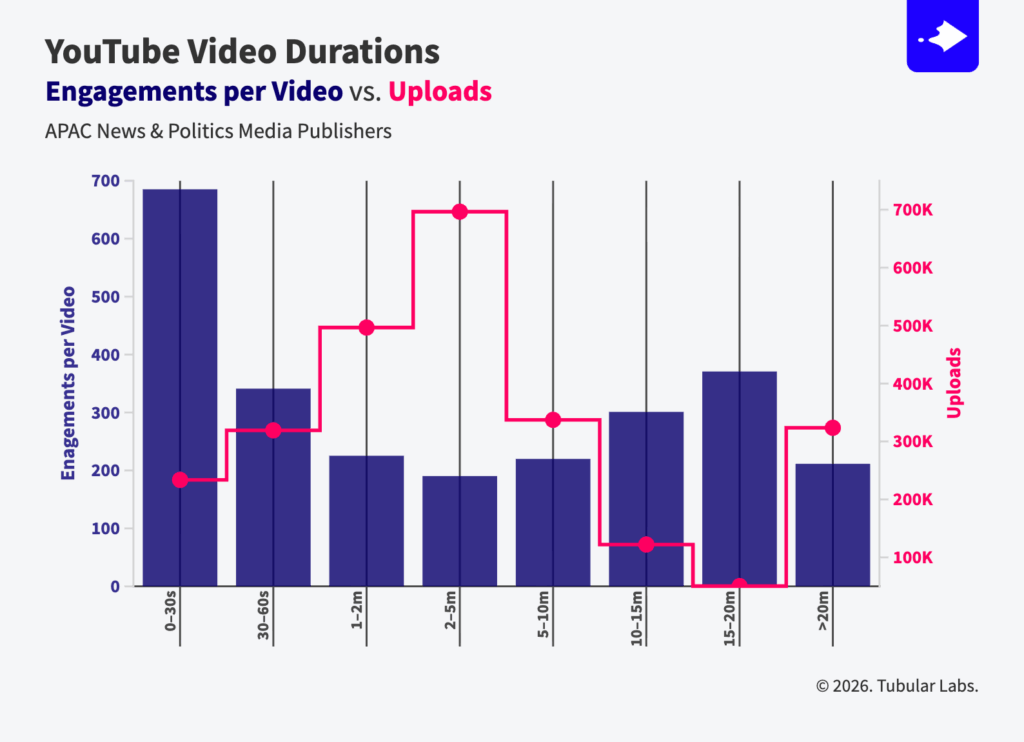
For years, the industry standard for digital video was the "mid-length" clip—typically clocking in at two to five minutes. It was long enough to provide context but short enough to retain the average viewer’s attention. However, the latest findings from the APAC region suggest that this "middle ground" is currently the least effective strategy for maximizing engagement.
In APAC, publishers are seeing a distinct polarization in viewer preference. Audiences are gravitating toward two extremes:
- Ultra-short, high-impact updates (0–30 seconds): These serve as the "breaking news" alert, providing immediate information that satisfies the viewer’s need for speed.
- Deep-dive, long-form explainers (15–20 minutes): These cater to a growing desire for intellectual depth and contextual analysis.
While mid-length videos still dominate the sheer volume of uploads, they are significantly underperforming in terms of "engagements per video." The takeaway is clear: publishers are currently optimizing for output—filling a feed—rather than impact. By pivoting toward either the lightning-fast update or the marathon explainer, publishers can better serve their audiences’ dual needs for speed and substance.

The Timing Mismatch: Unlocking Hidden Potential in LATAM
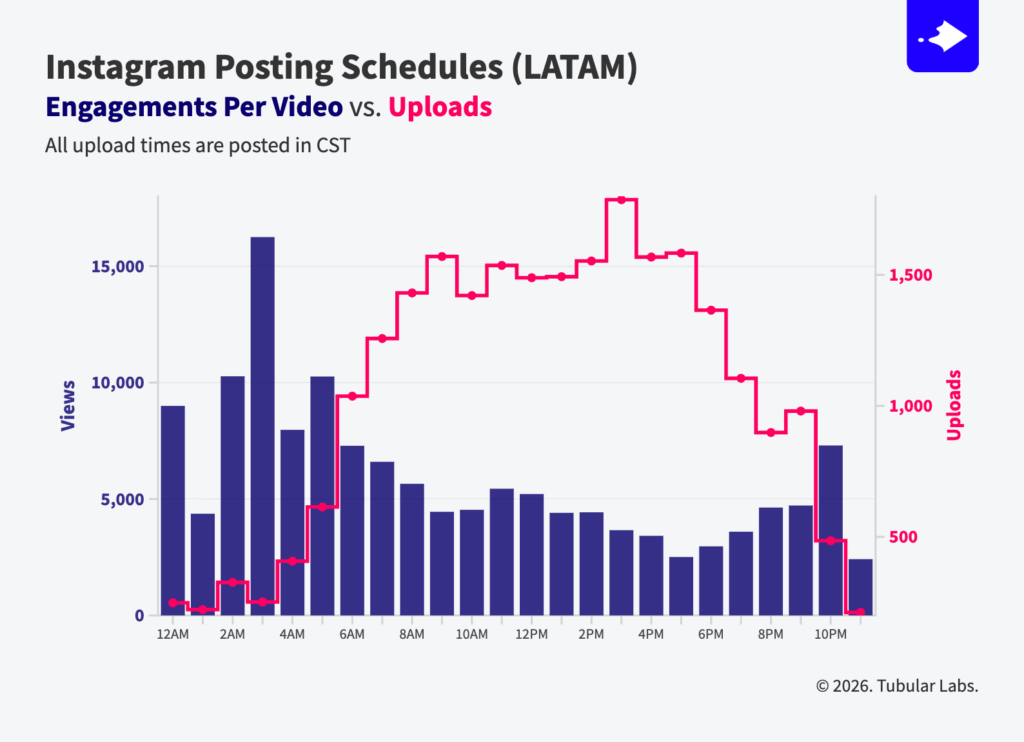
Perhaps the most striking inefficiency discovered in the report concerns posting schedules in the LATAM market. The data suggests a significant "timing mismatch" that could be costing publishers millions of impressions.
Current trends show that the vast majority of political content in the region is uploaded between 3:00 PM and 3:59 PM CST. This follows the traditional logic of "prime time" viewing. However, the raw engagement metrics tell a different story: the highest engagement-per-video peak occurs between 3:00 AM and 3:59 AM CST.
This early-morning surge represents an untapped blue ocean for content distribution. By shifting distribution windows to the early hours, publishers can capture a captive, underserved audience. When users check their phones upon waking, they are often looking for a recap of the night’s events. By being the first to provide that content, publishers can face less competition and secure higher engagement rates.
Hashtag Strategy: Discovery and Authority in EMEA
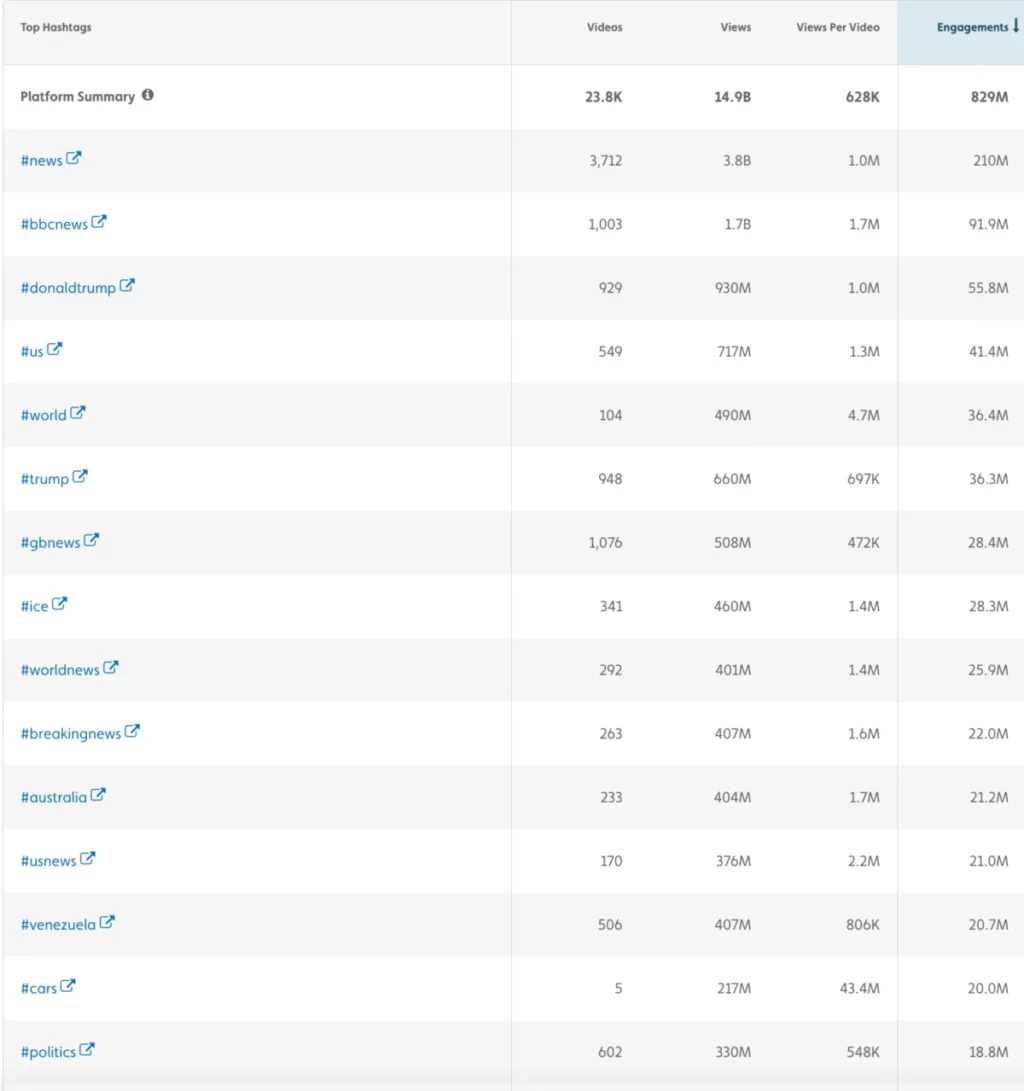
In Europe, the Middle East, and Africa (EMEA), the use of hashtags has evolved from a simple organizational tool into a sophisticated mechanism for building brand authority and search discoverability.
The most successful publishers in this region are utilizing a multi-layered hashtag strategy that blends:
- Global Flashpoints: Using tags like #trump, #ICE, or #venezuela to ride the wave of trending international topics.
- Brand Authority: Consistently using branded tags such as #bbcnews to ensure that when a user searches for a major story, the newsroom’s own content appears at the top of the results.
- Geographic Identifiers: Tagging specific countries to bridge the gap between local reporting and global interest.
This approach transforms the hashtag from a metadata tag into a strategic asset, allowing publishers to "own" the conversation surrounding a breaking news event and ensuring their content remains discoverable long after the initial broadcast.
The Viral Paradox: Hard News vs. Emotional Resonance
Perhaps the most surprising finding from the US market is the dichotomy between "Most Viewed" and "Most Engaging" content.
In the period analyzed, a Reuters report on a high-profile car crash involving boxing champion Anthony Joshua generated 180 million views in 30 days. This proves that high-profile, "hard" news events still command massive reach. However, the "Most Engaging" video—garnering 63.5 million engagements in just seven days—centered on a man mocking an AR-15 purchase during an ICE protest.
The implication is profound: TikTok and similar short-form platforms treat "hard news" as a commodity, but they treat "human interest" and "humor" as a currency. When content sparks an emotional or cultural reaction—even if that reaction is irony or mockery—it drives deeper engagement and conversation. For newsrooms, the challenge is clear: how do you maintain editorial integrity while injecting the cultural resonance necessary to stop the scroll?
Implications for the Future of Newsrooms
The findings from this data set point to a fundamental shift in the media landscape. The "one-size-fits-all" approach to social media is dead.
1. From "Publishing" to "Programming"
Newsrooms must move away from treating social media as a repository for broadcast clips. Instead, they must function like programming departments. This means producing content specifically tailored to the platform’s algorithm and the specific time of day the audience is most active.
2. The Return on Depth
While the industry has been obsessed with short-form content, the high performance of 15–20 minute explainers in APAC demonstrates that there is a massive, hungry audience for long-form, thoughtful content. Publishers who double down on high-quality, long-form journalism may find themselves in a stronger position than those fighting over 15-second soundbites.
3. Data-Led Decision Making
The timing mismatch in LATAM is a wake-up call for newsrooms globally. If publishers are relying on "gut feeling" to decide when to post, they are almost certainly missing peak engagement windows. The integration of real-time intelligence tools is no longer a luxury; it is a necessity for survival.
Conclusion: The Path Forward
The path to success in the digital news era is not paved by simply publishing more content. It is paved by publishing smarter.
As we look beyond the first quarter of 2026, the publishers that thrive will be those that view their audience through a lens of regional nuance and algorithmic logic. By analyzing the data—not just the headlines—publishers can align their content strategy with the real-world behaviors of their audience. Whether it is moving to early-morning posting schedules, refining hashtag strategies to boost search authority, or finding the balance between hard news and cultural resonance, the opportunity for growth is significant.
The future of political journalism is digital, and it is data-driven. The question for publishers is no longer "what is the story?" but rather "how, when, and where will this story resonate most?" Those who answer these questions with precision will lead the next generation of global media.
