
The 2026 B2B Outlook: Navigating the Era of Agentic Marketing
As the B2B landscape enters 2026, the industry stands at a critical inflection point. For the past three years, the conversation has been dominated by the hype surrounding generative AI. Now, as the technology matures from simple chatbots to sophisticated, autonomous agents, the core strategies of B2B go-to-market (GTM) are undergoing a radical, structural transformation.
In a special guest feature, Jon Miller—co-founder of Marketo and a veteran architect of modern B2B marketing—outlines a vision for 2026 where the focus shifts from "AI-assisted tasks" to "autonomous agent orchestration." This year, the industry moves beyond the novelty of content generation toward a complex, signal-driven future where the most successful companies will be those that learn to market to machines as effectively as they do to humans.
The Paradigm Shift: Marketing to Agents
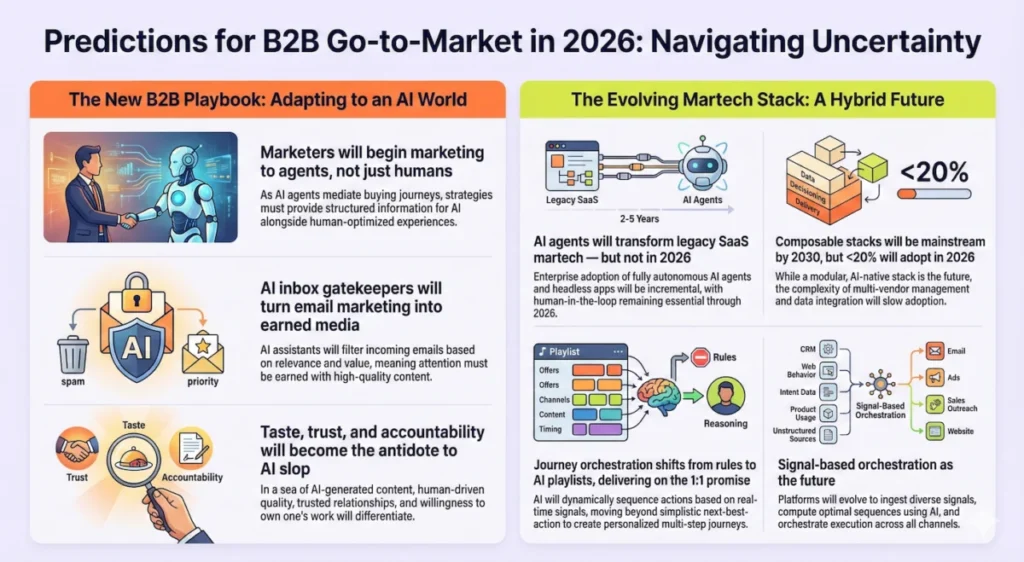
The most profound development of 2026 is the recognition of the "Agentic Buying Committee." As B2B buyers increasingly delegate research, vendor comparison, and data synthesis to AI agents, the traditional B2B funnel is being rewritten.
The Rise of Answer Engine Optimization (AEO)
By the end of 2025, 90% of B2B buyers were already utilizing LLM-based tools like ChatGPT for initial vendor research. This has relegated traditional Search Engine Optimization (SEO) to a secondary priority, replaced by the urgent need for Answer Engine Optimization (AEO). Marketers are now prioritizing structured data and schema markup, ensuring that their product capabilities are easily ingested and accurately represented by AI models.
Content Architecture for Dual Audiences
The industry is moving toward a "headless" content strategy. In this model, information is bifurcated:
- For Humans: Branded, emotionally resonant experiences that prioritize trust and relationship building.
- For Agents: Direct, API-based access to pricing, technical specifications, and compliance documentation.
This duality is essential. While agents compress the research phase by objectively evaluating criteria like security compliance and feature parity, the final contract remains a human decision rooted in trust.
Chronology: The Path from Rules to Reasoning
The transition toward an AI-native GTM model is not a sudden "flip of the switch" but a tiered evolution.
- 2023–2024: The "Experimental Phase." Organizations focused on basic productivity gains, using LLMs to draft emails and generate blog posts.
- 2025: The "Integration Phase." Companies began experimenting with Answer Engine Optimization and integrating AI into CRM workflows.
- 2026: The "Orchestration Phase." The focus shifts to reasoning models. Unlike rigid, rules-based automation—where a simple "if/then" logic dictated every lead movement—2026 is defined by AI agents that can "reason" through context, recognize patterns, and adjust strategies in real-time.
Supporting Data: Why Change is Necessary
The current state of B2B marketing is hampered by "AI slop"—a deluge of generic, low-value content created by indiscriminate AI usage. According to recent industry reports, the following data points highlight the urgency for a shift in strategy:
- The Trust Gap: Forrester indicates that B2B customers are increasingly bypassing institutional brand promises, preferring instead to rely on curated, personal networks.
- The "Silent Freeze": Data from Pave shows a dramatic decline in entry-level hiring, with tech companies reducing their 21-25-year-old workforce demographic from 15% to 6.8% over the last two years. This suggests that AI is already replacing junior-level administrative and research roles, forcing a structural change in how organizations develop talent.
- Signal Commoditization: Public intent data (job changes, funding rounds) has become a commodity. The "alpha" or competitive edge now lies in proprietary signal synthesis—combining internal product usage data with external behavioral signals to predict buying intent with high precision.
Official Perspectives: The End of "Owned Media"
A central theme of the 2026 outlook is the decline of email as "owned media." As AI-driven inbox gatekeepers—such as Outlook Copilot and various personal AI assistants—become the primary interface through which buyers view their messages, the "batch-and-blast" approach is effectively dead.
Industry leaders argue that email has transitioned into a form of "earned media." To reach a buyer, an email must now provide demonstrable value that satisfies both the human recipient and the AI gatekeeper. If the content is deemed irrelevant, it is filtered out before it ever reaches a human inbox. This puts a premium on relevance, trust, and the reputation of the sender.
Implications for GTM Teams
The implications for marketing and revenue operations are severe, necessitating a pivot in how teams are structured and managed.
1. From "SaaS Tools" to "Autonomous Labor"
The next generation of GTM companies will not sell software licenses; they will sell "outcomes" delivered by AI agents. This shift from buying software seats to hiring digital labor forces companies to rethink their budgets and operational infrastructure.
2. The Rise of "Context Engineering"
AI models are only as good as the context they are provided. "Context engineering" is emerging as a critical discipline. This involves documenting the "tribal knowledge"—the reasoning behind Salesforce schemas, the nuances of lead routing, and the strategy behind campaign definitions—and feeding it into AI systems. Without this, AI remains generic and prone to error.
3. Composable "Lite" Stacks
While the industry talks about fully "composable" martech stacks, the reality for 2026 is "composable lite." Most organizations are not ready to dismantle their core platforms like HubSpot or Marketo. Instead, they are integrating data warehouses with their existing platforms to allow for more sophisticated, signal-driven orchestration while maintaining the stability of a central, human-managed hub.
4. The Human Imperative
Perhaps the most critical implication is the redefined role of the human marketer. As AI absorbs the "messy middle" of operational tasks, the value of the human worker shifts toward:
- Taste: The ability to discern what is actually valuable.
- Accountability: The willingness to stake one’s professional reputation on the output of an AI-assisted project.
- Strategic Leadership: Managing the AI agents themselves, setting guardrails, and defining the emotional tone of the brand.
Conclusion: Navigating the Uncertainty
The year 2026 will not be "predicted" so much as it will be "navigated." With the World Uncertainty Index at historic highs, the stability of traditional B2B playbooks has eroded. Organizations that attempt to freeze or maintain the status quo risk irrelevance.
Success in 2026 requires a focus on building organizational resilience. By driving efficiency through AI, banking the resulting savings, and upskilling teams to focus on high-level strategy and human relationships, leaders can build a GTM engine capable of thriving in an era of constant, rolling disruption. The tools are more powerful than ever, but the winning strategy remains constant: the human ability to trust, to lead, and to make the final judgment on what truly matters to the customer.
