
The New Visibility Frontier: Why LLM Rankings are the Next SEO Revolution
Large Language Models (LLMs) have transcended their status as mere technological novelties. They are no longer just chatbots; they are the new arbiters of consumer discovery and decision-making. If the traditional Google search engine served as the digital map for the last two decades, LLMs—such as ChatGPT, Claude, and Gemini—have become the authoritative tour guides. They are answering complex queries directly, curating product recommendations, and effectively pushing traditional, link-based search results into the background.
For businesses and marketers, this shift represents a tectonic change in how visibility is earned. "LLM Rankings"—the measure of a brand’s presence within these AI-generated responses—are now the critical metric for digital survival. If your brand is not being cited by an AI assistant when a potential customer asks for a recommendation, you are essentially invisible to a growing, high-intent audience.
What Are LLM Rankings?
At their core, LLM rankings represent "SEO for AI assistants." Unlike traditional Search Engine Optimization, which focuses on capturing a blue link on a Search Engine Results Page (SERP), LLM optimization focuses on inclusion within the generative synthesis provided by AI models.
When a user asks, "What is the best project management software for a remote team?" the AI does not provide a list of ten websites; it synthesizes a paragraph of expert-level advice, often mentioning three to five specific brands. If your brand is absent from that synthesis, you have effectively lost a highly qualified lead to your competitors before the user has even clicked a link.
The Chronology of the Shift: From Links to Synthesis
The digital landscape has evolved in three distinct phases:
- The Directory Era (Early 2000s): Visibility was dominated by human-curated directories and early search algorithms that relied on keyword density and basic backlinking.
- The SERP Era (2010–2023): Google refined its dominance, emphasizing authority, domain rating, and user experience. Businesses invested heavily in content marketing to rank on the first page of search results.
- The Generative Era (2024–Present): We are currently in the midst of a transition toward "Answer Engines." Users are shifting away from evaluating multiple links toward relying on the singular, synthesized answer provided by LLMs.
This chronology suggests that the "search" paradigm is being replaced by a "recommendation" paradigm. The brands that understand how to influence these recommendations will win the next generation of customer acquisition.
The "Big Four": The Platforms Shaping Modern Discovery
While the market is fluid, four key platforms currently dominate the landscape of AI-driven search:
- OpenAI (ChatGPT): The market leader in terms of brand recognition and adoption. Its conversational depth makes it a primary source for product research.
- Google Gemini: Holds a massive advantage due to its integration within the Google ecosystem and its ability to pull real-time data from the web.
- Anthropic (Claude): Renowned for its sophisticated reasoning and nuance, making it a favorite for enterprise-level decision-making.
- Perplexity: A purpose-built "answer engine" that cites sources directly, making it the most transparent of the platforms and a major disruptor in the search space.
Because you cannot assume which tool your target audience prefers, a comprehensive visibility strategy requires tracking performance across all four. Relying on one is akin to optimizing for Google while ignoring Bing or DuckDuckGo in the early 2000s—a strategic oversight that invites obsolescence.
Supporting Data: The ROI of AI Visibility
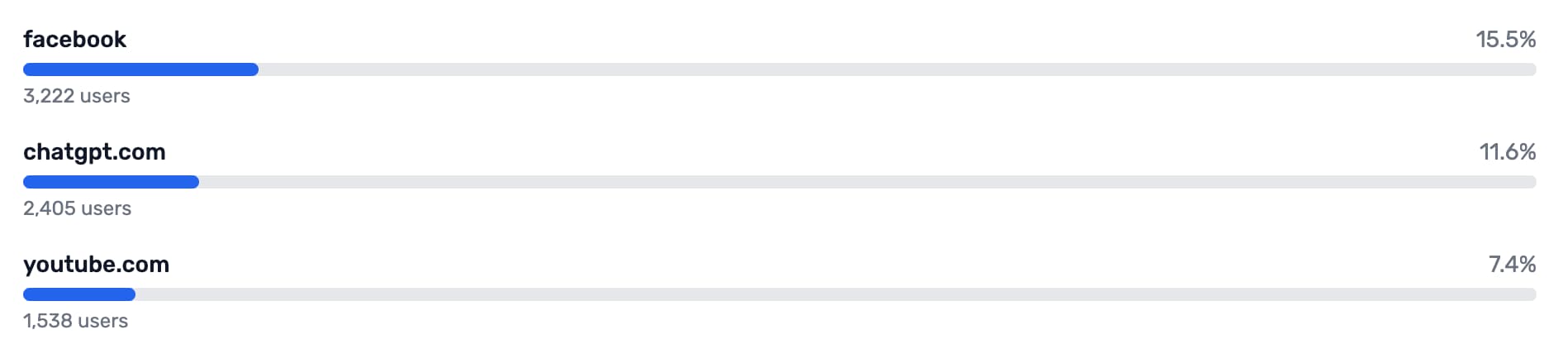
Data indicates that LLM-driven traffic is not just a rounding error; it is a significant and high-quality slice of the traffic pie. Current estimates suggest that LLM-driven interactions account for 10–13% of total inbound visits for digitally mature brands.
However, the value lies in intent quality. Unlike broad search queries, which may attract casual browsers, users interacting with LLMs have often moved further down the funnel. They are asking specific, comparative questions—e.g., "Compare X product to Y in terms of pricing and durability." When an AI recommends a product in response to such a high-intent query, the likelihood of conversion is significantly higher than that of a standard search result.
Furthermore, statistics show that the user base for these tools is growing exponentially. In recent benchmarks, ChatGPT’s daily active users have surpassed those of major legacy platforms, confirming that the shift in user behavior is not a fad but a permanent change in information consumption.
The Process: How to Measure LLM Visibility
Since there is no "LLM Search Console" provided by OpenAI or Anthropic, brands must adopt a manual or automated auditing process. The methodology generally follows these steps:
- Define the Keyword Universe: Identify the "high-intent" queries relevant to your niche.
- Select the Model Portfolio: Run tests across the Big Four models to account for different training data and reasoning styles.
- Standardize Prompt Sets: Create consistent prompts that simulate real-world user behavior.
- Sentiment and Context Analysis: Evaluate not just if you are mentioned, but how you are mentioned. Are you the top recommendation? Are you described as "too expensive" or "hard to use"?
The Importance of Prompt Engineering
Your visibility data is only as accurate as your prompts. To gain a true snapshot, you must test:
- Direct Intent: "What are the best CRM tools for startups?"
- Comparative Intent: "Is [Brand A] better than [Brand B] for enterprise?"
- Contextual/Niche Intent: "Which software helps with GDPR compliance in healthcare?"
Ignoring "obscure" queries is a common mistake. Often, brands appear in AI responses for related terms they didn’t even know they were associated with. Tracking these "hidden" mentions provides an early warning system for your brand’s digital reputation.
Implications for Future Marketing
The transition to AIO (AI Optimization) is inevitable. Once a brand begins tracking its LLM rankings, the focus must shift to influencing the output. Unlike traditional SEO, which relies on technical metadata and backlink velocity, LLM optimization relies on:
- Brand Authority in Training Data: Ensuring your brand is consistently mentioned in high-quality articles, white papers, and reviews that LLMs crawl.
- Entity Association: Crafting content that clearly defines your brand’s relationship to specific solutions and competitors.
- High-Quality First-Party Content: Feeding the AI verifiable, structured data about your products that it can reliably cite.
The Cost of Inaction
The costs associated with this monitoring are not trivial. They involve API access fees, computational costs for running thousands of queries, and the human capital required to analyze the sentiment and quality of those outputs.
Mathematically, the cost of auditing is a fraction of the potential revenue loss. If you perform 100 queries a week across 4 models, the computational cost is manageable, but the data—when applied correctly—can lead to massive optimizations in your market share.
Conclusion: The New Battleground
In the same way that brands once scrambled to understand Google’s PageRank, the current era demands a masterclass in AI influence. LLM rankings are the new battleground for brand visibility.
Brands that start tracking and optimizing today will own the conversation inside the AI tools that define tomorrow’s market. Those that continue to ignore this shift will inevitably wake up to find that they have vanished from their customers’ primary point of contact. The map has changed, and the tour guides have arrived; it is time to ensure your brand is part of the itinerary.
