
The Algorithmic Newsroom: Decoding Global Engagement Trends in a New Era of Digital Journalism
In the modern digital landscape, news publishers are no longer merely competing against one another for the reader’s attention. They are locked in an increasingly sophisticated arms race against the algorithmic gatekeepers of social video platforms. Success in the "News & Politics" genre is no longer defined solely by the gravity of the story, but by the strategic alignment of content with the nuanced behavioral patterns of a global audience.
New data from Tubular Intelligence, covering the period from November 2025 through February 2026, reveals that the path to virality and sustained engagement is highly localized and platform-specific. By analyzing video duration, posting cadence, hashtag utility, and content performance across APAC, LATAM, EMEA, and North America, a clearer picture emerges: the "one-size-fits-all" approach to digital news distribution is effectively dead.
The Strategic Shift: Moving Beyond Volume to Impact
The fundamental challenge for modern newsrooms is the "output trap." Many publishers operate under the assumption that frequency—the sheer volume of daily uploads—is the primary driver of success. However, the latest metrics suggest that publishers who prioritize cadence over context often sacrifice meaningful audience engagement.
As social video platforms like YouTube, Instagram, and TikTok refine their recommendation engines to prioritize user retention and interaction, the "News & Politics" category has become a masterclass in behavioral psychology. Whether it is the rapid-fire delivery of a 30-second headline update or the immersive, deep-dive documentary style of a 20-minute analysis, the format must match the platform’s intent.
Chronology of Trends: A Seasonal Snapshot (Nov ’25 – Feb ’26)
The data collection period—spanning the end of 2025 through the first two months of 2026—offered a unique look at how global audiences react to shifting geopolitical climates.

- November 2025: Initial spikes in engagement were tied heavily to year-end reviews and preparations for upcoming policy changes in major economies.
- December 2025: As holiday consumption patterns took hold, there was a noticeable shift toward "digestible" news—short-form content that could be consumed during brief periods of downtime.
- January 2026: A sharp pivot toward high-stakes political discourse was observed, with engagement metrics favoring deep-dive explainers as viewers sought clarity on complex global events.
- February 2026: The trend cycle matured into a hybrid model, where breaking news was increasingly accompanied by "reactionary" commentary, highlighting the rise of the viewer-as-participant.
Supporting Data: Regional Nuances and Behavioral Patterns
1. APAC: The Polarization of Video Duration
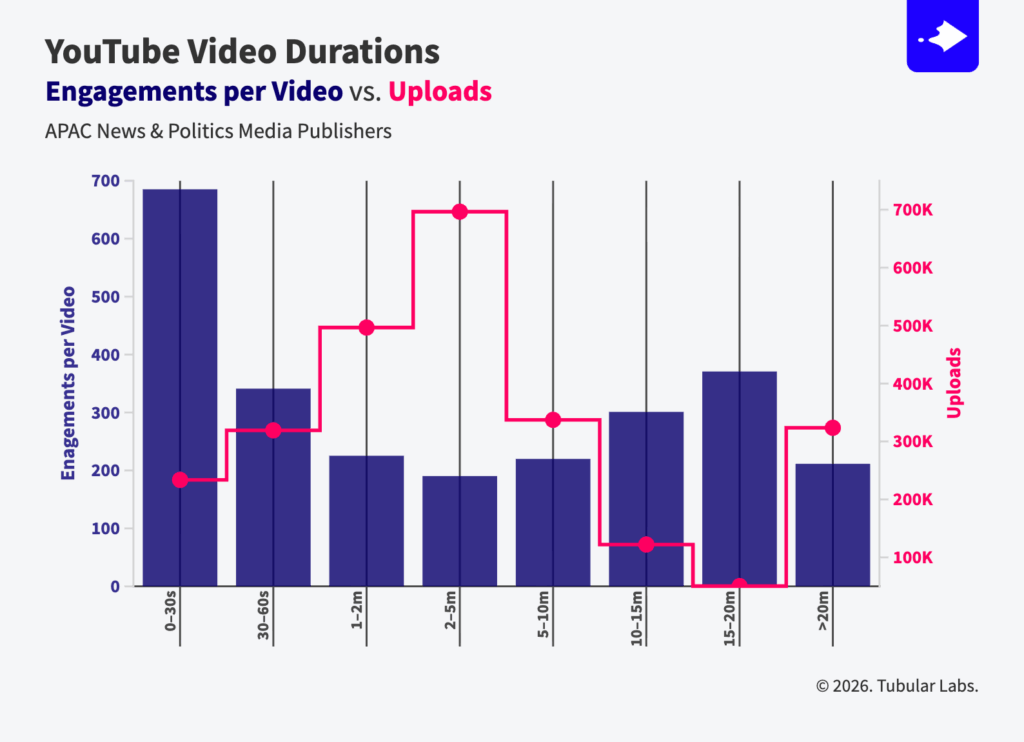
In the Asia-Pacific (APAC) region, data reveals a stark bifurcation in viewer preference. Publishers who focus on the "middle ground"—videos between two and five minutes—often find themselves in a performance desert. Conversely, the highest engagement per video is consistently found in two extremes:
- Ultra-short (0–30s): Ideal for immediate news alerts and breaking developments.
- Long-form (15–20 minutes): Essential for deep-dive investigative journalism and expert analysis.
The takeaway for APAC newsrooms is clear: mid-length content is currently suffering from a lack of identity. By leaning into the extremes, publishers can better serve the audience’s desire for either instant gratification or comprehensive knowledge.
2. LATAM: The Early-Morning Opportunity
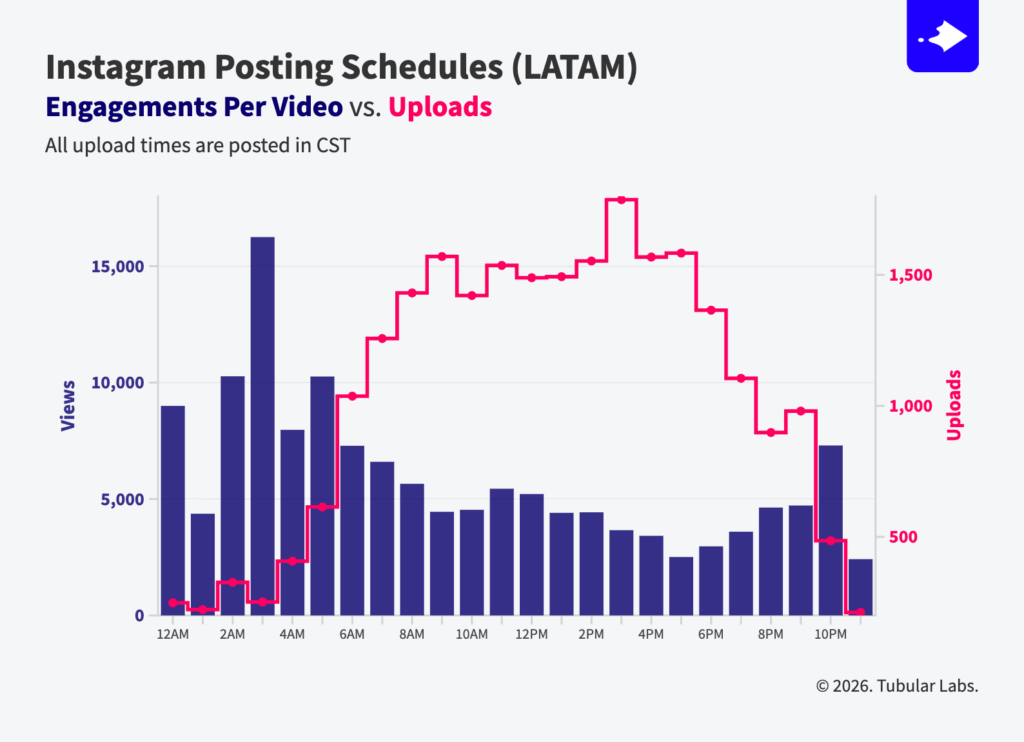
A fascinating discrepancy exists in Latin America (LATAM) regarding posting schedules on Instagram. Currently, the majority of publishers operate on a standard "business hour" cadence, flooding the feed between 3:00 PM and 3:59 PM.
However, engagement data tells a different story. The highest engagement per video occurs during the early morning window of 3:00 AM to 3:59 AM. This suggests a massive untapped opportunity. Publishers who pivot to an early-morning distribution strategy may capture a significant portion of the audience while operating in a low-competition environment, allowing their content to dominate the feed before the mid-afternoon rush.
3. EMEA: The Strategic Power of Hashtags
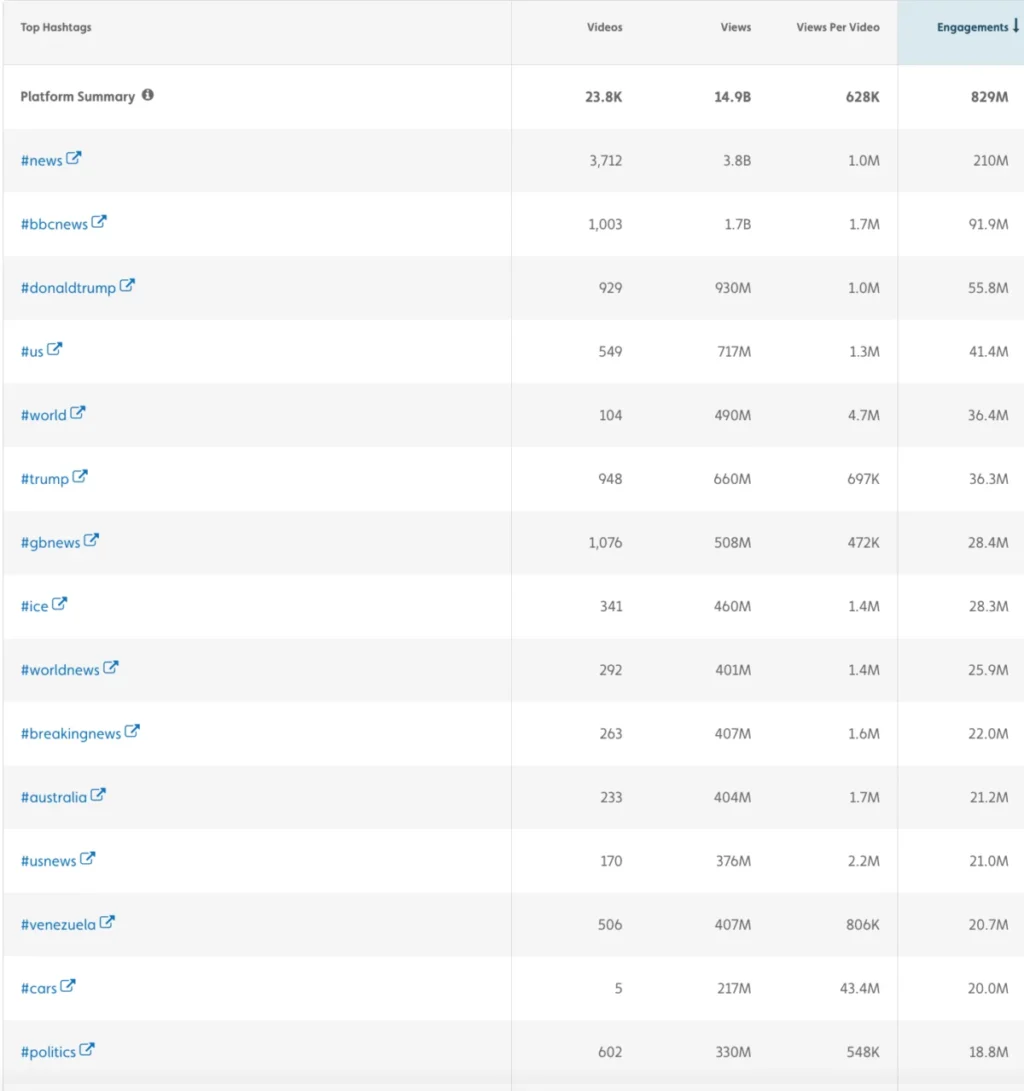
In Europe, the Middle East, and Africa (EMEA), the use of hashtags has evolved from a simple organizational tool into a sophisticated search-engine optimization (SEO) strategy. Publishers are now utilizing a tripartite approach:
- Geopolitical Flashpoints: Using tags like #trump, #ICE, or #venezuela to ride the wave of trending global interest.
- Brand Authority: Consistently utilizing branded tags such as #bbcnews to build brand equity and trustworthiness.
- Country Identifiers: Using localized tags to ensure regional relevance while maintaining global reach.
This multi-layered approach helps newsrooms bridge the gap between niche local coverage and global discoverability.
The "Human" Element: Why News Goes Viral
In the United States, the most successful content on TikTok highlights a growing divide between "hard news" and "cultural commentary." While breaking news stories—such as the tragic car crash involving Anthony Joshua—garner massive viewership (reaching 180 million views in 30 days), the highest engagement is often found in content that triggers an emotional or humorous response.
A notable example occurred during an ICE protest, where a viral clip of an interviewee was mocked by the internet community. Despite the serious nature of the subject matter, the post generated 63.5 million engagements in just seven days. This illustrates a critical reality: TikTok audiences are not merely passive consumers of information. They are looking for a spark—a cultural or emotional "hook"—that invites them to participate in the conversation.
Official Industry Perspectives: The Strategic Pivot
While individual newsrooms have not released official manifestos on these specific data points, the industry trend is moving toward "Data-Informed Journalism."
Leading media analysts suggest that the "Newsroom of the Future" will operate less like a traditional printing house and more like a high-frequency trading desk. The emphasis is shifting from "What is the biggest story?" to "What is the most effective way to package this story for this specific platform at this specific time?"
By utilizing intelligence platforms, news organizations are moving away from editorial intuition alone and toward a hybrid model where data science dictates the "how" and "when" of delivery, while journalists maintain control over the "what."
Implications for the Future of Journalism
The implications for publishers are profound. The ability to thrive in this environment requires three distinct shifts in organizational culture:
- Platform Agnosticism is a Liability: Publishers must stop treating social media as a secondary distribution channel. Platforms like TikTok, Instagram, and YouTube have unique "dialects," and publishers who fail to adapt their content to these dialects will find their reach stifled by algorithms that prioritize native-style content.
- The Death of "One-Size-Fits-All": Content must be repurposed and optimized at every stage. A 20-minute investigative report on YouTube should be stripped down into a series of 30-second clips for TikTok, with a distinct emphasis on humor or emotional resonance, and then teased via Instagram with a strategic hashtag strategy to maximize searchability.
- Timing is a Competitive Advantage: As evidenced by the LATAM data, posting time is not merely a logistical choice; it is a strategic maneuver. By identifying "low-competition, high-engagement" windows, newsrooms can gain an outsized share of voice without needing to increase their overall production budget.
Conclusion
The data from late 2025 and early 2026 serves as a wake-up call for the news industry. We are witnessing the maturation of the digital newsroom, where the barrier to entry is no longer just the quality of the journalism, but the efficiency of the delivery.
The successful publisher of the future is the one who understands that they are not just reporting the news—they are navigating a complex, algorithmically driven ecosystem. By aligning their content strategy with the real-world behavioral patterns of their audience, news organizations can do more than just survive; they can thrive, turning fleeting impressions into lasting, engaged communities.
For those ready to move beyond intuition and embrace a data-first approach, the opportunity to redefine news consumption has never been greater. The question is no longer whether you have the story, but whether you have the strategy to ensure it is heard.
