
Beyond the Click: Redefining SEO Measurement in the Age of AI Search and Zero-Click Queries
The traditional rules of digital marketing analytics are undergoing a radical rewriting. For decades, the path from search query to website visit was linear and easily trackable: a user entered keywords into a search engine, clicked a blue link, landed on a brand’s website, and either converted or bounced. Analytics tools captured every step of this journey with predictable precision.
Today, that paradigm is fracturing. With the explosive rise of generative AI search engines, conversational answer engines, and zero-click search features, artificial intelligence frequently answers user queries directly on the search engine results page (SERP). An AI assistant might recommend a specific product, detail its specifications, and guide a consumer toward a purchase decision without ever generating a traditional outbound link to the brand’s website.
When that consumer later searches for the brand directly, visits a brick-and-mortar storefront, or completes a purchase offline, standard web analytics are left in the dark. Traditional metrics cannot connect the conversion back to the initial AI recommendation that sparked it.
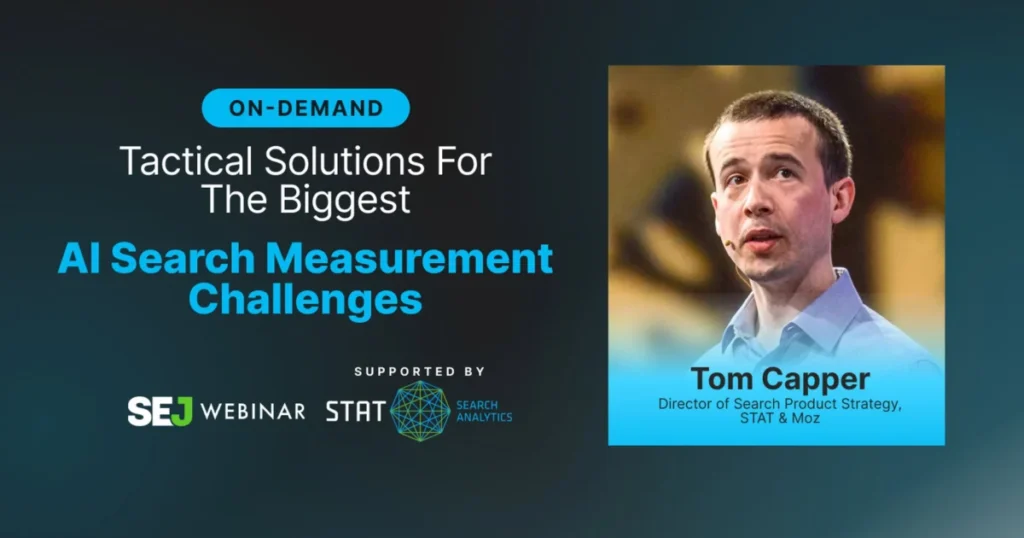
To address this pressing industry crisis, Tom Capper, Director of Search Product Strategy at STAT, recently took center stage in an in-depth webinar titled Tactical Solutions For The Biggest AI Search Measurement Challenges. Capper dissected the modern "measurement problem," arguing that zero-click searches represent a fundamental attribution challenge rather than a simple traffic crisis. His solution? Marketers must pivot away from outdated metrics, stop relying solely on click-through rates, and instead measure holistic brand visibility alongside tangible business outcomes.
Main Facts: The Core Challenge of AI Search Measurement
The evolution of search engine technology from a directory of links to an interpretive, conversational oracle has broken standard Key Performance Indicators (KPIs). The core issues defining this modern SEO challenge include:
- The Disconnect Between Visibility and Clicks: AI-generated answers frequently recommend products and services without providing a direct hyperlink to the brand’s domain. Traditional web analytics register zero traffic from these interactions, yet significant brand influence has occurred.
- Citation vs. Mention: A vital distinction exists between a domain being cited (having its URL explicitly listed in the AI’s output) and a brand being mentioned (being recommended within the text of the AI’s response). Relying exclusively on citation tracking misses the vast majority of brand recommendations.
- Prompt Variability: Unlike traditional keyword rankings—which remain relatively stable across broad geographies—AI-generated responses can vary drastically based on prompt phrasing, user intent, location, and device context.
- The Attribution Gap: Multi-touch attribution models fail when the initial touchpoint occurs inside an enclosed AI chat interface or zero-click overview, forcing digital marketers to rethink how they measure marketing ROI and consumer journeys.
Chronology of a Paradigm Shift: From Keywords to Conversational AI
Understanding how the search industry arrived at this crossroads requires looking at the rapid transformation of search engine results pages over the past several years.
Phase 1: The Era of Pure Keyword Tracking (Early 2010s)
For years, SEO professionals operated in a straightforward environment. Success was defined by ranking positions on a standard list of ten blue links. Keyword trackers ingested terms, measured rankings day-over-day, and reported organic traffic growth. Click volume was treated as a direct proxy for brand interest and SEO success.
Phase 2: The Rise of Zero-Click Real Estate (Late 2010s to Early 2020s)
Search engines began introducing Featured Snippets, Knowledge Panels, and "People Also Ask" boxes. These features allowed users to find answers directly on the SERP without clicking through to external websites. Organic click-through rates began to erode, forcing early-stage adaptation among advanced SEO teams who realized that ranking #1 no longer guaranteed the traffic volume it once did.
Phase 3: The Generative AI Explosion (2023–Present)
The launch of conversational AI search tools fundamentally upended traditional search behavior. Rather than presenting a list of links for the user to sift through, generative engines synthesize information from multiple sources, summarize it, and deliver a definitive, synthesized answer.
In this current landscape, tracking legacy metrics has become actively misleading. Recognizing this, industry thought leaders like Tom Capper began outlining actionable frameworks to help digital marketers measure their true impact in an ecosystem where clicks are no longer the primary currency of search.
Supporting Data and Strategic Frameworks
To navigate the complexities of AI-driven search, Capper and other industry experts recommend replacing obsolete KPIs with a more sophisticated, multi-layered measurement framework.
1. Separating Brand Mentions from Source Citations
One of the most profound insights from Capper’s presentation is the necessity of decoupling brand visibility from URL citations. To illustrate this, Capper offered a hypothetical scenario involving an AI-generated car recommendation.
In the scenario, an AI engine recommends Audi to a prospective buyer based on safety and performance criteria. However, the footnotes or citation links appended to the response point to third-party automotive review sites—not Audi’s official domain.
If a marketing team evaluates their AI performance solely by tracking inbound citation URLs pointing to audi.com, their reporting will register a complete failure. In reality, the brand won the most critical battle: it was actively recommended to a high-intent buyer by the AI.
"So yeah, citations have URLs. That’s still valuable tactical data, but I don’t think it should be your KPI. Mentions have entities." — Tom Capper
The strategic takeaway is clear: digital marketers must define and track the specific brand entities and relevant sub-brands they care about, rather than assuming their domain’s backlink profile captures every valuable AI appearance. The same rigorous tracking must be applied to key competitors to maintain a reliable benchmark.
2. Building a Representative Prompt Sample
Because AI answers are inherently dynamic, tracking a static list of keywords in an automated tool is no longer sufficient. Capper compared this variability to the location- and device-specific results that sophisticated SEO teams have long learned to monitor.
Relying on a tiny, rigid set of prompts yields unstable, unreliable data. Instead, SEOs must build a representative prompt sample that mirrors real-world consumer behavior.
- Move Beyond Keyword Lists: Do not simply plug raw keyword lists into an AI prompt tracker.
- Incorporate Real Intent: Start with "People Also Ask" data, consumer personas, geographic variations, budget constraints, and specific user pain points.
- Prioritize Realistic Collection Environments: Capper noted that STAT utilizes the actual web interfaces of AI search engines for data collection, warning that API responses can sometimes differ significantly from what an authentic end-user sees in their browser.
3. Using Citations as Diagnostic Tools, Not KPIs
While Capper cautioned against treating URL citations as the primary metric of success, he emphasized that they remain invaluable diagnostic tools. When a competitor’s product is recommended alongside a specific citation, that cited URL serves as a clue.
By investigating the third-party review sites, industry publications, or aggregator pages that consistently earn citations in AI responses, marketing teams can identify external sources shaping the AI’s "opinion." Brands can then focus PR, content, and digital outreach efforts on improving their presence on those influential third-party properties, subsequently monitoring whether those efforts correlate with an increase in direct brand recommendations.
Official Responses and Industry Perspectives
The challenges outlined by Capper reflect a broader anxiety sweeping the digital marketing industry. As organic click-through rates face continuous pressure from generative search features, agencies and enterprise brands are forced to re-evaluate their reporting structures to executive leadership.
Industry veterans note that proving SEO ROI to C-suite executives—who are accustomed to clear, linear attribution reports—has become significantly more complex. When organic traffic dips while brand revenue holds steady or grows, marketing teams require new narratives to explain the disconnect.
Furthermore, platforms across the digital ecosystem are racing to adapt. Enterprise SEO platforms—such as seoClarity, which recently hosted sessions on AI shopping optimization with leaders like Chris Sachs and Aris Vrakas—are rapidly developing specialized tracking modules designed to capture AI engine visibility, product recommendations, and agent-driven commerce paths. These platform developments underscore a universal industry consensus: legacy rank-tracking software is no longer equipped for modern search realities.
Implications: Building a Modern Measurement Plan
Adopting a future-proof measurement strategy requires structural changes to how marketing teams collect data, analyze performance, and report to stakeholders. Organizations looking to thrive in the era of AI search should implement the following strategic shifts:
1. Broaden Leading Indicators
Traditional ranking reports must be supplemented with modern leading indicators of visibility. Rather than fixating exclusively on position #1 through #10, marketers should track:
- Share of Voice in AI Recommendations: How often is your brand entity mentioned across a robust, representative sample of conversational prompts compared to top competitors?
- Above-the-Fold Visibility: In traditional and hybrid SERPs, assess whether your assets occupy prime visual real estate, even if organic rank numbers appear stable.
- Qualitative Sentiment Themes: Rather than relying on volatile automated sentiment scores—which often overemphasize minor nuances in neutral text—focus on the recurring qualitative themes associated with your brand in AI-generated summaries.
2. Deploy Post-Purchase Surveys
To bridge the attribution gap left by multi-touch analytics models, organizations must implement qualitative feedback mechanisms directly into their customer onboarding or checkout flows.
Asking customers a simple, open-ended or multiple-choice question—such as "Where did you first discover or research our brand?"—frequently uncovers touchpoints that traditional analytics fail to capture. When customers explicitly cite an AI assistant or conversational search engine, marketing teams can pass these survey answers into their analytics platforms as custom dimensions. This allows leadership to cross-reference self-reported discovery channels with automated attribution models, painting a much fuller picture of true marketing influence.
3. Educate Stakeholders on the New Paradigm
Ultimately, the most critical shift is cultural rather than technical. Digital marketing leaders must actively re-educate executive boards, clients, and internal stakeholders. Moving away from the addiction to immediate, click-based attribution is difficult, but necessary.
By framing SEO success around comprehensive brand visibility, entity ownership, and holistic business outcomes, organizations can stop fighting the shifting tides of search technology and instead position themselves to win where modern consumers are actually making their decisions: inside the conversational, zero-click world of artificial intelligence.
