

Beyond the Like: The Definitive Guide to Measuring Employee Advocacy Success
In the modern digital landscape, the most powerful marketing channel a company possesses is not a paid advertisement or a viral campaign—it is its own workforce. Employee advocacy—the promotion of an organization by its staff through their personal social media channels—has evolved from a "nice-to-have" social experiment into a critical business driver. However, as budgets tighten and marketing departments face increasing pressure to justify every dollar spent, advocacy programs are being held to the same rigorous standards as paid media.
Measuring the success of these programs is no longer about vanity metrics like “likes” or “shares.” It is about proving that employee voices drive real-world outcomes: qualified leads, reduced recruitment costs, and stronger talent retention.

The Strategic Imperative: Why Measurement Matters
To secure long-term buy-in from the C-suite, advocacy programs must transcend the “fluff.” Without concrete data, these initiatives risk being viewed as secondary projects that lack strategic depth.
The primary risk of an unmeasured program is stagnation. Without performance tracking, leadership cannot identify which content resonates, which departments are driving the most value, or where the program needs to evolve. Furthermore, measurement serves as a powerful motivator; when employees see the tangible impact of their efforts—such as helping a former colleague land a dream job or contributing to a high-value pipeline—their participation and engagement levels increase.

According to recent 2026 industry benchmarks, ROI has become the defining factor for the longevity of ambassador programs. In short, if you cannot measure it, you cannot scale it.
Establishing a Four-Step Measurement Framework
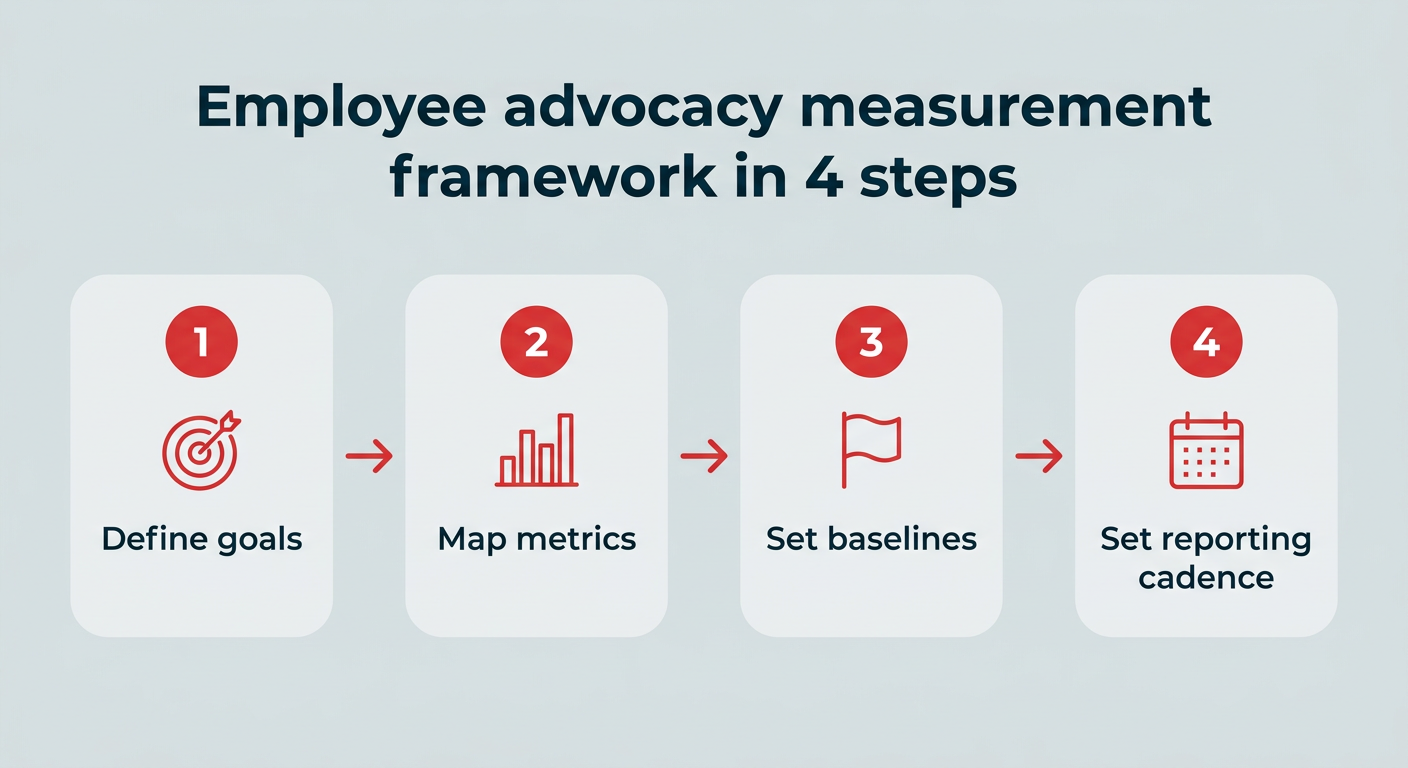
Before a single post is shared, organizations must implement a robust framework to avoid drowning in irrelevant data. This framework ensures that every metric tracked ties directly back to a business goal.
- Define Core Objectives: Start by identifying what the program is meant to achieve. Is the goal to increase brand awareness, fill a specific recruitment gap, or support social selling for sales teams?
- Map KPIs to Goals: For every objective, assign specific metrics. If the goal is recruiting, track applicant quality and time-to-hire. If it is sales, focus on click-through rates (CTR) and pipeline influence.
- Establish Historical Baselines: You cannot measure progress without a starting point. Compare your current metrics against your company’s historical organic social performance.
- Define Reporting Cadence: Consistency is key. Establish a monthly cadence for operational reporting (participation and activity) and a quarterly cadence for strategic impact reporting (ROI and business outcomes).
Decoding the Metrics: A Seven-Pillar Approach
To gain a holistic view of program health, organizations should categorize their tracking into seven key pillars:
1. Awareness and Reach
Reach and impressions tell you how far your brand message travels through personal networks. However, the most persuasive way to present this to leadership is through Earned Media Value (EMV). By calculating the cost of reaching that same audience through paid advertisements, you can present a clear "cost savings" figure to your stakeholders.
2. Engagement
Engagement goes beyond surface-level metrics. Look at sentiment, comments, and shares to see if employee-shared content sparks more authentic conversation than branded posts. LinkedIn data consistently shows that engagement on employee-shared content is often 10x higher than that of corporate accounts, confirming the human-to-human advantage.
3. Recruiting Pipeline
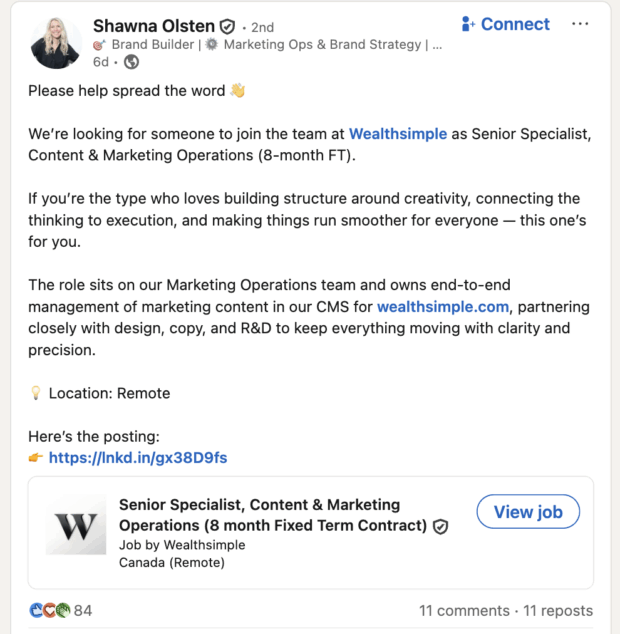
Advocacy is a superpower for HR. Track applicant volume, the quality of candidates, and the reduction in time-to-hire. When current employees share job openings, they act as trust signals, making the candidate experience more credible and the hiring process more efficient.
4. Sales and Lead Generation
This is where the program proves its financial worth. By using UTM tracking links on every piece of content distributed through your advocacy platform, you can trace specific leads, website traffic, and eventual conversions back to employee shares.
5. Employee Participation
Your program is only as strong as its advocates. Track adoption rates (how many employees signed up) and activity rates (how many are consistently sharing). High adoption with low activity suggests an engagement problem, while low adoption suggests a need for better internal promotion.
6. Cultural Impact
Advocacy is a reflection of internal culture. Does the program make employees feel like thought leaders? Use internal surveys to measure pride and sentiment. When employees feel empowered to build their personal brands, they are less likely to seek opportunities elsewhere, directly impacting retention.
7. Retention
Finally, track turnover rates among active advocates compared to the broader workforce. There is a clear correlation between employees who feel deeply connected to the company’s brand and their longevity within the organization.
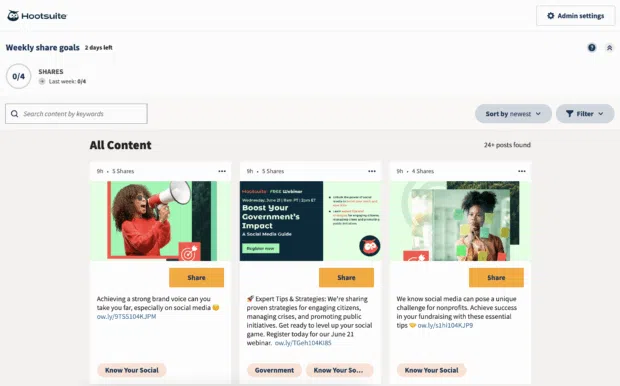
Industry Benchmarks: Newer vs. Mature Programs
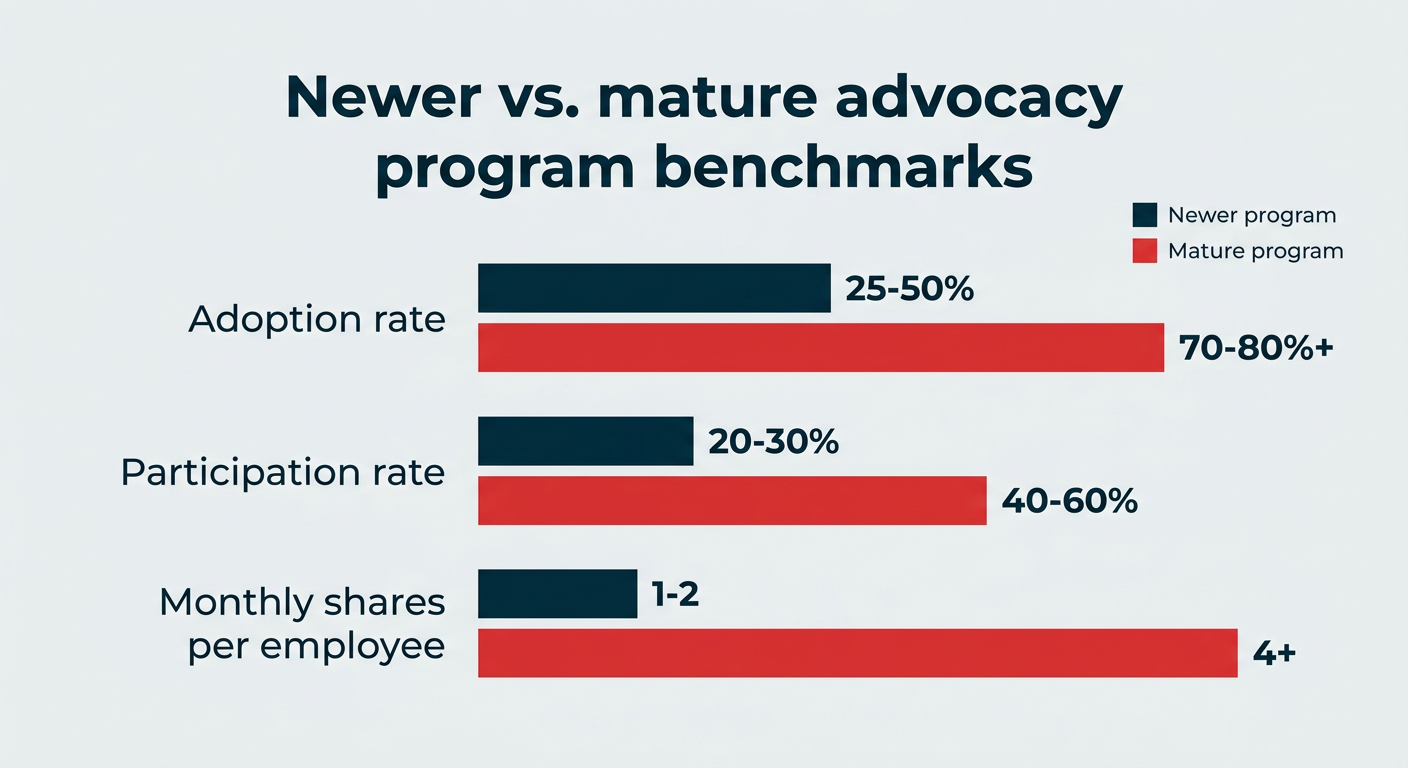
What constitutes "success"? Benchmarks vary based on the maturity of your program.
- Adoption Rates: A newer program might aim for 25–50% adoption, while a mature program should strive for 70–80% or higher.
- Participation: Aim for 20–30% of your signed-up base to be actively sharing on a monthly basis, scaling toward 40–60% as the program grows.
- Frequency: A healthy mature program typically sees an average of four or more shares per active employee, per month.
Calculating the ROI of Advocacy
The ROI formula is straightforward, but the inputs require rigor:
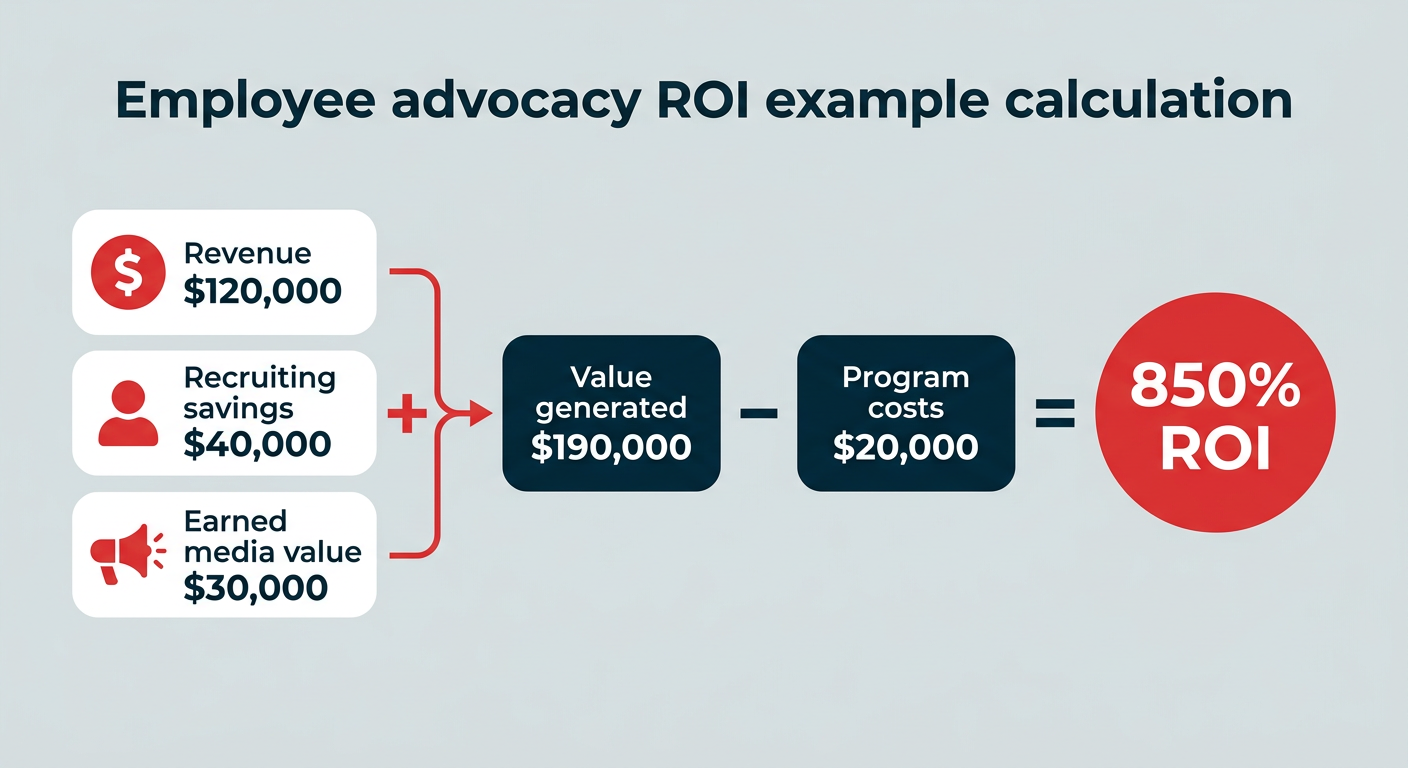
ROI (%) = [(Value Generated – Program Costs) ÷ Program Costs] × 100
To find the "Value Generated," aggregate the dollar value of:
- Attributed Revenue: Leads and closed deals traced via UTMs.
- Recruiting Savings: The cost saved by reducing agency fees or paid job board spend.
- Earned Media Value: The equivalent cost of paid impressions.
- Retention Savings: The reduction in costs associated with replacing talent.
For example, a program generating $190,000 in combined value on a $20,000 investment delivers an impressive 850% ROI.
Strategic Best Practices for Success
To ensure your measurement efforts yield actionable results, consider these industry-standard best practices:
- Build a Culture of Voluntary Advocacy: Never mandate sharing. Employees should feel that sharing is a career asset, not a chore.
- Use UTMs on Everything: If you aren’t using tracking tags, you aren’t measuring ROI.
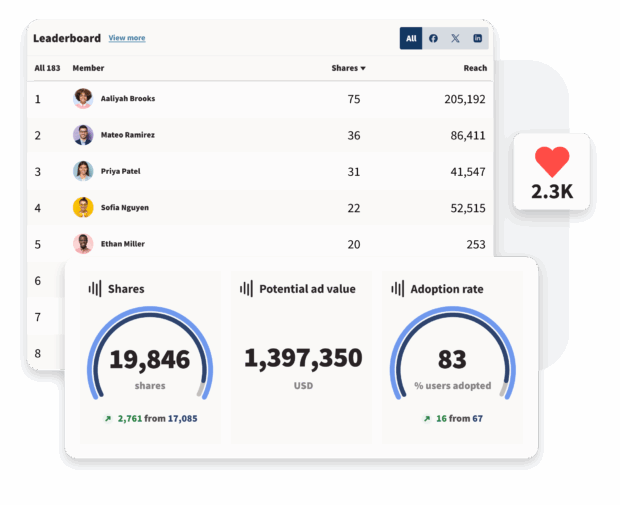
- Gamify Participation: Use leaderboards and rewards—such as gift cards or professional development opportunities—to incentivize consistent sharing.
- Report Outcomes, Not Just Data: When presenting to the C-suite, lead with the business impact. Keep the granular platform metrics in an appendix for those who want to drill down.
- Prioritize Tech Reliability: Ensure your advocacy platform integrates seamlessly with your existing social media management stack. Technical friction is the primary killer of program momentum.
The Future of Advocacy
As we move through 2026, the reliance on algorithmic social reach continues to fluctuate, making human-to-human connection more valuable than ever. Brands that successfully transition from "broadcasting" to "advocating" through their employees are better positioned to weather shifts in market trust.

Ultimately, the success of your employee advocacy program is defined by the narrative it creates. By measuring the right KPIs, you aren’t just tracking posts—you are documenting the growth of your company’s most influential and authentic asset: its people. When you provide the right tools, clear benchmarks, and a culture of recognition, advocacy ceases to be a marketing initiative and becomes an organic, unstoppable engine for business growth.
