
Beyond the Vanity Metric: How Audience Intelligence Is Rewriting the Playbook for Influencer Marketing
NEW YORK — For the better part of the last decade, the currency of the creator economy was simple, loud, and deceptively straightforward: views, likes, and follower counts. Brands chased macro-influencers with millions of subscribers, assuming that raw exposure automatically translated into consumer trust, market share, and bottom-line revenue.
Today, that paradigm is fracturing. According to a comprehensive new industry analysis, the organizations winning the digital marketing race are no longer the ones with the deepest pockets or the highest aggregate view counts. Instead, they are the brands asking more sophisticated questions about who is actually consuming content, how intent is formed, and which creators truly drive business outcomes.
This fundamental shift in philosophy is the centerpiece of a landmark research initiative titled Redefining Influencer Value: How Audience Intelligence Transforms Reach into Revenue. Spanning high-stakes verticals including healthcare, gaming, and consumer packaged goods (CPG), the report’s data delivers a sobering message for modern marketers: the creators generating the most views are frequently not the ones generating the most commercial value.
Main Facts: The Evolution From Reach to Revenue
The transition from vanity metrics to behavior-driven analytics marks a mature phase in the influencer marketing industry. For years, media buyers relied on top-line numbers as a proxy for success, often resulting in bloated budgets, misallocated resources, and campaigns that generated high visibility with zero conversion.
The new report demonstrates that modern audience intelligence—which maps search affinities, cross-platform shopping behavior, and underlying cultural alignments—presents a vastly different calculus. By analyzing how communities migrate across digital ecosystems, brands can pinpoint micro-moments where consumer curiosity converts into active purchase intent.
Rather than treating influencers as digital billboard spaces, forward-thinking brands are utilizing data-driven mapping to uncover hidden synergies. They are identifying creators who operate as trusted authorities within specific niches, allowing companies to bridge gaps between mainstream awareness and deeply targeted, high-intent consumer segments.
Chronology: How the Creator Economy Pivot Unfolded
To understand how the industry arrived at this data-driven crossroads, it is helpful to trace the evolution of digital influence over recent years:
- The Era of Mass Aggregation (2015–2019): Driven by the rapid growth of Instagram and YouTube, brands prioritized sheer scale. Influencer marketing operated much like traditional television advertising, where the primary objective was maximizing eyeballs at the lowest possible cost per impression.
- The Micro-Influencer Awakening (2020–2022): As audiences fragmented, marketers realized that smaller creators often enjoyed higher engagement rates. Brands began shifting budgets toward niche content creators, though selection criteria remained largely focused on basic engagement metrics rather than deep audience psychographics.
- The Integration of Advanced Analytics (2023–2024): With the proliferation of short-form video on TikTok and Instagram Reels, tracking consumer behavior became more complex. Brands faced mounting pressure to prove return on investment (ROI), prompting early adopters to experiment with search affinity tracking and audience overlap analysis.
- The Era of Intelligent Mapping (2025–Present): Today, advanced data tools allow marketers to look beneath the surface of follower counts. Campaigns are increasingly engineered based on behavioral alignment, cross-creator audience migration, and intent metrics, rendering legacy vanity metrics obsolete.
Supporting Data: Deep Dive Into Vertical Insights
To illustrate how audience intelligence functions in practice, the report breaks down specific market dynamics across healthcare, gaming, and consumer packaged goods.
Healthcare Conversations on Instagram: Clinical Meets Alternative
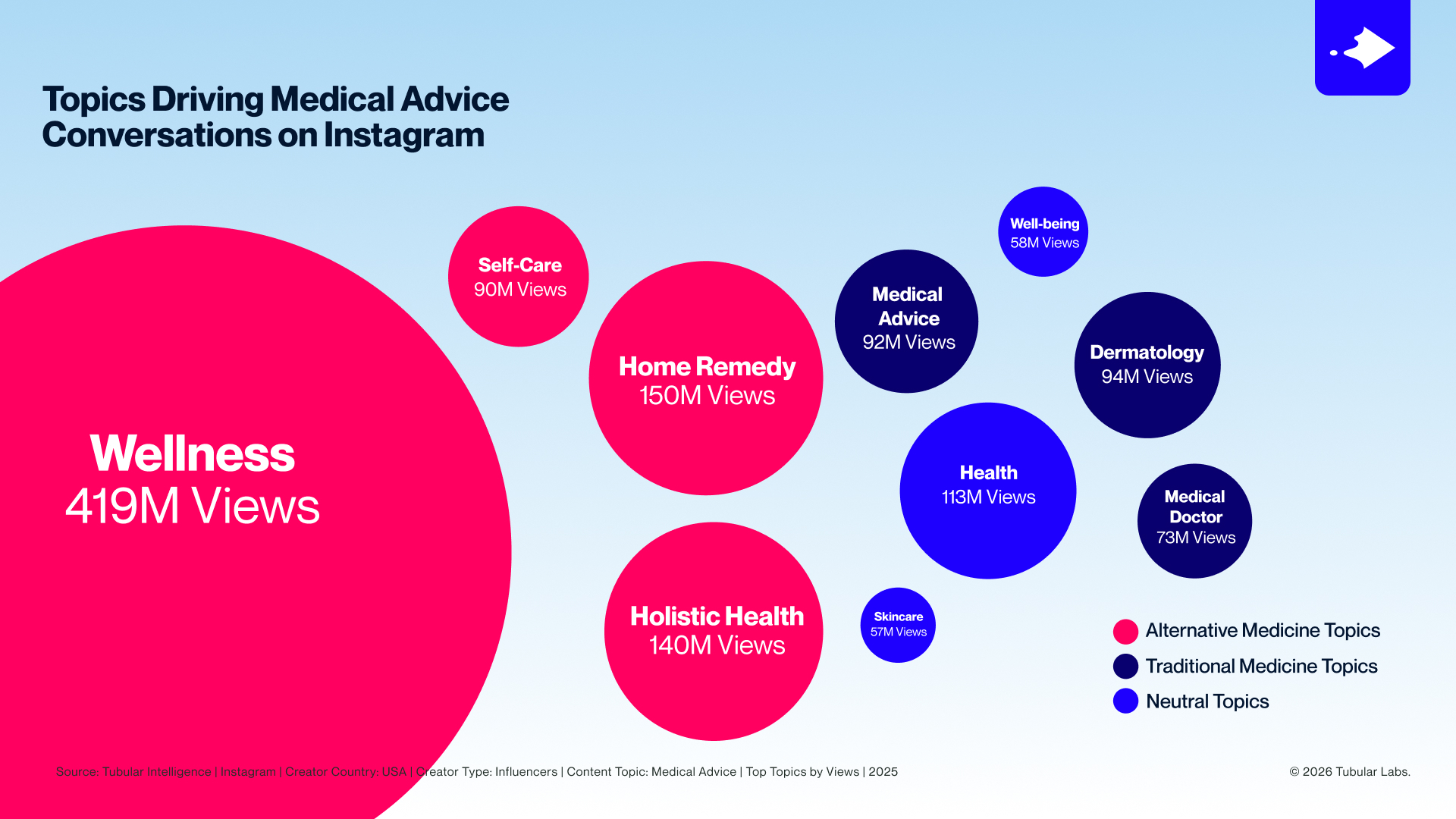
Nowhere is the necessity of nuance more apparent than in the healthcare sector. To map the drivers of medical and wellness conversations on Instagram, researchers analyzed leading topics by views among U.S. influencer content.
The data reveals a fascinating duality: clinical, evidence-based content and alternative wellness narratives are no longer competing forces. Instead, they appear side by side in consumer feeds. Modern consumers do not choose between traditional medicine and holistic wellness; they consume both simultaneously, navigating a complex web of information before making health, pharmaceutical, or skincare decisions.
For pharmaceutical companies, supplement manufacturers, and skincare brands, this trend opens a vital strategic window. Brands that restrict their influencer partnerships strictly to clinical figures risk missing out on massive consumer segments driven by alternative or curiosity-led wellness trends. Meeting audiences where their curiosity is highest—and where intent is actively forming—requires a multi-layered approach to creator selection.
Case Study: Deconstructing Dermatology Partnerships
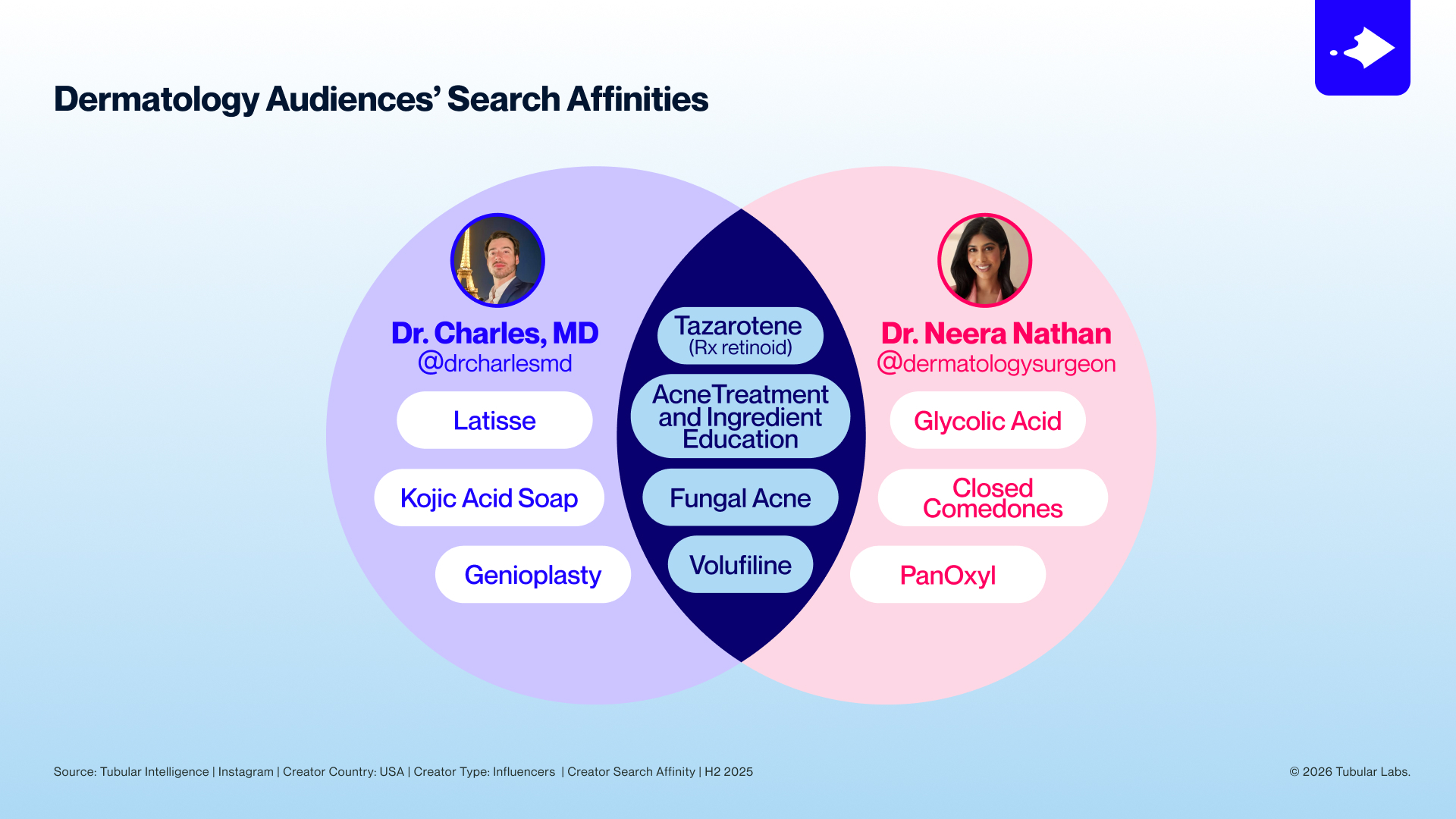
To demonstrate how audience intelligence transcends raw follower counts, the report examines two prominent Instagram dermatology creators: Dr. Charles, MD and Dr. Neera Nathan.
Imagine a brand marketing a specialized aesthetic product, such as Latisse. A traditional, surface-level media buy might immediately direct the entire budget toward Dr. Neera Nathan, whose audience of 1.8 million followers is broad, medically authoritative, and heavily focused on specific skin conditions and treatments.
However, layering in audience intelligence uncovers a much more strategic opportunity through audience overlap and search affinities:
- Dr. Neera Nathan excels at translating complex dermatological topics into accessible, highly shareable educational content for a broad audience.
- Dr. Charles, MD focuses heavily on breaking down ingredient science through a rigorous clinical lens while actively challenging overhyped industry trends.
Crucially, the audience data reveals a powerful asymmetry: 17% of Dr. Charles, MD’s audience also watches Dr. Neera Nathan, but only 2% of her audience watches him.
For a marketer, this creates an asymmetric advantage. Partnering with Dr. Charles does not just capture a highly engaged, niche scientific community; it provides a direct bridge into Dr. Neera’s broader mainstream reach. This strategic layering delivers clinical credibility before mainstream understanding takes hold, proving that audience overlap data uncovers leverage points invisible to those tracking follower numbers alone.
Global Scale: Gaming and Consumer Packaged Goods
The principles of audience intelligence extend far beyond medicine and skincare. In the gaming and CPG sectors, the data reinforces the same underlying theme: raw volume is a poor predictor of business impact.
- Anime and Gaming in Asia: On YouTube, anime influencers across East and Southeast Asia generated an astonishing 18 billion views. Yet, a granular look at the data shows that the creators actively shaping fan behavior and purchase intent represent a tiny, highly specialized fraction of that vast ecosystem. Filtering for true intent allows brands to cut through the noise.
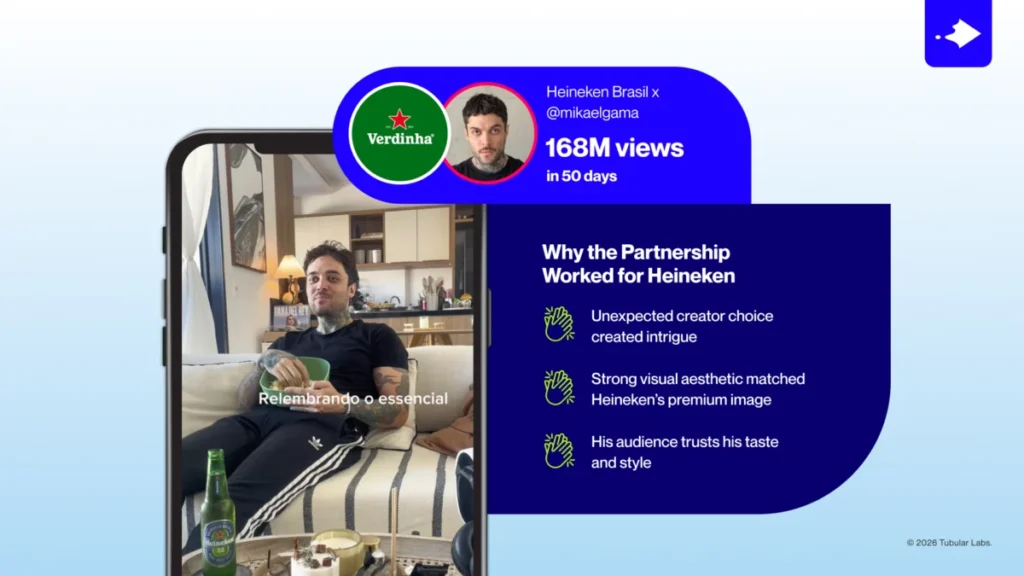
- Cultural Fit in Brazil: Brazil ranked as the second-largest market globally for TikTok influencer views and engagement rates. Demonstrating the supremacy of cultural alignment over strict category alignment, Heineken partnered with a men’s fashion creator who possessed a modest 136,000 followers. Despite the smaller follower base, the collaboration generated 168 million views and 1 million engagements over 50 days, proving that deep cultural resonance outweighs broad category relevance.
Official Responses and Industry Perspectives
Marketing analysts and data scientists emphasize that the days of guessing game strategies are over.
"Reach was never a strategy; it was always just a starting point," notes a lead research strategist behind the report. "When marketers rely exclusively on follower counts, they are essentially buying blindfolded. Audience intelligence gives brands the x-ray vision needed to see how audiences actually behave, what they search for, and who they truly trust."
Industry executives point out that corporate boards and chief marketing officers are demanding tighter accountability. In an economic climate where every marketing dollar must justify its existence, the ability to trace a direct line from an influencer partnership to consumer behavior and purchase intent is no longer a luxury—it is a baseline requirement.
Implications for the Future of Brand Strategy
As the influencer marketing landscape continues to mature, the implications for brands and agencies are profound. The widening gap between visibility and value means that organizations must overhaul how they evaluate, select, and compensate creators.
To capitalize on these shifts, leading marketing teams are adopting a streamlined, four-part framework:
- Look Beyond the Follower Count: Treat raw reach as an initial filter rather than the primary Key Performance Indicator (KPI).
- Map Search Affinities and Overlaps: Use advanced audience intelligence tools to understand where consumer attention flows between different creators within the same ecosystem.
- Prioritize Cultural and Intent Alignment: Match brand partnerships not just with category adjacencies, but with creators who hold genuine cultural authority and drive active consumer intent.
- Layer Strategic Partnerships: Combine niche, highly technical authorities with broader, mainstream educators to build a comprehensive funnel from credibility to mass awareness.
Ultimately, brands that continue to buy influence based solely on vanity metrics risk wasting capital on audiences that watch without converting. By embracing audience intelligence, marketers can stop guessing, invest with absolute confidence, and transform fleeting digital reach into enduring, measurable revenue.
