
The 2026 Dropshipping Showdown: An In-Depth Architectural and Operational Analysis of Doba and Spocket
Main Facts
The global dropshipping industry remains a powerhouse in 2026, boasting an estimated market valuation of approximately $543.53 billion. However, this persistent economic viability brings a harsher reality: intense, hyper-saturated market competition. For e-commerce entrepreneurs navigating this landscape—particularly those deploying storefronts on platforms like Shopify—operational survival depends on infrastructural infrastructure and supply chain velocity.
At the center of this battleground are two of the industry’s most prominent suppliers and operations engines: Doba and Spocket.
- Spocket maintains its reputation for selectivity, curation, and localization, targeting merchants who value a frictionless onboarding process and high-quality European and North American suppliers.
- Doba functions as an all-encompassing central operations hub. It features an expansive catalog exceeding one million SKUs, aggressive multi-channel integration options, and an advanced AI operations assistant known as Doba Pilot.
While Spocket leans heavily into user-friendliness and aesthetic brand presentation (such as branded invoicing), Doba positions itself as a scalable engine for multi-channel merchants expanding across diverse sales funnels, including Amazon, TikTok Shop, Walmart, and eBay.
Chronology and Market Evolution
To understand where Doba and Spocket stand in 2026, it is vital to trace their operational trajectories over the past several years:
- The Traditional Era: Historically, platforms like Doba functioned primarily as static supplier directories—massive indexes of wholesale inventories where merchants manually sourced items, imported data via cumbersome CSV files, and handled order routing with minimal automation. Spocket emerged to disrupt this legacy model by focusing on immediate, software-driven curation, seamlessly pairing dropshippers with pre-vetted local manufacturers in the US and EU.
- The Multi-Channel Shift (2023–2025): As social commerce exploded and marketplaces like TikTok Shop and Walmart opened their doors to third-party dropshippers, both platforms were forced to evolve. Spocket streamlined multi-store access (though requiring distinct subscriptions per storefront), while Doba heavily invested in automated inventory synchronization, bulk data feeds, and API connectivity.
- The AI Revolution (2026): The defining milestone for the current generation of dropshipping software is the integration of advanced artificial intelligence agents. Doba’s recent overhaul of its Doba Pilot AI agent has fundamentally altered the platform’s utility. What began as a conversational search tool has matured into an autonomous operations agent capable of conducting market research, executing smart product sourcing, managing multi-channel listings, and proactively handling post-purchase fulfillment exceptions. Spocket, conversely, has taken a more conservative path, prioritizing intelligent metadata filtering over conversational AI automation.
Supporting Data: Comprehensive Feature Comparison
| Comparison Point | Doba | Spocket |
|---|---|---|
| Best Fit For | Growing multi-channel operations, scaling brands, and US-focused marketplace sellers | Beginners, single-store owners, and merchants prioritizing curated, local suppliers |
| Monthly Starting Price | $29.99 (Limited Plan) | $39.99 (Starter Plan) |
| Catalog Size | Over 1 million SKUs, with heavy domestic US warehouse representation | Close to 1 million curated products |
| Store Connections | Up to 15 (scaling by subscription tier) | Multiple stores manageable from one account, but each store requires a separate paid subscription |
| Sampling Mechanisms | Supported via individual supplier request or coordination | Dedicated "Order Samples" button on listings (max 5 units per item) |
| Branding & Invoicing | Varies by supplier; mandatory blind shipping for marketplace orders | Offers branded invoicing capabilities on higher-tier plans |
| Supported Sales Channels | Shopify, Amazon, Walmart, eBay, TikTok Shop, WooCommerce, BigCommerce, and more | Shopify, Wix, WooCommerce, BigCommerce, Squarespace, Amazon, and eBay |
| Advanced Controls | Doba Pilot AI agent, comprehensive automation, API, FTP server access, bulk migration | Supplier direct chat, premium product tiers, bulk checkout options |
| Primary Drawback | Steeper learning curve due to immense feature density | Financial friction of paying individual subscriptions for multiple storefronts |
Detailed Operational Analysis
1. Pricing Models and Total Cost of Ownership
When evaluating operational overhead, entry-level pricing tells only part of the story.
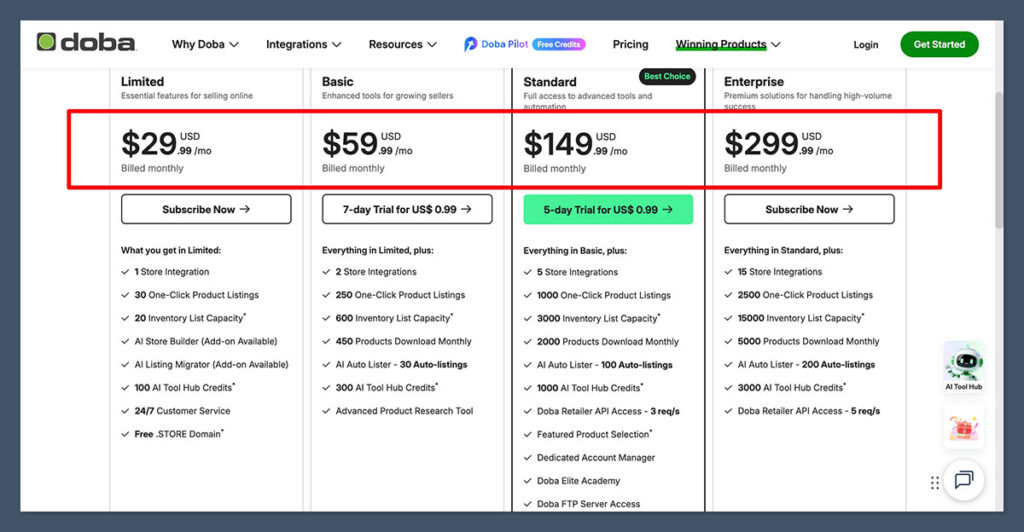
- Doba starts at $29.99 per month for its Limited plan (with quarterly and annual discounts available). This tier includes a single store integration, 30 one-click product listings, 20 inventory list slots, and 100 AI Tool Hub credits. As merchants scale, plans expand through the Basic ($59.99/mo) and Standard ($149.99/mo) tiers, the latter unlocking advanced API access, FTP server connectivity, dedicated account managers, and entry into the Doba Elite Academy.
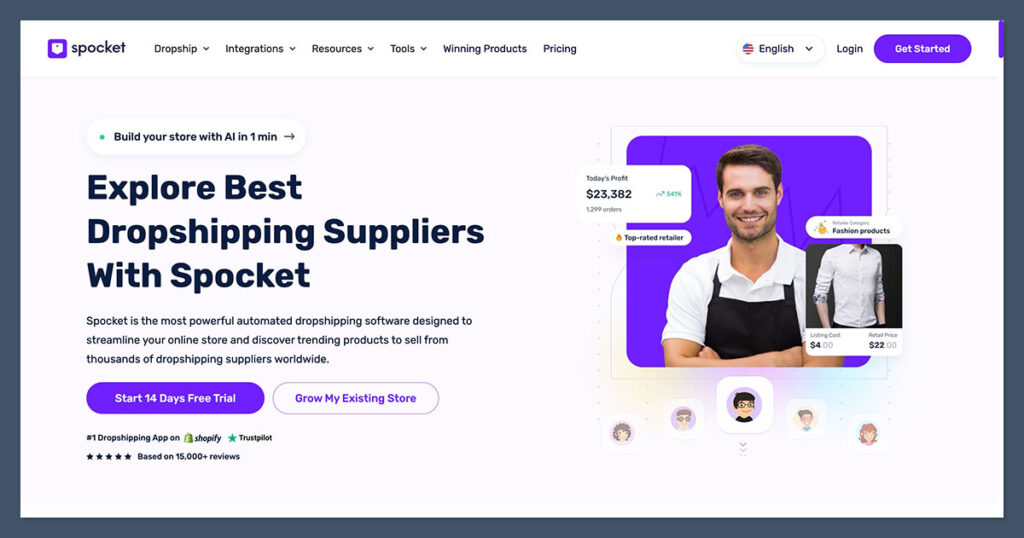
- Spocket opens at $39.99 per month, granting full catalog access, AliExpress dropshipping integration, and support for up to 25 unique products on its entry tier.
The Cost Caveat: While Doba appears more economical out of the gate, merchants must factor in structural limitations. Spocket requires a separate paid subscription for every newly connected store, meaning managing three distinct brand sites exponentially spikes monthly overhead. Furthermore, neither platform’s subscription fee covers the wholesale cost of the physical inventory; merchants must maintain separate working capital to purchase products as customer orders clear.

2. Ease of Use, Onboarding, and the Learning Curve
- Spocket remains the undisputed king of simplicity for first-time dropshippers. The user interface is minimalist: merchants browse a curated catalog, push desired items to an import list, make surface-level edits, and publish. However, a minor friction point persists: products must be reviewed and imported individually before any bulk publishing actions can be taken.
- Doba is undeniably more complex. Because it functions as an all-in-one operations engine—complete with an AI store builder and deep inventory controls—the platform has a steeper learning curve. Fortunately, the recent evolution of Doba Pilot mitigates this hurdle significantly. New users can engage the AI agent in a conversational onboarding flow to configure niche parameters, connect storefronts, and push initial listings live without manually hunting through backend menus. For advanced users, Doba’s higher tiers offer comprehensive educational resources via the Doba Academy.
3. AI Automation, Product Research, and Workflow Management
The technological divide between the two platforms is most stark within automation and artificial intelligence.
- Doba Pilot has evolved past simple text prompts into a full operational agent. Market Scout evaluates demand, seasonality, and competitive pricing metrics prior to capital commitment. Smart Sourcing digests natural language prompts—such as category, target price point, and geographic shipping constraints—to filter out irrelevant suppliers instantly. Once stores are connected (across Shopify, BigCommerce, Wix, Walmart, TikTok Shop, and eBay), Pilot manages listing updates, UPC uploads, and attribute matching. Crucially, Pilot now handles fulfillment monitoring, actively tracking logistics exceptions and attempting to intercept unshipped purchase orders if a customer cancels their frontend store order.
- Spocket bypasses conversational AI, relying instead on advanced metadata filters. Merchants can meticulously sort items by geographic origin, destination, price brackets, supplier status, and best-seller metrics. While efficient, it lacks the proactive operational intervention and automated multi-channel orchestration found in Doba’s ecosystem.
4. Product Quality, Sourcing, and Logistics
- Product Diversity: Doba boasts over a million SKUs spread across unconventional categories like automotive goods, beauty supplies, and expansive homeware lines, making it ideal for merchants testing multiple product angles. Approximately 90% of its catalog services the US market via domestic warehouses.
- Supplier Vetting: Spocket maintains rigid vetting parameters. Every supplier must either physically manufacture or hold their own inventory, or provide a minimum 25% discount off public retail pricing. While Doba thoroughly vets its suppliers, its sheer scale means product quality can occasionally vary, requiring merchants to order samples to verify vendor reliability.
- Fulfillment and Return Policies: Doba enforces strict accountability, requiring suppliers to refund orders that miss stated processing windows, while supplying prepaid return labels for damaged goods alongside optional After-Sales Protection Services. Spocket demands a 95% order success rate from its suppliers, but leaves individual return policies largely up to the discretion of each manufacturer—meaning some vendors refuse returns entirely.
Official Responses and Industry Stakeholder Perspectives
Representatives from both platform ecosystems emphasize distinct value propositions when addressing the modern dropshipping climate:
- Doba’s Product Strategy Team highlights the platform’s pivot toward centralized operational intelligence: "Dropshipping is no longer just about finding a winning product; it is about supply chain resilience, inventory synchronization across multiple marketplaces, and eliminating administrative drag. By transforming Doba Pilot into an autonomous operational agent, we are allowing merchants to scale horizontally across TikTok Shop, Walmart, and Amazon without proportionally increasing their administrative headcount."
- Spocket’s Customer Success Architecture stresses the enduring importance of supplier curation and brand integrity: "While automation is critical, merchant success ultimately hinges on the unboxing experience and customer trust. By enforcing strict inventory-holding mandates on our US and EU suppliers and offering native branded invoicing, Spocket protects retailers from the fulfillment failures and low-quality goods that plague uncurated directory sites."
Implications for E-commerce Entrepreneurs
Choosing between Doba and Spocket in 2026 ultimately depends on an enterprise’s current scale, growth trajectory, and multi-channel ambitions:
- Choose Spocket if: You are a beginner or a single-store operator launching a boutique Shopify or Wix storefront. If your primary objective is a fast, frictionless setup, high-quality European or North American local suppliers, easy sample ordering, and professional branded invoicing, Spocket provides an optimal, stress-free environment.
- Choose Doba if: You operate a scaling e-commerce enterprise, target multiple external marketplaces (such as Amazon, Walmart, and TikTok Shop), or require heavy automation to manage massive inventory catalogs. Despite a steeper learning curve, Doba’s central operations dashboard, expansive US warehouse footprint, and the autonomous workflow capabilities of Doba Pilot make it a far more robust, scalable infrastructure for long-term growth.
