
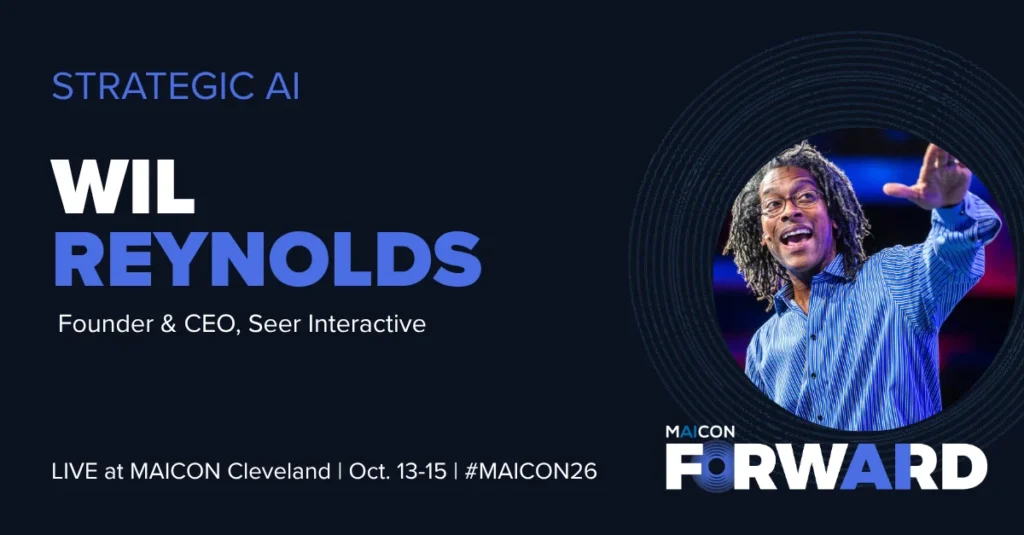
The Credibility Crisis: Why Visibility Without Trust Is a Dead End in the Age of AI
In the high-stakes world of digital marketing, the mantra has long been “visibility at all costs.” For over two decades, SEO professionals and content strategists have obsessed over search rankings, page views, and the sheer volume of output required to dominate the digital landscape. But as we stand at the precipice of a radical shift in how consumers discover information, Wil Reynolds—founder and CEO of the prominent digital agency Seer Interactive—is sounding a warning bell.
The industry’s collective sprint toward AI-generated content may be a trap. By prioritizing speed and scale over authority and trust, brands are inadvertently eroding the very foundations of their success. As the marketing world prepares for MAICON 2026, Reynolds is positioning himself as the industry’s contrarian voice, urging leaders to pivot from a strategy of "more" to a strategy of "meaning."
The Premise: The Trap of Automated Output
The current marketing ecosystem is dominated by a singular promise: AI can produce more content, faster, and with fewer human resources than ever before. While this efficiency is alluring, Reynolds argues that it is fundamentally flawed.
“Every tool on the market is promising the same thing,” Reynolds notes. “But more output does not automatically mean more trust. More visibility does not automatically mean more pipeline. And more AI-generated content does not automatically make a brand more useful, authoritative, or chosen.”
This realization stems from a shift in the underlying architecture of the internet. We are moving away from a world of blue-link search results toward an era of AI-driven synthesis. Platforms like ChatGPT and Gemini no longer simply crawl for keywords; they assess the authority of a brand before they even consider citing it. These models prioritize brands they already recognize as subject-matter experts. Consequently, organizations that spent years cutting corners to manufacture "visibility" are finding that their shortcuts have left them with no seat at the table when AI synthesizes answers for users.
Chronology of a Shifting Landscape
To understand the urgency of Reynolds’s message, one must look at the trajectory of digital marketing over the last decade.
- 2002–2012: The Foundation Phase. Digital marketing was defined by manual effort, high-touch content creation, and the nascent stages of SEO. Trust was built through long-form engagement.
- 2013–2022: The Scaling Era. The industry entered a race to the bottom in terms of cost-per-content. Programmatic SEO and content farms became the standard for brands looking to "hack" the algorithm.
- 2023–2025: The Generative Disruption. With the explosion of Large Language Models (LLMs), the barrier to content production collapsed. The internet became flooded with synthetic noise, making genuine, human-verified insights harder to find.
- 2026 and Beyond: The Authority Reset. As AI models become more sophisticated at filtering out "hallucinated" or low-quality data, brands that lack inherent, verified credibility will find their visibility plummeting, regardless of how much content they push out.
The Data Divergence: Why Traffic is No Longer the North Star
One of the most compelling aspects of Reynolds’s philosophy is rooted in a counterintuitive data trend he observed at Seer Interactive. In recent years, the agency witnessed a significant, sustained drop in organic search traffic. By traditional metrics, this would be a crisis. However, beneath that decline, the company’s actual revenue pipeline began to grow.
This divergence serves as a case study for the modern CMO. It suggests that the "traffic" being lost was largely low-intent, bot-driven, or superficial—the exact type of traffic that AI-generated content attracts. Meanwhile, the prospects who actually converted were those seeking deep, authoritative expertise—the kind that cannot be faked by a prompt-engineered bot.
“Everyone wants to be more visible and tie the results down to a specific ROI, or else,” Reynolds says. “But we are in the early innings, and these things are not even close to being settled.”
For marketing leaders, the implication is stark: relying on legacy KPIs like page views or keyword ranking volume is a dangerous habit. These metrics are becoming vanity signals in an AI-dominated search environment.
AI as a Tool for Thought, Not a Tool for Replacement
A central tenet of Reynolds’s upcoming session at MAICON 2026, titled "Seen. Believed. Chosen: AI Optimization That Builds Visibility and Credibility," is the ethical and tactical use of generative technology. Reynolds is remarkably transparent about his own workflow, drawing a sharp line between "thinking" and "outputting."
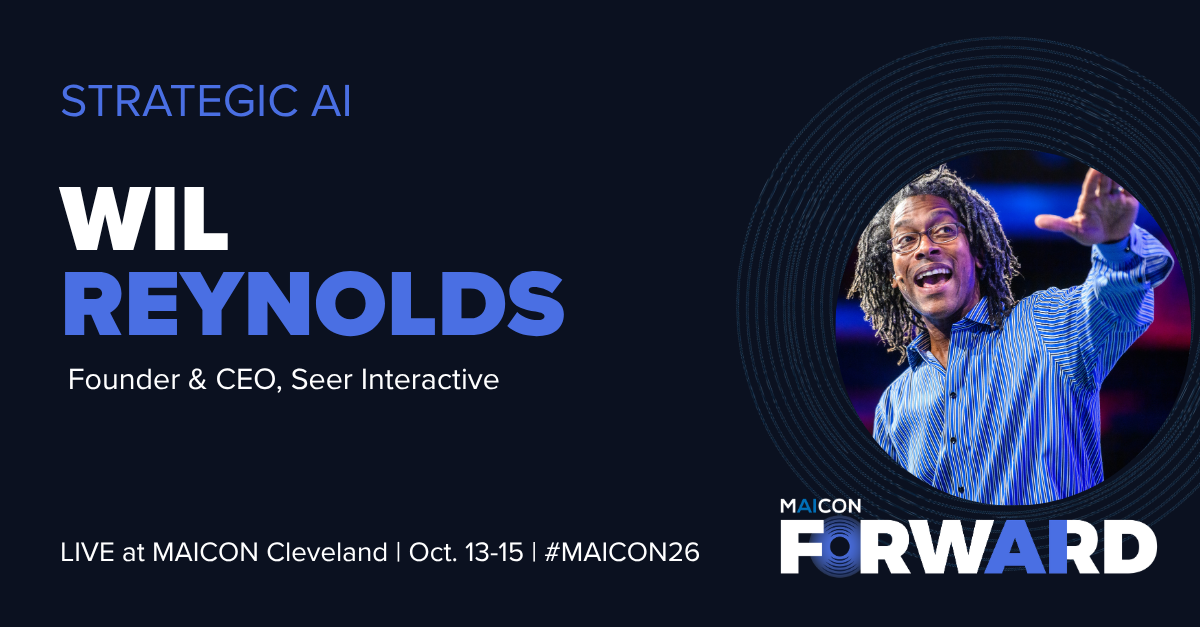
"I use AI to think, challenge, and connect dots between ideas and articles I’ve read," he explains. "It does not auto-produce anything for me personally. No emails, no video edits—those are my two biggies."
Reynolds’s refusal to use AI for surface-level automation is a deliberate branding choice. He understands that his voice—and the voice of his agency—is their most valuable asset. When a leader allows an AI to mimic their tone to save twenty minutes, they are essentially commodifying their own authority.
The principle he advocates is one of "AI-enhanced intelligence" rather than "AI-driven automation." By using these tools to refine logic, stress-test arguments, and identify gaps in research, marketers can raise the quality of their human-led output. Conversely, using AI to flood the market with mediocre content creates a "trust debt" that can take years to repay.
The Implications for Leadership
For CMOs and marketing directors, the shift Reynolds describes necessitates a complete overhaul of team strategy. The pressure to produce more with less is immense, but the consequences of yielding to that pressure are long-term brand erosion.
The New Framework for Strategy
- Stop Scaling Noise: Audit the content calendar. If a piece of content doesn’t build trust or provide proprietary value, stop producing it.
- Prioritize "Brand Signals": AI models look for "brand signals"—mentions, associations, and historical authority. Invest in PR, original research, and thought leadership that gets the brand cited by reputable sources.
- Redefine KPIs: Move away from volume-based metrics. Start measuring "Assisted Conversions" and "Brand Authority" metrics, even if they are harder to track.
- Embrace the "Tough Conversations": Marketing leaders must be willing to tell stakeholders that growth is shifting from "wide" to "deep."
The Road to MAICON 2026: Preparing for the Shift
As we approach MAICON 2026, the industry is at a crossroads. The temptation to "set it and forget it" with AI content strategies is strong, but the evidence suggests that this path leads to diminishing returns.
Reynolds’s session is designed to offer a practical, no-nonsense roadmap for this transition. Attendees will learn how to evaluate their current AI optimization strategies through the lens of buyer trust. They will be challenged to decide what to scale, what to slow down, and, perhaps most importantly, what to refuse.
The ultimate goal for any brand in the AI era is to transition from being merely "seen" (which any bot can achieve with enough volume) to being "chosen" (which requires the unique, human-centric authority that AI cannot replicate).
A Call to Action for the Modern Marketer
The shift from being a "content producer" to an "authority provider" is not just a tactical adjustment; it is a fundamental evolution of the marketing craft. As Wil Reynolds prepares to share his insights on the MAICON 2026 stage, the message is clear: the future belongs to those who have the courage to prioritize credibility over the illusion of visibility.
For those ready to move past the hype and build a sustainable, future-proof strategy, the conversation at MAICON 2026 is essential. It is time to stop playing the volume game and start playing the trust game. Whether you are leading a startup or managing a global brand, the lessons learned from the "Seen. Believed. Chosen" framework will be the difference between getting lost in the noise and becoming an indispensable voice in your industry.
Join the conversation at MAICON 2026 and hear from Wil Reynolds and over 50 other AI and business leaders as they navigate the future of marketing.
