
Beyond the Prompt: Why the Future of Marketing Lies in Building, Not Just Browsing
For the past two years, the marketing industry has been caught in a frantic gold rush. Teams are scrambling to adopt AI tools, chasing the promise of "doing more with less." The directive from leadership is clear: draft faster, publish more frequently, and automate the mundane administrative busywork. However, as the initial novelty of generative AI begins to fade, a new, more sophisticated realization is taking hold: the true competitive advantage isn’t found in using AI to speed up your existing job—it’s in transforming parts of your job into autonomous tools that work for you.
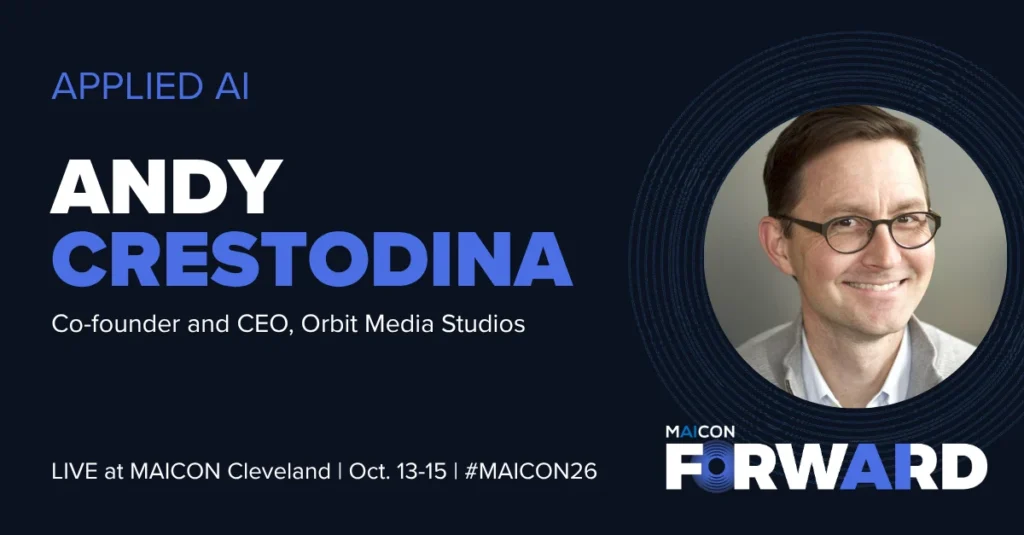
This strategic shift is the cornerstone of Andy Crestodina’s upcoming keynote at MAICON 2026. As the Co-founder and CMO of Orbit Media and a long-time industry luminary, Crestodina is challenging marketers to move beyond the "one-off prompt" mentality and embrace a new paradigm: turning human expertise into scalable, automated workflows.
The Evolution of the Modern Marketing Workflow
The narrative of AI in marketing has largely been centered on efficiency—the "faster, cheaper" argument. But Crestodina argues that this view is dangerously narrow. "The work of marketing has changed," he observes. "Modern marketing workflows evolve in a specific sequence, beginning with tasks that are 100% done by human hands, progressing to a hybrid model, and eventually reaching a state where the work is 100% done by assistants, then reviewed by humans."
This progression is not a light-switch event. It is a deliberate, iterative process. According to Crestodina, many teams fail to achieve true automation because they expect immediate perfection. "My most powerful assistants evolved gradually," he notes. "I don’t think you can one-shot a great AI worker bee. You have to build, test, and refine."
This evolutionary model suggests that the most successful marketing organizations will be those that treat their AI implementations as "digital employees" that require training, onboarding, and continuous performance reviews, rather than as static pieces of software.
The Expert as the Architect: Why Domain Knowledge Wins
One of the most persistent myths in the current AI landscape is that the technology will eventually render deep domain expertise obsolete. Crestodina’s philosophy is diametrically opposed to this. He asserts that the biggest missed opportunity in AI marketing isn’t the choice of LLM (Large Language Model) or the specific software stack; it is who is building the workflows.
"The best assistants are built by people who already do that job well," Crestodina explains. "The expert at the job is the best suited to evaluate AI’s output, judge it, and make improvements."
In this framework, AI serves as the ultimate skill-transfer mechanism. When a senior strategist builds an AI assistant, they aren’t just automating a task; they are codifying their professional experience. This creates a "force multiplier" effect where the senior expert’s judgment can be applied across dozens of tasks simultaneously, or where less-experienced team members can leverage the expert’s "digital twin" to perform work at a higher standard than they could on their own.
The New Literacy: "Your Prompts Are Code"
To facilitate this transition, marketers must undergo a fundamental shift in how they view their daily interactions with software. Andrej Karpathy, the former Director of AI at Tesla and co-founder of OpenAI, famously remarked that "the hot new programming language is English."
Crestodina has built his current framework around this exact premise. "Your prompts are code," he emphasizes. "They are functions. They are tools. You need to treat them with the same rigor you would use if you were writing a Python script or a SQL query."
This mindset shift is critical. Instead of asking AI to "write a blog post about X," a professional marketer should be building a function that takes a raw data set, applies a specific brand voice, formats it for SEO, and suggests internal linking structures.
By treating prompts as code, marketers are encouraged to:
- Iterate: Treat every output as a versioned product.
- Standardize: Store these prompts in a central, team-accessible repository.
- Compose: Combine simple prompts into complex, multi-step workflows.
- Test: Continuously validate the inputs and outputs to ensure quality and brand alignment.
"Don’t look for new tools," Crestodina advises. "Make your own tools. The only gap is our own imaginations."
Implications for the Industry: From "Tool Users" to "Tool Builders"
The transition from user to builder has profound implications for marketing departments. As organizations move toward this model, the role of the "Marketing Operations" function will likely merge with "AI Engineering."
The Shift in Hiring and Talent Development
We are entering an era where a marketer’s value is increasingly tied to their ability to architect systems. A candidate who can write a perfect prompt is valuable, but a candidate who can build a prompt library that automates 30% of the department’s content production is indispensable. Professional development budgets should pivot from purchasing SaaS licenses to teaching team members how to build, refine, and maintain internal AI agents.
The Death of the "One-Off" Workflow
Organizations that rely on fragmented, individual-level AI use will find themselves struggling with brand inconsistency and data security risks. Crestodina’s approach suggests that institutionalizing "prompt engineering" is the only way to scale. When a company treats its prompts as intellectual property, they create a moat that competitors cannot easily cross.
The Role of Leadership
For CMOs and marketing directors, the challenge is cultural. It requires moving the team away from the "shiny object syndrome"—the constant search for the next buzzy AI tool—and toward a culture of iterative, internal development. Leaders must provide the time and the technical environment for their experts to document their workflows and convert them into automated systems.
Preparing for MAICON 2026: A Roadmap
As the industry looks toward MAICON 2026, the focus is squarely on moving from the theoretical to the practical. Crestodina’s upcoming session, "From Process to Prompt to Automation: How a Marketing Job Becomes a Marketing Tool," is designed to provide the tactical scaffolding for this transition.
Attendees can expect to explore:
- The "Audit" Phase: How to identify which workflows are actually ripe for automation, as opposed to those that require human empathy and creative nuance.
- The "Prototype" Phase: Best practices for moving from a manual task to a prompt-based prototype.
- The "Productization" Phase: How to turn successful prompts into repeatable, reusable tools that can be shared across the enterprise.
For those who have spent the last year experimenting with ChatGPT, Claude, or Midjourney but feel they haven’t yet reached a point of operational efficiency, this session promises to be a turning point. It is not about keeping up with the speed of AI; it is about steering the ship with a set of tools you built yourself.
Conclusion: The Expert’s Competitive Advantage
In his book, Content Chemistry, Crestodina famously grounded marketing success in performance, data, and evidence. His move toward AI automation is a logical extension of that work. If most websites fail to drive leads because the content lacks strategy or consistency, AI—when wielded by an expert—becomes the solution to the volume-versus-quality dilemma.
The future of marketing is not going to be determined by who has the most AI tools, but by who has the most sophisticated "toolset." As we look toward MAICON 2026, the message is clear: Stop shopping for the future and start building it. The expert who understands their craft well enough to teach an AI to perform it will be the most valuable professional in the next decade of digital business.
For marketing leaders, the mandate is to foster an environment where this expertise is valued, documented, and scaled. The era of the "prompt-as-code" has arrived, and it is time for marketers to step into the role of the architect.
