
The Rise of Conscious Commerce: A Comprehensive Guide to Curating Genuinely Sustainable Print-on-Demand Catalogs
Introduction and Market Overview
The e-commerce landscape is undergoing a fundamental paradigm shift. Consumers are no longer voting solely with their wallets based on price and convenience alone; they are increasingly demanding environmental accountability from the brands they support. According to PwC’s widely cited Voice of the Consumer survey, modern shoppers are willing to pay almost 10% more for goods that carry verifiable eco-friendly credentials.
For entrepreneurs and independent creators utilizing print-on-demand (POD) infrastructure, this consumer sentiment presents a lucrative commercial opportunity. However, building a sustainable product catalog is fraught with challenges. The print-on-demand market is currently saturated with suppliers claiming their inventory is "green," yet many fail to provide transparent details regarding supply chain mechanics, material composition, or ethical manufacturing standards.
To bridge the gap between consumer expectations and supplier claims, this report evaluates the current state of sustainable print-on-demand merchandising, outlines critical certification standards, and details the 20 best eco-friendly products worth integrating into an e-commerce catalog.
What Makes a Product Genuinely Eco-Friendly?
The term "sustainable" has unfortunately become a marketing buzzword, often employed without regulatory standardization. Navigating this space requires rigorous independent research into material lists, manufacturing processes, and supply chain transparency. Crucially, even minor variations—such as the color of a garment—can alter a product’s material mix, shifting it away from true sustainability.
Decoding Industry Certifications
To maintain the promises made to eco-conscious consumers, store owners must look for globally recognized, third-party certifications:
- GOTS (Global Organic Textile Standard): The gold standard for organic textiles, covering not only the harvesting of raw materials but also socially and environmentally responsible processing along the entire supply chain.
- OEKO-TEX Standard 100: Tests product components for the presence of harmful substances, ensuring safety for both the consumer and the environment.
- GRS (Global Recycled Standard): Tracks and verifies the presence of recycled raw materials in a final product through the chain of custody.
- OCS (Organic Content Standard): Verifies the presence and amount of organically grown material in a final product.
- FSC (Forest Stewardship Council): Ensures that paper and wood-based products originate from responsibly managed forests that provide environmental, social, and economic benefits.
Beyond material provenance, true sustainability dictates product durability. An eco-friendly garment that suffers from fading prints or unraveling seams after a few washes ultimately contributes to fast-fashion waste, rendering its initial production footprint counterproductive.
Chronology of the Sustainable POD Movement
The evolution of eco-friendly merchandise within the print-on-demand sector has developed in distinct phases over the past decade:
- Phase 1: The Novelty Era (Pre-2018): Early attempts at eco-friendly merchandise were largely limited to basic, rough-textured organic cotton tees offered by a handful of niche suppliers at exorbitant wholesale prices. Quality was inconsistent, and color options were severely restricted.
- Phase 2: The Blend Revolution (2018–2021): Major POD platforms began integrating recycled polyester (rPET) blended with conventional or organic cotton. This era solved many durability and softness issues, though transparency regarding the exact sourcing of recycled bottles remained opaque.
- Phase 3: The Circular Economy and Hyper-Local Fulfillment (2022–Present): Modern fulfillment networks like Gelato, Fourthwall, and Printful introduced localized production models—producing items closer to the end consumer to drastically cut transportation emissions. Simultaneously, pioneers like Teemill introduced true circular fashion models, featuring QR codes on garment labels to facilitate post-consumer recycling.
Supporting Data & Industry Metrics
- Premium Pricing Power: PwC research indicates that nearly 10% of consumers accept price inflations for sustainable alternatives, allowing merchants to protect profit margins despite higher base wholesale costs.
- Local Fulfillment Efficiency: Leading networks report that up to 90% of localized orders are produced within regional hubs, significantly shrinking the carbon footprint of cross-border shipping while guaranteeing delivery windows under five days.
- Material Lifespans: Biodegradable items, such as specialized plant-based phone cases, achieve structural decomposition within roughly one year under active composting conditions, balancing durability with end-of-life disposal.
Official Responses and Supplier Accountability
As greenwashing scrutiny intensifies from regulatory bodies such as the Federal Trade Commission (FTC) and the European Commission, print-on-demand suppliers are facing increased pressure to substantiate their sustainability claims.
Major platforms have responded by publicly auditing their supply chain partners. For instance, platforms featuring Stanley/Stella and Bella+Canvas items now routinely publish compliance documentation detailing exact percentages of organic fibers and recycled polymers. Furthermore, the adoption of PETA-Approved vegan inks for Direct-to-Garment (DTG) printing has become standard practice among top-tier suppliers aiming to eliminate animal-derived byproducts from their chemical inventories.
The 20 Best Sustainable Products Worth Selling
To assist creators in structuring a viable catalog, the following 20 items have been categorized by product type, balancing consumer demand, margin potential, and verifiable sustainability credentials.
Sustainable T-Shirts
1. Stanley/Stella Organic Cotton T-Shirt
- Price: Starting at $14.50 (Fourthwall)
- Details: Crafted from 100% organic ring-spun cotton with broad unisex sizing. Retail pricing around $30 yields a $15.50 profit margin. Available with zero minimum order quantities (MOQ).
- Best For: Premium clothing lines, especially when utilizing the embroidery fulfillment option.
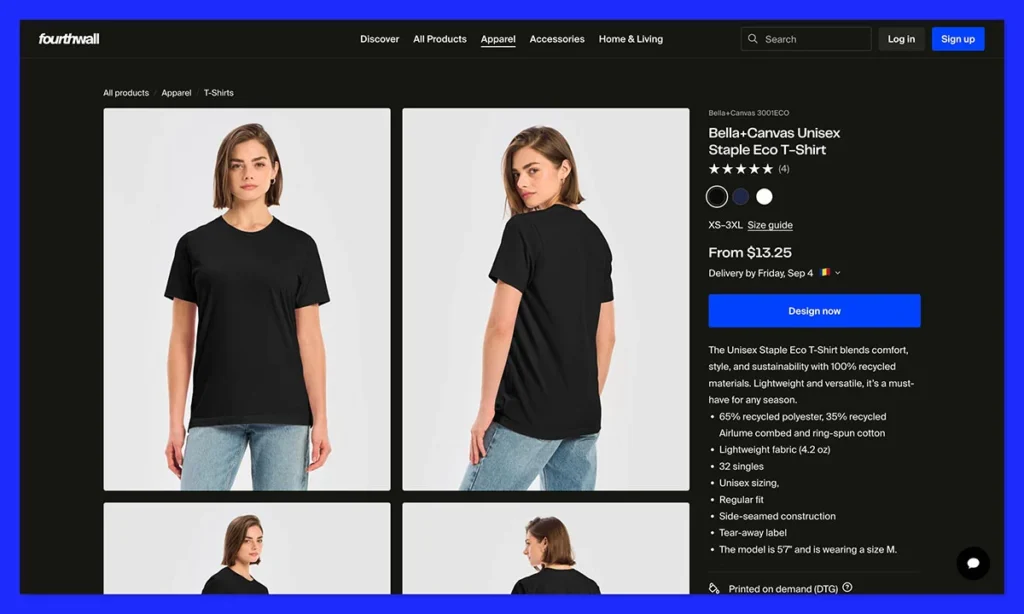
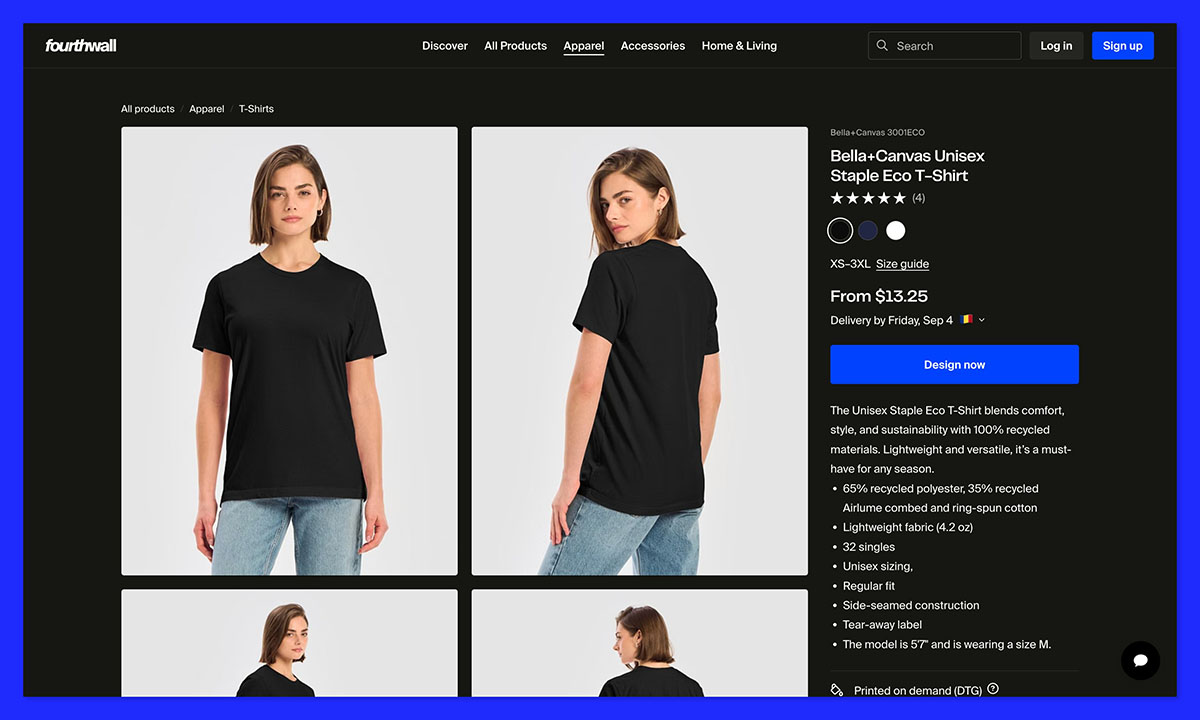
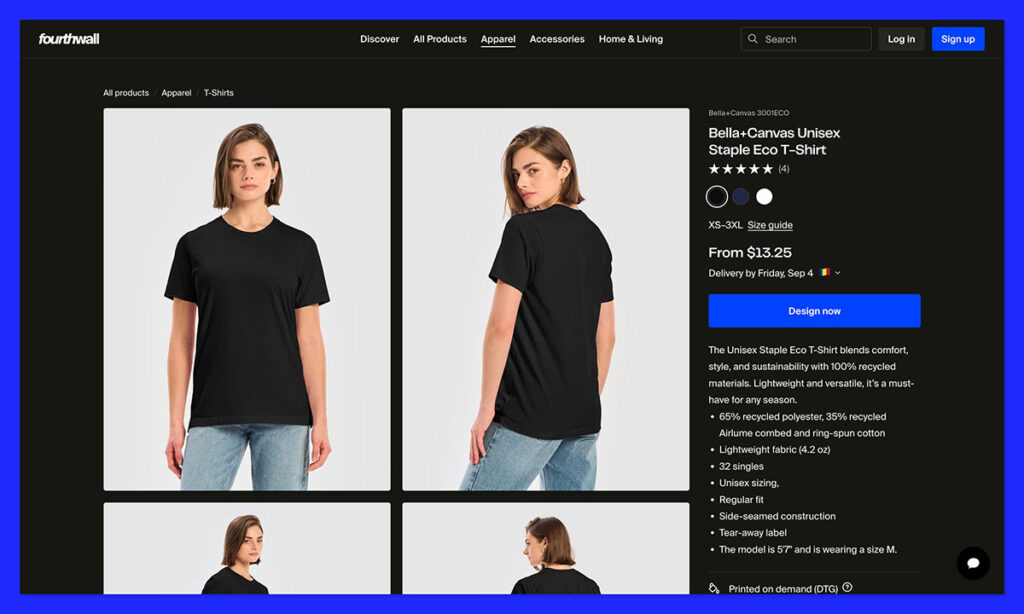
2. Bella+Canvas Unisex Staple Eco T-Shirt
- Price: Starting at $13.25 (Fourthwall)
- Details: A budget-friendly option composed of 65% recycled polyester and 35% recycled Airlume cotton featuring a tear-away label.
- Best For: High-volume streetwear drops; sample testing is recommended to calibrate dark-fabric DTG printing.
3. Organic Unisex Crewneck T-Shirt (Gelato)
- Price: Localized pricing via Gelato
- Details: Made with 100% certified organic ring-spun cotton. Supported by Gelato’s localized fulfillment network, where roughly 90% of orders are produced regionally.
- Best For: Global stores seeking fast fulfillment windows and reduced shipping emissions.
4. Circular Organic T-Shirt (Teemill)
- Price: Custom quote via Teemill
- Details: Utilizes 100% organic cotton and water-based vegan inks. Labels feature integrated QR codes allowing customers to return worn items for recycling.
- Best For: Brands fully committed to closed-loop circular economies.
Hoodies and Sweatshirts
5. Stanley/Stella Essential Eco Hoodie
- Price: Starting at $33.20 (Fourthwall)
- Details: Blends 85% organic cotton with 15% recycled polyester. Highly customizable across fronts, backs, sleeves, and interior labels.
- Best For: Premium apparel brands targeting cooler seasons.
6. SOL’s Eco Raglan Hoodie
- Price: Starting at $35.70 (Fourthwall)
- Details: Offers diverse colorways; however, material mixes vary by shade (e.g., Charcoal utilizes 60% cotton and 40% recycled polyester).
- Best For: Retailers prioritizing aesthetic variety in raglan cuts.
7. Gelato Organic Hoodies
- Price: Localized pricing via Gelato
- Details: Features blends of 55% cotton and 45% polyester (or pre-shrunk variations for zip-up models), printed using water-based inks.
- Best For: Standardized, localized merchandise catalogs.
8. Organic Stanley/Stella Oversized Sweatshirt
- Price: Starting at $40.02 (Fourthwall)
- Details: Features a brushed interior, drop-shoulder volume, and durable ribbing. Holds GOTS and OEKO-TEX certifications alongside PETA-Approved vegan status.
- Best For: Modern streetwear collections.
9. Recycled Polyester Sweatshirt (Gelato)
- Price: Localized pricing via Gelato
- Details: Constructed from recycled polyester yarn derived from post-consumer PET bottles.
- Best For: Eco-conscious athleisure lines.
Totes, Hats, and Practical Accessories
10. Econscious Organic Cotton Tote
- Price: Starting at $18.31 (Fourthwall)
- Details: Heavy-duty canvas capable of holding up to 30 pounds and measuring 20×14 inches.
- Best For: Event merchandise or high-value lifestyle collections.
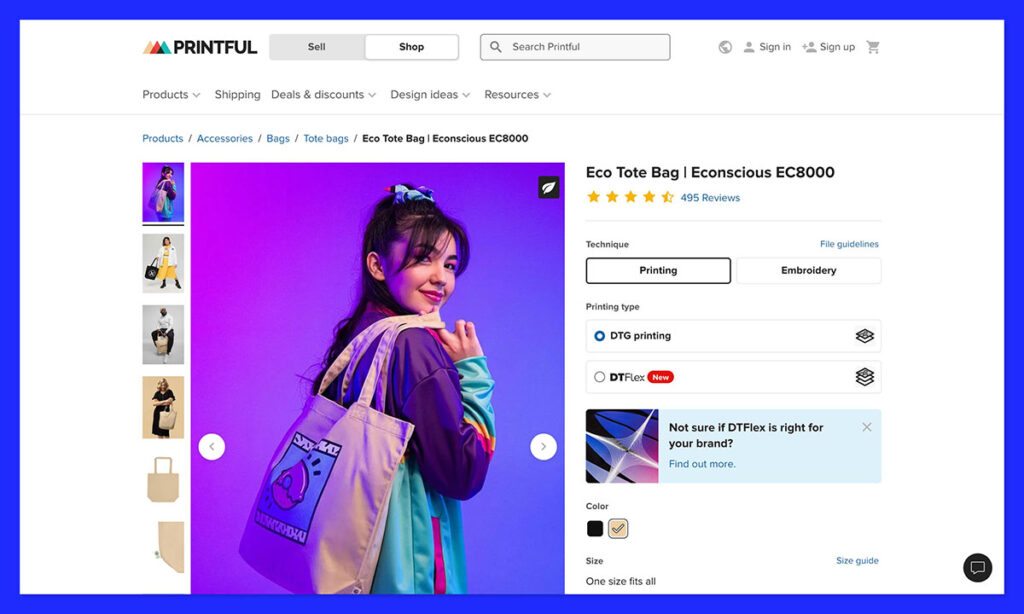
11. Printful Eco Tote Bag
- Price: Localized pricing via Printful
- Details: Constructed from 8-ounce certified organic cotton twill. Backed by GOTS, OCS, and OEKO-TEX Standard 100 certifications.
- Best For: Versatile accessory add-ons with embroidery or DTFlex printing.
12. Econscious Organic Dad Hat
- Price: Starting at $15.85 (Fourthwall)
- Details: Made from 8-ounce organic cotton twill, bypassing complex apparel sizing hurdles while maintaining healthy margins.
- Best For: Universal merchandise additions.
13. Atlantis B50 Organic Ribbed Beanie
- Price: Starting at $18.59 (Fourthwall)
- Details: 100% organic knit optimized for cold climates and high-quality embroidery.
- Best For: Fall and winter merchandise drops.
14. SOL’S Organic Cotton Apron
- Price: Starting at $24.75 (Fourthwall)
- Details: 7.08-ounce organic cotton featuring adjustable straps and a split front pocket. (Currently limited to EU fulfillment).
- Best For: Culinary, baking, or artisan-focused creator brands.
Kids, Activewear, and Lifestyle Products
15. Stanley/Stella Kids Organic Cotton T-Shirt
- Price: Starting at $15.50 (Fourthwall)
- Details: 4.57-ounce 100% organic ring-spun combed cotton covering ages 3 to 14.
- Best For: Family-oriented creators, schools, and youth communities.
16. Babybugz Organic Short-Sleeve Bodysuit
- Price: Starting at $15.64 (Printify)
- Details: GOTS- and OEKO-TEX-certified organic cotton for solid colors, covering newborns to 18-month-olds.
- Best For: Baby announcements, gifting, and family milestone stores.
17. Sublicolor All-Over Print Sports Jersey
- Price: Starting at $30.55 (Fourthwall)
- Details: Moisture-wicking performance fabric with all-over print capabilities in sizes up to 6XL.
- Best For: Esports teams, fitness coaches, and athletic communities.
18. Sublicolor Recycled String Bikini
- Price: Starting at $27.49 (Fourthwall)
- Details: Composed of 81%–88% recycled polyester with OEKO-TEX and GRS certifications, plus UPF 50+ sun protection.
- Best For: Travel, festival, and swimwear fashion niches.
19. Biodegradable Phone Case
- Price: Starting at $13.25 (Printful)
- Details: Designed to safely decompose within one year in compost environments without sacrificing daily durability.
- Best For: Low-cost, high-margin catalog cross-sells.
20. Scented Soy Candle with White Lid (9 oz.)
- Price: Starting at $9.80 (Printify)
- Details: Features 7.5 ounces of US-grown soy wax, a cotton wick, and a 50-to-60-hour burn time inside reusable glass jars.
- Best For: Home wellness, literature, and lifestyle brands.
Implications and Strategic Recommendations
Curating a sustainable print-on-demand catalog requires a disciplined, measured approach. Merchants should avoid the temptation to list all 20 products simultaneously. Instead, begin with a focused collection—such as an organic tee, a signature hoodie, and one or two lifestyle accessories like a tote bag or candle.
Crucially, store operators must physically test all inventory before public release. Order physical samples to inspect seam integrity, wash-test garments to monitor shrinkage and print degradation, and verify that supplier sizing charts align with customer expectations.
Because modern POD platforms impose no minimum order quantities, merchants enjoy the flexibility to experiment safely. By monitoring early consumer data and tracking which eco-friendly items generate the highest organic interest, creators can systematically scale their sustainable catalog with minimal financial risk.
