
The Agency Renaissance: How AI is Forcing a Radical Redefinition of Marketing Services
The traditional agency model—once defined by billable hours, creative intuition, and siloed execution—is currently undergoing its most significant transformation since the dawn of the internet. We are witnessing a clear, widening chasm in the marketing landscape: on one side, agencies clinging to the status quo, treating Artificial Intelligence as a mere efficiency tool; on the other, a new vanguard of "AI-native" firms that are fundamentally reimagining the architecture of service delivery.
The most forward-thinking agencies are not just bolting AI onto their existing service menus. They are transforming into hybrid entities—part consultancy, part software developer, and part data scientist. By integrating AI-powered systems into their core operations, these agencies are discovering entirely new ways to deliver strategy, creative output, technology, and operations.
The Chronology of Disruption: From Experimentation to Integration
To understand where the industry is heading, one must look at how the agency model has evolved over the past decade.
- 2015–2019 (The Digital Maturity Era): Agencies focused on digital transformation, migrating clients from legacy systems to cloud-based marketing stacks. The primary goal was visibility and data collection.
- 2020–2022 (The Automation Wave): The pandemic accelerated the adoption of marketing automation. Agencies began implementing tools like HubSpot and Salesforce at scale, focusing on "doing more with less."
- 2023–2024 (The Generative AI Shock): The release of large language models (LLMs) forced agencies to confront the commoditization of content. Many initially reacted by using AI to churn out lower-cost, higher-volume assets.
- 2025–Present (The Architectural Pivot): We are now in the era of the "AI-Native Agency." The leading firms are no longer just producing content; they are building proprietary AI agents, developing custom workflows, and providing executive-level consulting on how to operationalize AI within a client’s entire business structure.
The New Vanguard: Agencies Redefining the Landscape
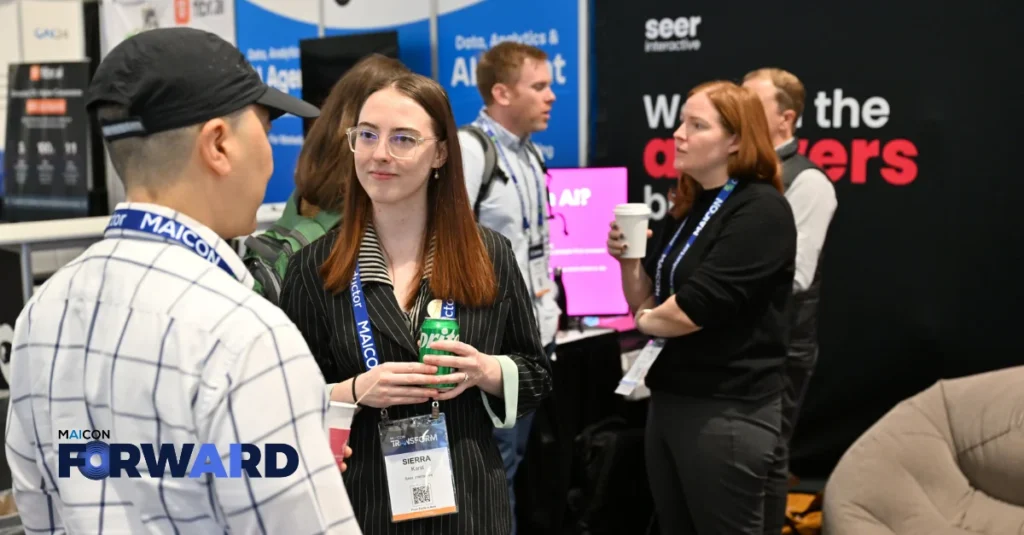
The following agencies, all sponsors of the upcoming Marketing AI Conference (MAICON), exemplify this shift toward systemic, AI-driven transformation.
1. Algomarketing: People and Process Transformation
Algomarketing is moving beyond simple service delivery by focusing on organizational change. They deploy senior practitioners directly into client teams to audit workflows. The goal is to co-build AI-native agents that automate repetitive tasks, effectively "human-in-the-loop" systems that allow creative staff to focus on high-value strategy. Their emphasis on coaching ensures that the internal team is not just using new tools, but truly adapting to a new way of working.
2. Demand Spring: B2B Revenue Consulting
For B2B organizations, the complexity of the buyer journey is the biggest hurdle to growth. Demand Spring positions itself as a revenue marketing consultancy that bridges the gap between strategy, technology, and execution. By providing AI advisory services—covering everything from Account-Based Marketing (ABM) to Answer Engine Optimization (AEO)—they help clients move past the "shiny object" phase of AI and into formal governance and at-scale operationalization.
3. EMMIE Collective: Fractional Operations
EMMIE Collective represents the shift toward flexible, on-demand expertise. By embedding operators into client teams, they provide a bridge between traditional agency support and internal hiring. Their expertise in managing platforms like Marketo, Salesforce, and Tableau—bolstered by data operations—allows them to act as a fractional arm of a client’s internal Marketing Operations (MOps) department.
4. Fjorge: The Invisible Technical Partner
While many agencies are marketing-forward, Fjorge focuses on the "plumbing" of the digital world. As a development partner, they embed with creative and marketing agencies to provide the custom technical infrastructure required to power modern AI applications. Their role highlights an important industry trend: the increasing need for custom software development to deliver the complex, AI-driven digital experiences that modern consumers expect.
5. Intercept: The AI-Native Delivery Model
Intercept has embraced an AI-native approach to the full marketing funnel. By utilizing proprietary workflows, they accelerate research and content production without sacrificing the human-led strategy that is vital for complex enterprise tech buying journeys. Through Intercept Labs, they provide a safe space for clients to iterate on new AI-driven marketing methodologies, ensuring that innovation is backed by empirical data.
6. Level Agency: AI Orchestration
Level Agency focuses on brands with complex, high-consideration buying cycles. Their model is built on "AI orchestration," a methodology that connects strategy, execution, and data science into a repeatable, automated system. By integrating SEO, AI search, and CRM automation, they ensure that the data collected at one point of the buyer journey informs the strategy at every other point.
7. Seer Interactive: Research and Development
With over two decades of experience, Seer Interactive is a prime example of an agency that has successfully pivoted to stay relevant. Their AI Lab serves as a center for internal experimentation, which directly informs their SeerAdvance consulting wing. By treating AI as a research discipline, they provide clients with custom, data-backed AI strategies that have been stress-tested in the real world.
8. Soarion Digital: The New Search Foundation
As AI search (like ChatGPT and Perplexity) disrupts traditional SEO, Soarion Digital is pivoting toward "Answer Engine Optimization." They help clients build a foundation of citation-driven content, earning the trust of AI algorithms. This represents a significant shift: moving from chasing traffic to becoming the definitive, AI-verified answer for a brand’s specific industry.
Supporting Data: Why the Shift is Necessary
The urgency of this transition is supported by current market data. A recent report by the Marketing AI Institute suggests that while 85% of marketers have experimented with AI, fewer than 20% have reached a level of "operational maturity."
- Productivity Gains: Agencies utilizing AI-native workflows report an average 30-50% increase in content production velocity.
- Cost Efficiency: Clients are increasingly demanding "outcome-based" pricing rather than "time-based" pricing. Agencies that can use AI to deliver results faster are finding higher profit margins despite reduced billable hours.
- The Governance Gap: The primary barrier to AI adoption in 2025 is not technology, but fear of data leakage and lack of internal governance. Agencies that offer "AI Advisory" services are currently seeing higher demand than those offering pure creative services.
Official Perspectives: The Agency Leader’s View
According to industry analysts and the leadership at these firms, the "Agency of the Future" will be judged by its ability to integrate AI into the client’s internal stack.
"The goal is not to have the agency do the work forever," says a spokesperson for one of the MAICON-participating firms. "The goal is to help the client build the internal infrastructure so that their own teams become AI-powered. We are moving from being service providers to being partners in digital transformation."
This sentiment reflects a shift in the value proposition. In the past, agencies guarded their "secret sauce." Today, the most valuable agencies are those that provide the roadmap for the client to replicate success internally.
Implications: The Future of the Agency Model
The implications of this shift are profound for both the client and the agency owner.
- The Death of the Generalist: Agencies that try to be "everything to everyone" without a clear technological edge will likely struggle. Specialization—whether in AI search, revenue operations, or technical development—is becoming the primary differentiator.
- The Rise of the "Consultancy-Agency" Hybrid: The line between a management consultancy (like McKinsey) and a creative agency is blurring. Clients need the strategic rigor of the former and the creative agility of the latter, all powered by the technical infrastructure of a software firm.
- Human-Centricity in an Automated World: As AI handles the "how" (execution, production, optimization), the "why" (strategy, brand identity, emotional resonance) becomes even more critical. Agencies that focus on human-led strategy will thrive, while those that rely purely on generative volume will be commoditized.
Conclusion: Moving from Experimentation to Impact
As the marketing landscape continues to evolve, the distinction between those who use AI and those who are built by AI will become the defining factor of success. For business leaders, the challenge is to move past the initial phase of AI experimentation.
To truly understand how these models can be applied to your business, it is essential to move from theory to practice. The upcoming MAICON 2026 (October 13–15 in Cleveland, Ohio) is designed to facilitate this transition. By bringing together the pioneers of these new agency models and business leaders looking to operationalize AI, the conference serves as a critical junction for the future of marketing.
The agency model is not dying; it is being rewritten. For those willing to embrace the change, the opportunities for growth, efficiency, and market leadership are unprecedented. The question for every CMO and business owner is no longer "should we use AI?" but rather, "how will our agency partner help us win in an AI-first world?"
