
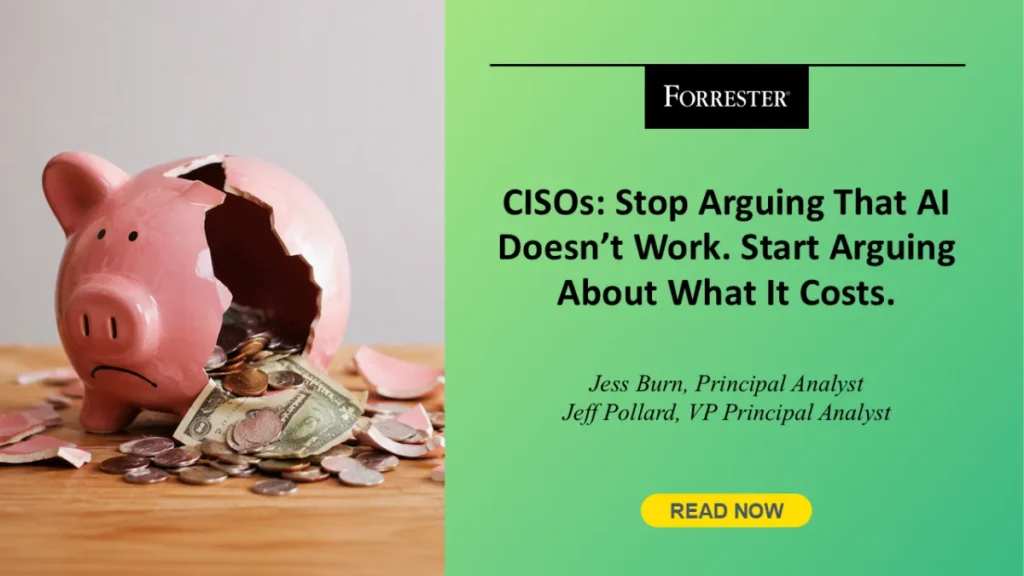
The CISO’s Dilemma: How to Reset the Enterprise AI Narrative Beyond the Hype
WASHINGTON, D.C. — In the rapidly evolving landscape of corporate technology, Chief Information Security Officers (CISOs) are facing an unprecedented operational bottleneck. The mandate to adopt Artificial Intelligence (AI) is expanding exponentially, vastly outpacing the budgets, technical expertise, and foundational governance controls required to make such deployments secure, sustainable, and legally compliant.
This tension—brewing in corporate boardrooms and trickling down to information security teams—served as the core thesis of a landmark keynote delivered at Forrester’s Security & Risk event. That presentation has since been codified into a definitive industry report titled, Resetting Security’s AI Narrative With Boards And Executives.
As organizations rush to integrate autonomous agents, large language models (LLMs), and machine learning pipelines into their daily operations, security leaders find themselves trapped between the relentless pursuit of corporate innovation and the stark reality of unprepared infrastructure. To survive this paradigm shift, security executives must fundamentally alter how they communicate risk to the C-suite.
Main Facts: The Great AI Mandate vs. Security Reality
The central conflict in modern enterprise technology is simple yet perilous: the business case for AI is almost entirely decoupled from the actual cost of securing it.
When executives and corporate boards look at AI, they see a golden path to unprecedented scale, operational productivity, and cost efficiency. Driven by intense market competition and the fear of missing out (FOMO) on technological revolutions, leadership teams are greenlighting AI initiatives at a breakneck pace.
However, this executive enthusiasm often overlooks the hidden, foundational pillars required to support secure AI adoption. CISOs across industries report a recurring set of systemic pressures:
- Resource Deficits: The corporate mandate for AI expansion outpaces allocated security budgets.
- Talent Shortages: There is a critical lack of internal expertise to audit, govern, and monitor complex AI models and agentic workflows.
- Premature Deployment: Business units are deploying third-party and custom AI tools faster than security teams can map data flows or establish access controls.
According to industry analysts, security leaders cannot resolve this mounting tension simply by pushing back and arguing that AI tools, models, or autonomous agents fail too often. Economic incentives and competitive pressures will invariably drive executive adoption, even when the underlying technology falls short of perfection. Furthermore, when a CISO leads with an argument that outright opposes a technology that the board and executive team desperately want, they risk undermining their own professional credibility.
The mandate is clear: security leaders must shift the enterprise conversation away from whether AI works, and focus intensely on what the enterprise must invest in to make AI trustworthy.
Chronology: From Boardroom Optimism to the Security Crisis
The friction between corporate ambition and security governance did not happen overnight. It is the result of a rapid, multi-year technological sprint that caught enterprise risk management off-guard.
Phase 1: The Exploration Era (2022–2023)
Following the public explosion of generative AI tools, enterprise leadership viewed AI primarily as an experimental novelty. Business units tested standalone prompts, internal chatbots, and marketing copy generators. During this phase, security teams treated AI largely as an isolated software category, applying legacy shadow-IT policies and standard SaaS vetting processes.
Phase 2: The Agentic Leap (2024–2025)
As AI evolved from simple text generators to autonomous "agentic" workflows—systems capable of executing multi-step business processes, querying databases, and making operational decisions—the attack surface exploded. Companies moved past isolated testing into deep operational integration. It was during this phase that CISOs began sounding the alarm. Budgets remained static, but the scope of what AI could access expanded into sensitive customer data, proprietary codebases, and financial systems.
Phase 3: The Narrative Reset (Late 2025–Present)
Recognizing that traditional pushback strategies were failing to curb unchecked AI rollouts, security thought leaders at events like the Forrester Security & Risk Forum began calling for a radical narrative reset. Rather than playing the role of the corporate "blocker," CISOs were urged to reframe AI governance as a critical business enabler tied directly to revenue protection, brand trust, and regulatory compliance.
Supporting Data and Economic Realities: What the Business Case Misses
The prevailing business case for enterprise AI routinely suffers from a severe blind spot: it accounts for top-line revenue gains and productivity metrics while entirely omitting the heavy investments required to maintain security, privacy, and continuous governance.
1. The True Cost of Data Readiness
AI models are only as good as the data fed into them. However, preparing enterprise data for secure AI consumption involves massive undertakings in data hygiene, access permission audits, and data loss prevention (DLP) upgrades. Many organizations fail to budget for the data classification and cleansing processes required to prevent sensitive intellectual property from leaking into public or semi-private model training sets.
2. Regulatory Exposure and Compliance Overhead
Governments worldwide are rapidly tightening regulations surrounding automated decision-making, algorithmic bias, and data privacy (such as the European Union’s Artificial Intelligence Act). The cost of non-compliance—ranging from hefty statutory fines to catastrophic reputational damage—rarely appears in initial AI project budgets. Security teams are left scrambling to implement continuous compliance monitoring retroactively.
3. Workforce Upskilling and Human Oversight
Autonomous AI agents do not eliminate the need for human labor; they shift it. Enterprises must invest heavily in upskilling existing practitioners to monitor AI outputs, detect prompt injections, and manage model drift. Neglecting workforce readiness transforms productivity tools into operational liabilities.
Strategic Shift: Three Questions to Change the C-Suite Conversation
To bridge the gap between executive ambition and security reality, CISOs must connect AI security to outcomes that the business already deeply values: revenue protection, customer trust, regulatory exposure, workforce readiness, and sustainable long-term growth.
Industry experts recommend that security leaders initiate this narrative shift by posing three fundamental questions to their boards and executive peers:
- "What is our true cost tolerance for operational failure and data leakage in our autonomous AI workflows?"
- Objective: Forces the C-suite to look beyond initial productivity gains and acknowledge the potential financial and brand fallout of an unmitigated security breach.
- "Do our current workforce and technology budgets adequately account for continuous monitoring, data governance, and model auditing?"
- Objective: Highlights budget shortfalls without outright rejecting the technology, tying funding directly to the sustainability of the AI initiative.
- "How are we measuring the ROI of our AI deployments against the growing legal and regulatory liabilities we are assuming?"
- Objective: Shifts the discussion from speed-to-market to sustainable, legally compliant growth.
By framing the dialogue around these strategic inquiries, security leaders move away from sterile technical debates over model efficacy and step into a collaborative role helping to shape enterprise-wide investments, accountability structures, and workforce strategies.
Industry Implications: Private AI, B2B Marketing, and the Road Ahead
The imperative to secure AI responsibly is also rippling across specific enterprise verticals, creating distinct operational sub-narratives.
In the realm of B2B marketing, for instance, a profound strategic debate is taking shape: Private AI versus Public AI. As foundational AI models become universally accessible, companies are discovering that access to capable technology no longer provides a competitive differentiator. When every competitor has access to the exact same off-the-shelf public AI models, true operational differentiation vanishes.
Consequently, B2B marketing and technology leaders are increasingly pivoting toward private, proprietary AI implementations trained on internal data moats. However, private AI models introduce their own distinct security challenges, requiring robust localized governance, specialized infrastructure, and rigorous compliance frameworks that exceed the capabilities of standard public cloud offerings.
Furthermore, as modern identity management, threat intelligence, and data resilience intersect with AI adoption, information security leaders are recognizing that secure AI cannot be treated as an isolated silo. It requires a holistic modernization of the entire enterprise security architecture.
Looking Forward: The Forrester Security & Risk Forum
To address these compounding challenges, industry practitioners, CISOs, and risk executives are preparing to convene at major industry events.
Forrester’s upcoming Security & Risk Forum, scheduled for November 9–10 in Washington, D.C., is slated to dive deep into these exact themes. The event will focus heavily on:
- Advanced AI cost governance and ROI alignment.
- Securing operational intent in autonomous agentic workflows.
- Elevating the CISO’s role in corporate trust and assurance.
- Continuous practitioner upskilling in an automated world.
Ultimately, the message for corporate leadership is unambiguous. Secure enterprise AI adoption depends on far more than the AI technology itself. It demands a synchronized effort spanning boardrooms, executive suites, and security operations centers. CISOs who successfully master this narrative reset will move past the exhausting cycle of technological skepticism and emerge as indispensable architects of sustainable, secure enterprise growth.
