
The Great Optimization Divide: Crazy Egg vs. AB Tasty in the Post-Merger Landscape
In the rapidly evolving world of Conversion Rate Optimization (CRO), the tools we choose to understand and influence user behavior are as critical as the strategies themselves. As we navigate 2026, the marketplace has seen a seismic shift, most notably with the merger of AB Tasty and VWO. For digital marketing managers, product leads, and growth teams, the question of which platform best serves their needs has moved from a simple feature comparison to a strategic decision about infrastructure.
Should your team invest in a specialized, high-end experimentation engine, or is there more value in an all-in-one platform that bridges the gap between analytics and action? This deep dive compares Crazy Egg and AB Tasty to help you determine which tool aligns with your organizational maturity and budget.
The Core Philosophy: Two Divergent Approaches
The fundamental difference between these two platforms lies in their architectural philosophy.
Crazy Egg operates on the principle of the "full experimentation cycle." It is designed as a self-contained ecosystem where a team can analyze traffic, pinpoint friction, form hypotheses, build variants, and deploy tests without ever leaving the dashboard. It is an end-to-end solution built for speed, transparency, and accessibility, catering to everyone from nimble startups to large enterprises.
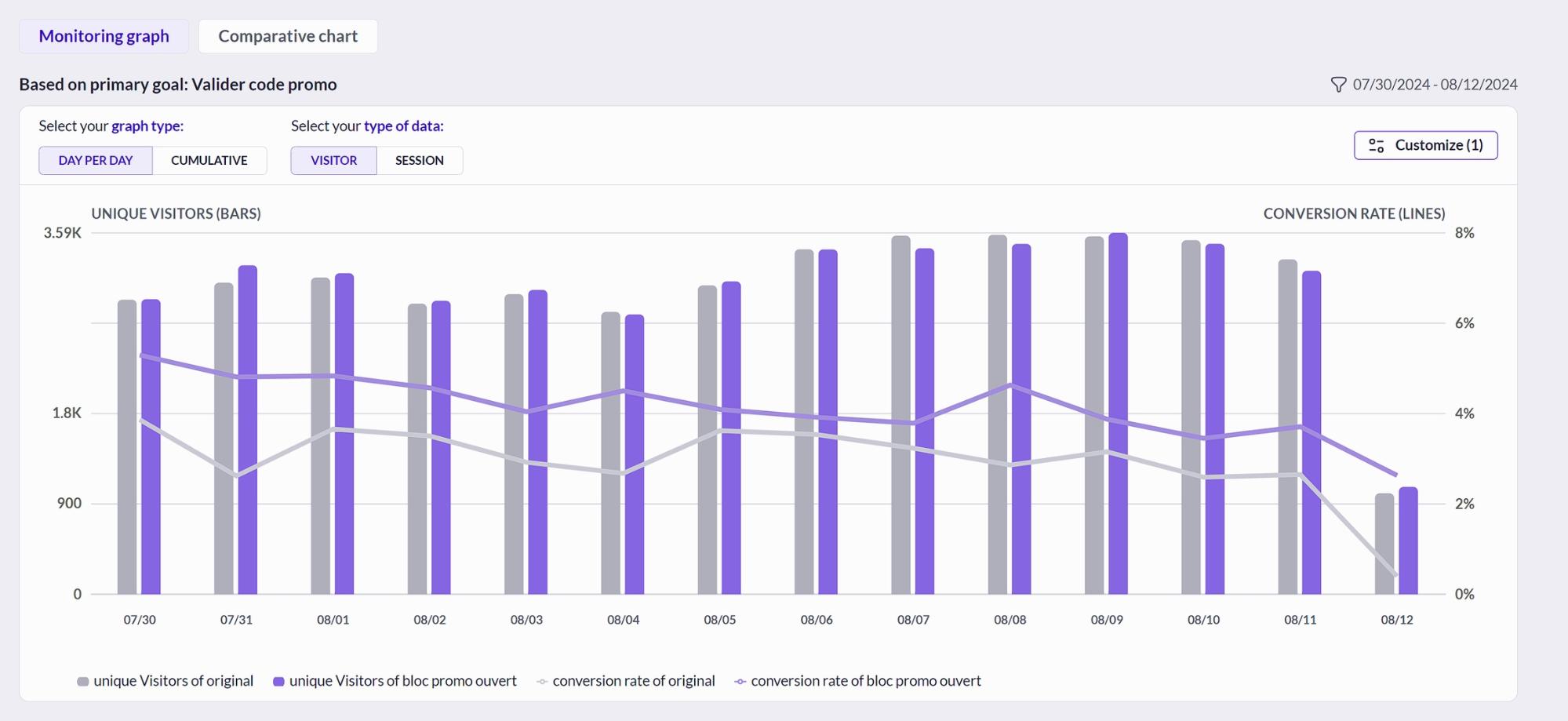
AB Tasty, conversely, functions as a high-precision instrument for teams that already have their data house in order. Following its 2026 merger with VWO, the platform has solidified its position as an upmarket leader in deep-tier A/B and multivariate testing. It is built for organizations that possess dedicated data analysts and separate, best-in-class analytics tools, allowing AB Tasty to focus exclusively on the mechanics of experimentation and sophisticated personalization.
Chronology: The 2026 Market Shift
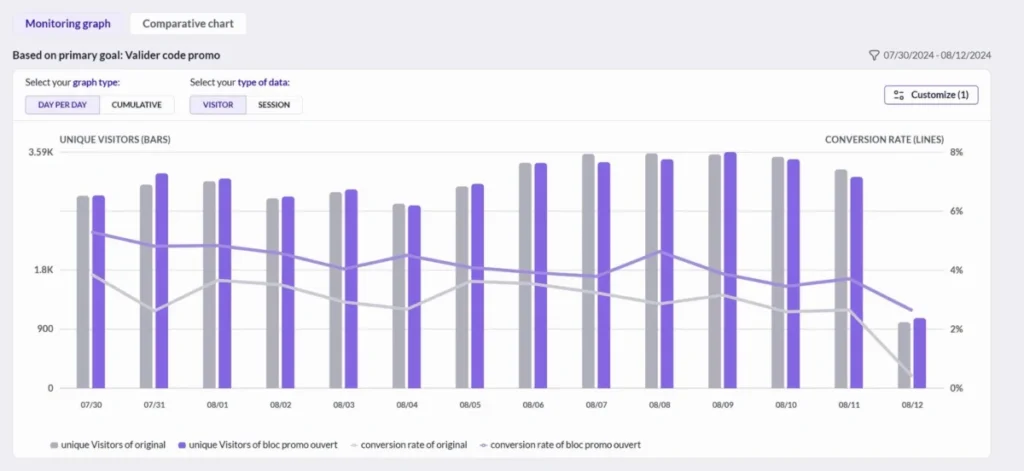
The digital landscape changed significantly in January 2026 when AB Tasty merged with VWO. This consolidation created a juggernaut in the testing space, signaling a move toward more "agentic" AI-driven workflows. For existing customers, this transition period has necessitated a review of current contracts and a re-evaluation of product roadmaps.
While the merger promised enhanced capabilities—such as the integration of VWO’s "Copilot" with AB Tasty’s "Evi" to form the new "Wandz" AI layer—it also introduced a period of uncertainty regarding account management and long-term pricing structures. Meanwhile, Crazy Egg has maintained a steady trajectory, focusing on expanding its internal AI optimization loop and deepening its integration with modern development workflows via the Model Context Protocol (MCP).
Feature Breakdown: A Comparative Analysis
1. A/B Testing and Experimentation
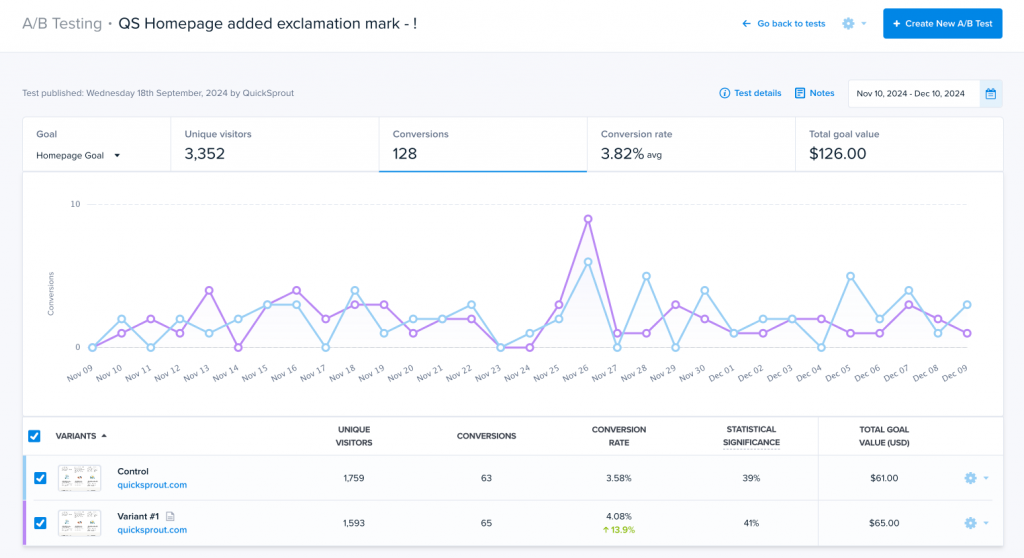
AB Tasty is the clear leader in sheer testing variety. Beyond standard A/B and split URL tests, it offers robust multivariate testing and complex mutually exclusive experiments—a necessity for large sites running dozens of simultaneous tests. It also provides "Feature Experimentation," allowing product engineering teams to manage feature flags and server-side rollouts.
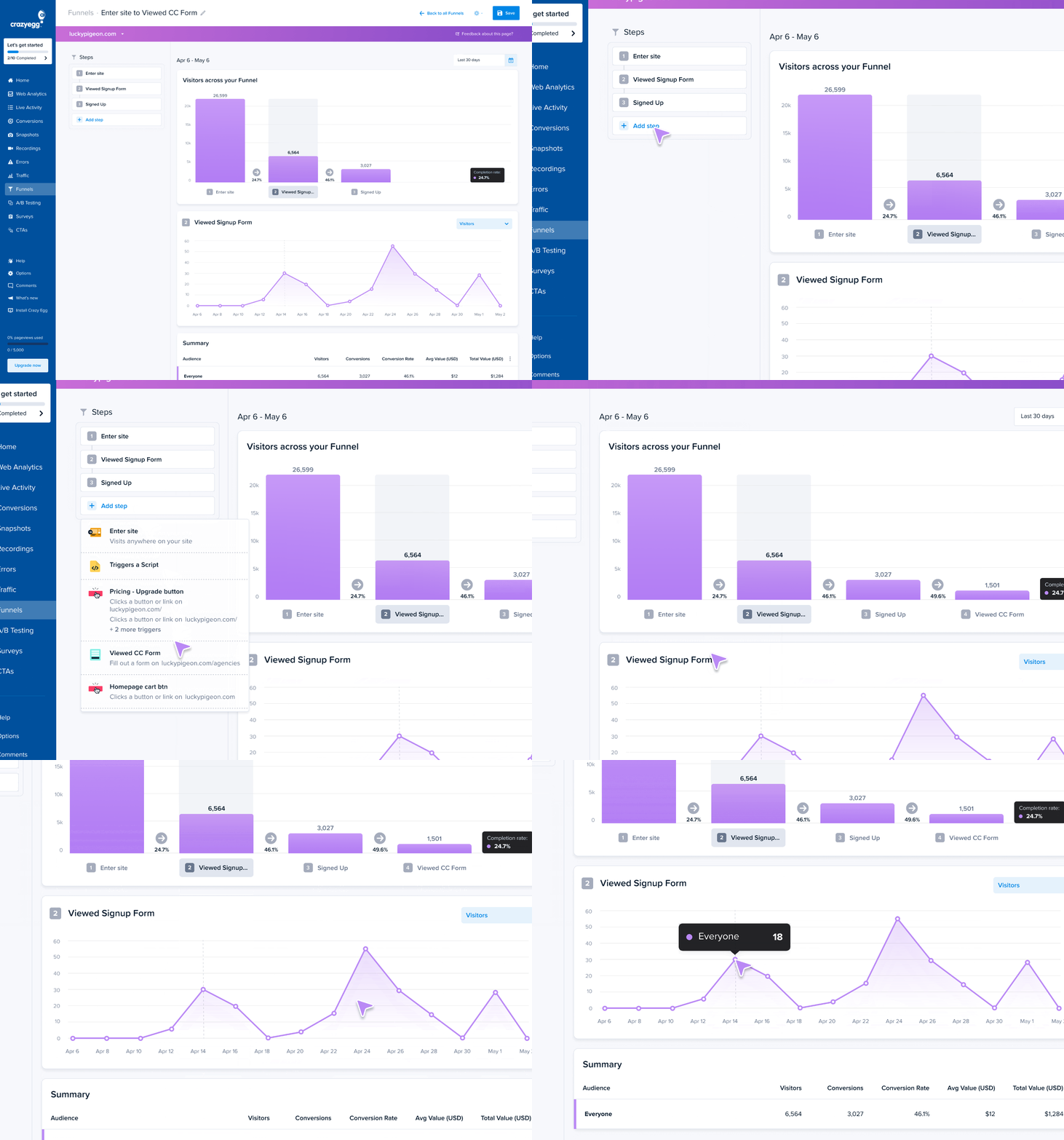
Crazy Egg focuses on the "practical" side of testing. While it lacks multivariate testing, it provides a seamless visual editor and a powerful Multi-Armed Bandit (MAB) algorithm that automatically reallocates traffic to winning variants. Its strongest differentiator is that every test variant comes with auto-generated heatmaps and session recordings, allowing teams to not just see that a variant won, but to understand why.
2. Analytics, Heatmaps, and Session Replay
This is where the two platforms diverge most sharply.
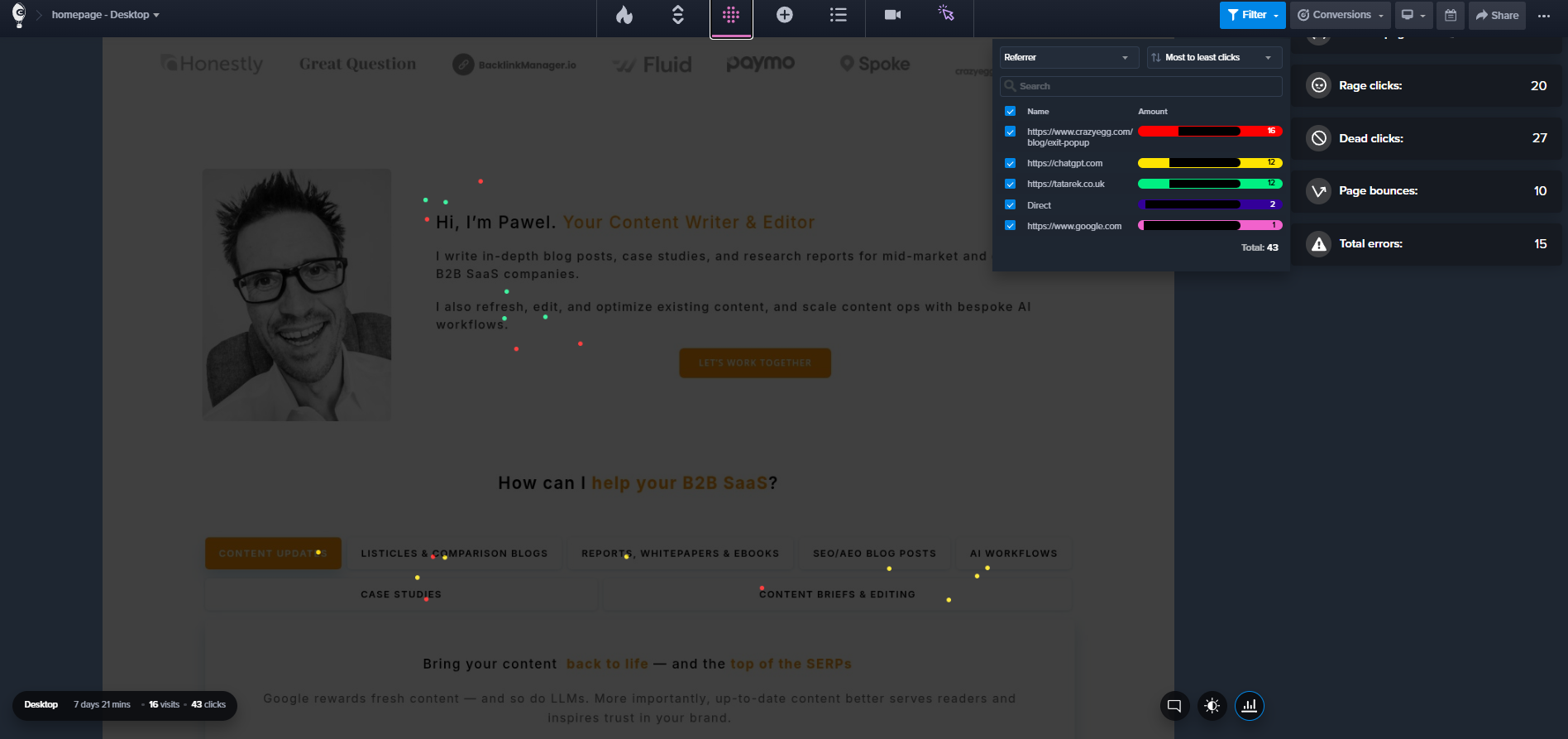
- Crazy Egg: Includes a native web analytics dashboard, conversion tracking, and a visual funnel builder. It provides five types of heatmaps (Click, Scroll, Confetti, Overlay, and List) and full session recordings auto-tagged with 13+ event types.
- AB Tasty: Does not include native analytics or heatmap modules. It assumes you are already using a stack like GA4, Mixpanel, or Contentsquare. If you choose AB Tasty, you must be prepared to pay for and manage these external integrations.
3. JavaScript Error Tracking
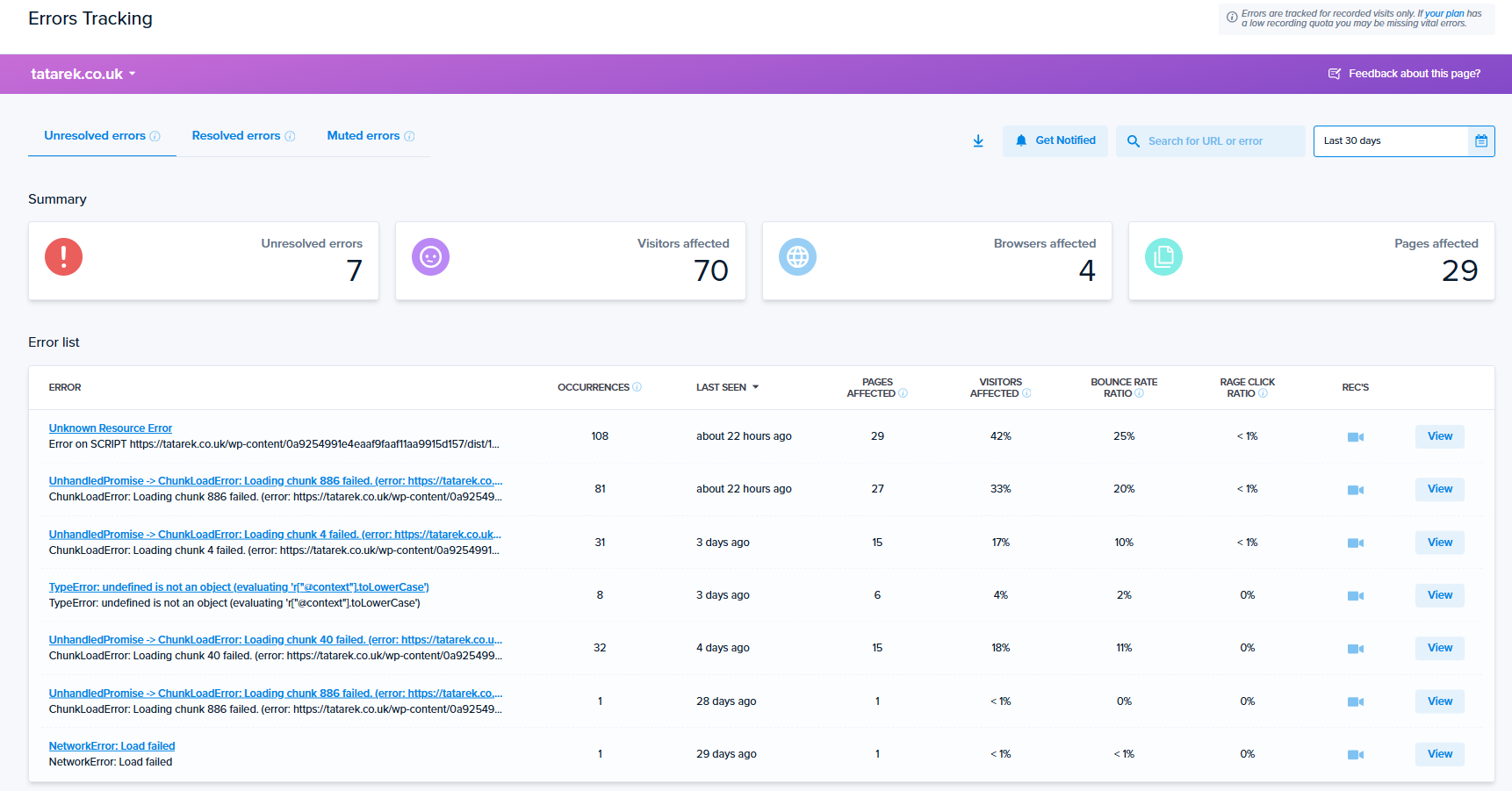
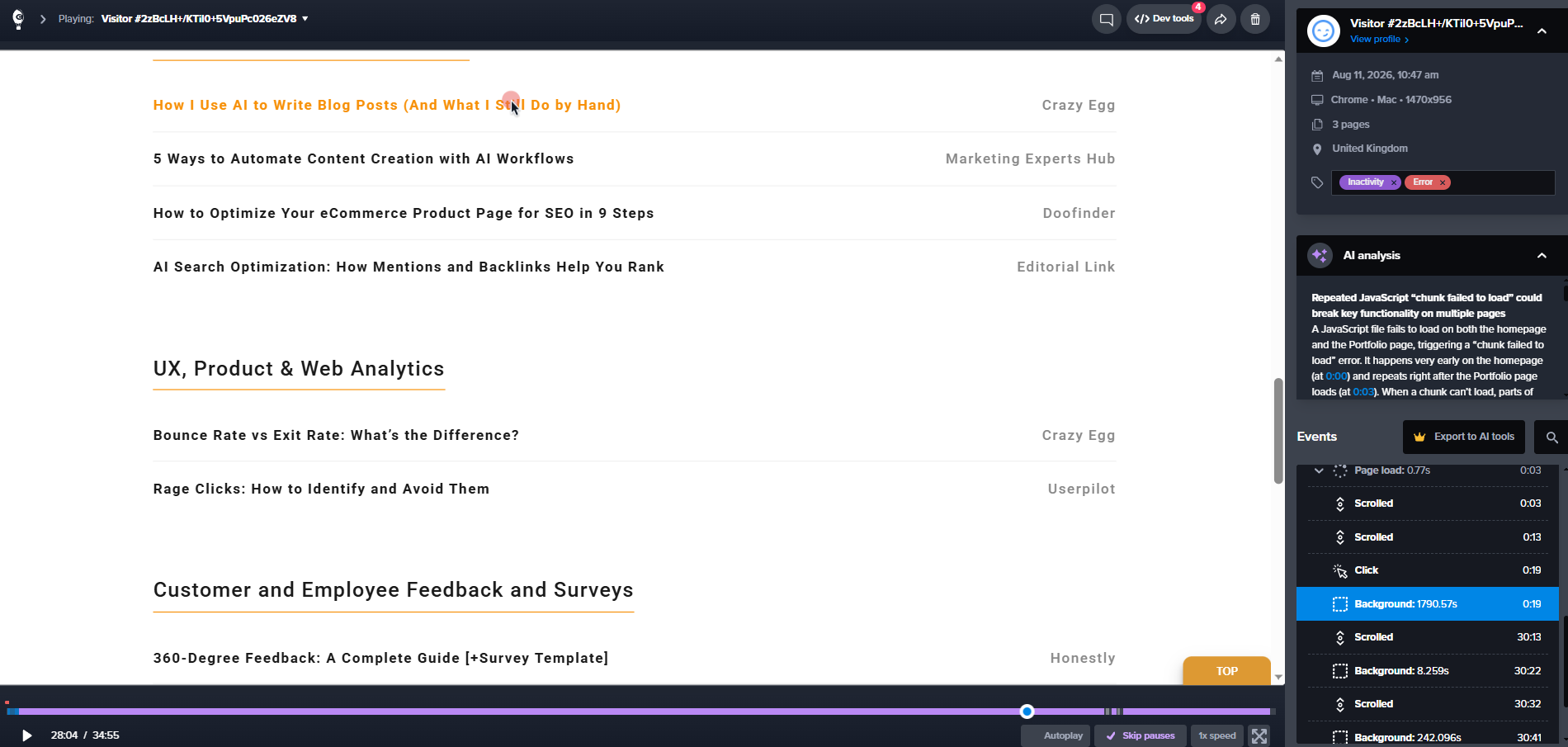
A silent killer of conversions is the JavaScript error. Crazy Egg captures these errors automatically, providing a stack trace and—crucially—a link to the exact session recording where the error occurred. This allows developers to see the user’s frustration in real-time. AB Tasty does not track live JS errors, relying instead on third-party integrations like LogRocket or Sentry.
4. Personalization and AI
Both platforms have aggressively integrated AI, but with different goals:
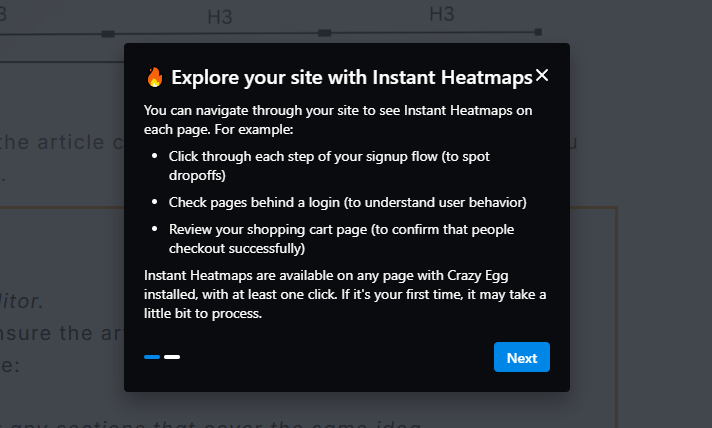
- Crazy Egg emphasizes AI Analysis and Workflow. Its MCP server allows users to query their data directly from tools like Claude or Cursor. Its upcoming "Tasks" feature automates the entire optimization loop, from identifying a problem to suggesting a variant.
- AB Tasty emphasizes AI-Driven Personalization. Its "Wandz" layer and "EmotionsAI" (which classifies user behavior into emotional profiles) are designed for highly complex, personalized customer journeys. If you have a large budget and need predictive intent modeling, AB Tasty’s "AdaptiveCX" is a powerhouse.
Implications of Choice: Value and Scalability
When evaluating these tools, the financial implications are significant.
Crazy Egg offers a transparent pricing model based on tracked pageviews with no overages. Their enterprise plan, at $599/month, provides a comprehensive suite of features that would cost significantly more if purchased as separate tools (analytics, session replay, and testing).
AB Tasty utilizes a quote-based, enterprise-only model. Market data from platforms like Vendr suggests that annual contracts for AB Tasty often range from $40,000 to over $150,000 depending on session volume. While this provides premium support and a dedicated Customer Success Manager (CSM), it is a major capital investment that demands a high ROI to justify the spend.
Official Stances and User Considerations
The merger of AB Tasty and VWO has created a new entity under the "Wingify" umbrella. Organizations currently renewing their AB Tasty contracts should perform due diligence to ensure that the transition to the new corporate structure does not disrupt their service level agreements (SLAs).
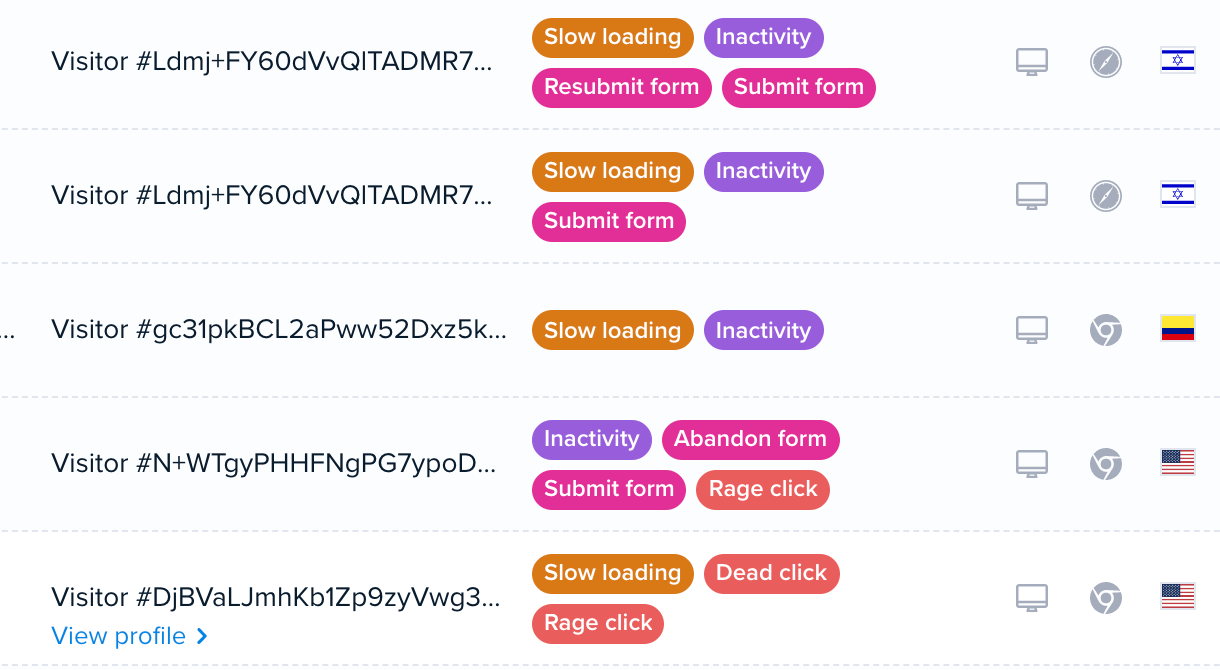
Crazy Egg continues to lean into its "SMB-to-Enterprise" accessibility, maintaining that a tool should be powerful enough for a Fortune 500 company but intuitive enough for a lean marketing team. Their commitment to US-based priority support and a no-credit-card-required trial underscores this philosophy.
Final Verdict: Which Path to Take?
Choose AB Tasty if:
- You are a large enterprise with a dedicated, well-staffed CRO and data analytics team.
- You already have an established tech stack (Analytics, Heatmapping, Session Replay) and only need a high-end, specialized engine for A/B/n and multivariate testing.
- You require server-side testing and complex, global-scale feature flagging.
- Budget is secondary to feature depth and customizability.
Choose Crazy Egg if:
- You want a unified "all-in-one" platform that eliminates the need for managing multiple vendor contracts.
- You value the ability to see why a test won through integrated heatmaps and session recordings.
- You need built-in JS error tracking and a survey builder without paying extra.
- You want predictable, transparent pricing that scales with your traffic rather than massive annual licensing fees.
The Bottom Line: If your team is currently "tool-fatigued" and looking to consolidate your stack while increasing your speed-to-insight, Crazy Egg offers a compelling, modern alternative to the high-friction, enterprise-exclusive model of AB Tasty. However, if your experimentation program is already mature and requires the most granular, heavy-duty testing features on the market, the newly merged AB Tasty/VWO ecosystem remains the industry heavyweight.
