

The Great Rewiring: How AI Agents are Redefining the Marketing Landscape for 2026
As we approach 2026, the marketing industry stands at a critical juncture. For the past two decades, the "Martech" revolution has been defined by the pursuit of automation, data integration, and the optimization of human-led workflows. However, the emergence of autonomous AI agents is shifting the goalposts entirely. This is no longer just about using software to help marketers work faster; it is about a fundamental restructuring of how businesses reach, interact with, and transact with their customers.
On December 2, the Martech for 2026 report will be unveiled, offering an exhaustive look at this paradigm shift. The findings suggest that the industry is moving past the experimental phase and into an era of "Agentic Commerce," where the primary interface for many consumers will no longer be a website or a search engine, but an AI-powered assistant.
The Rise of the Agentic Ecosystem: Main Facts
The core narrative of the upcoming report is simple but profound: AI agents are officially a cornerstone of the modern marketing stack. According to the AI & Data in Marketing study, a staggering 90.3% of participants—comprised of leaders at top-tier B2B and B2C brands—are already integrating AI agents into their operations.
These aren’t just chatbot interfaces or simple automated responders. These are task-oriented systems capable of brainstorming, producing, distributing, and analyzing campaigns. Yet, the report draws a critical distinction between two types of agents:
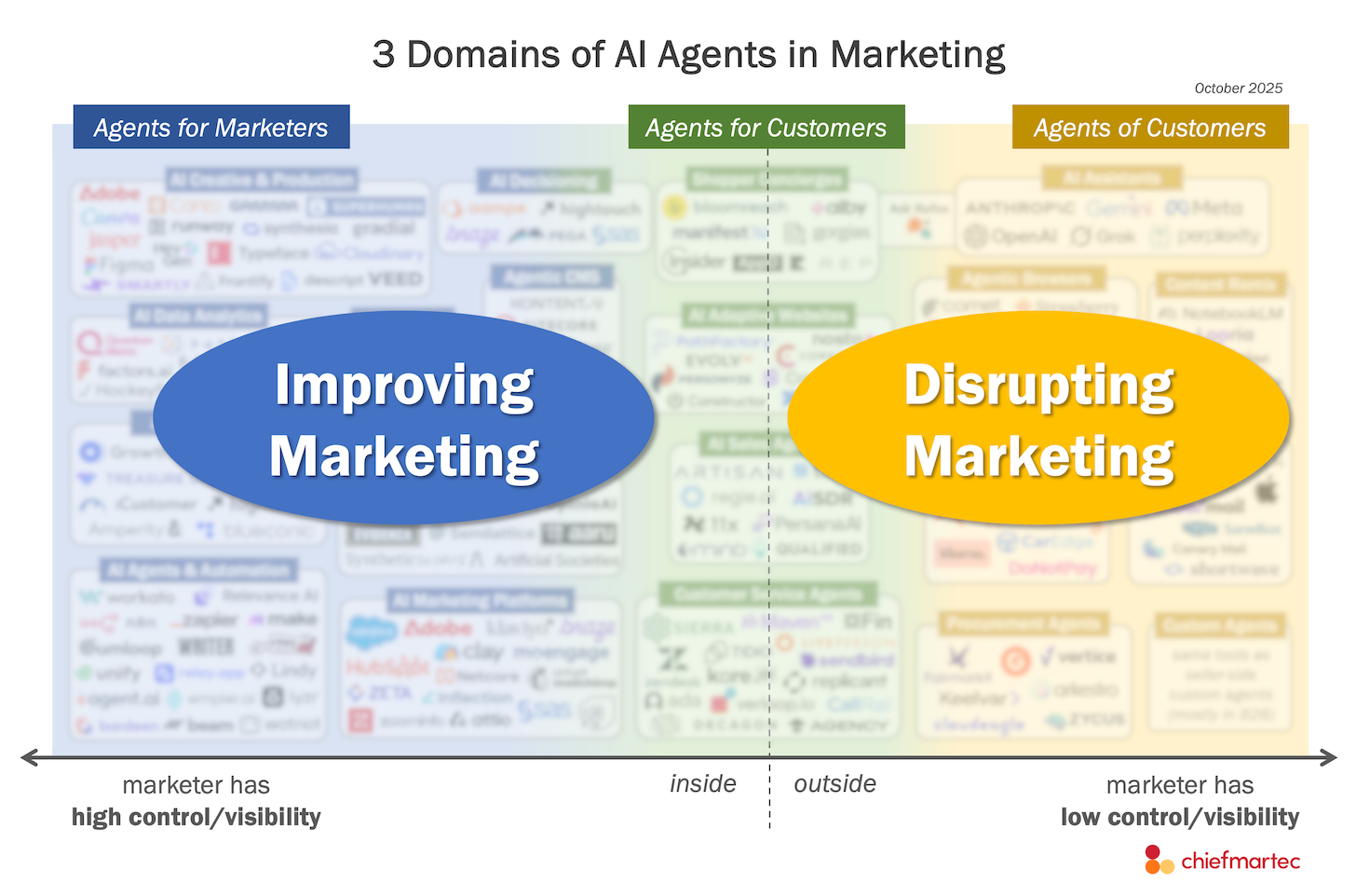
- Seller-side agents: Tools designed to help marketers "do more with less."
- Buyer-side agents: Independent entities that consumers use to navigate the marketplace, effectively bypassing traditional marketing funnels.
While seller-side agents offer incremental efficiency gains, the report argues that buyer-side agents represent a genuine, structural disruption to the traditional buyer’s journey.
A Chronology of the Shift
To understand how we arrived at this moment, one must look at the rapid acceleration of AI capability over the last 24 months:
- 2023: The Generative Awakening. The industry focused on Large Language Models (LLMs) as creative assistants for content generation and basic data synthesis.
- 2024: The Proliferation of "Agentic" Tools. Martech platforms began baking autonomous features into their suites, allowing marketers to automate entire workflows rather than just individual tasks.
- 2025: The Rise of Action Engines. We saw the emergence of AI as a transactional partner. OpenAI’s "Instant Checkout" for Etsy and Shopify, along with Walmart’s integration into ChatGPT, marked the shift from "answer engines" to "action engines."
- Late 2025 – Early 2026: The Agent-to-Agent Frontier. Google introduced features where its Gemini agent could initiate voice calls to local businesses to verify stock and pricing. This signaled the death of the passive, static website experience.
We are currently witnessing the final stages of the "Search Era," as SEO playbooks that governed the last 25 years are being rendered obsolete by AI assistants that synthesize information rather than providing a list of links.
Supporting Data: The Pragmatic Shift
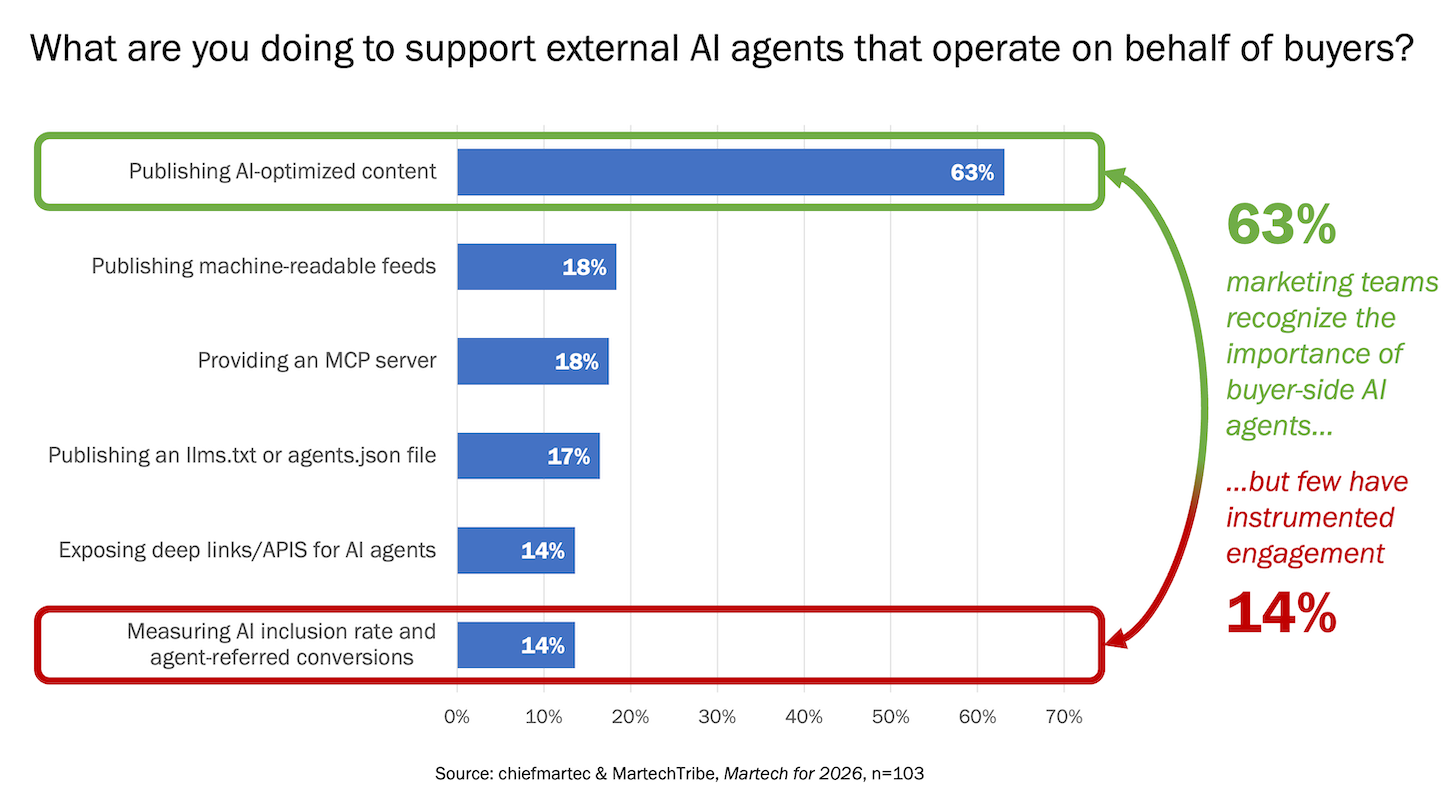
The Martech for 2026 report provides quantitative evidence of this industry-wide pivot. While 63% of marketing teams acknowledge that their buyer demographics have shifted toward AI-assisted research and purchase channels, the execution gap remains vast.

- Recognition vs. Instrumentation: While over 60% of teams are adjusting their strategy, only 14% have formally instrumented their tech stacks to support or influence these buyer-side agents.
- The Investment Gap: This 14% is expected to grow rapidly as companies realize that visibility—once guaranteed by top-ranking Google search results—is evaporating.
- Operational Maturity: The study notes that participants are not "starry-eyed" or reckless; they are highly pragmatic. These are organizations managing high-stakes, multi-million dollar portfolios, and they are prioritizing agentic support not as a luxury, but as a survival mechanism.
Official Perspectives: The End of the "Outbound" Era
One of the most provocative findings in the report is the irony surrounding outbound marketing. For years, B2B companies have heavily invested in AI-driven SDRs (Sales Development Representatives) to automate the bombardment of prospects with "personalized" outreach.
The report suggests that this strategy is about to face a harsh reality check. As buyers empower their own AI agents to screen calls, filter emails, and handle vendor evaluations, the "outbound" model of the early 2020s is becoming increasingly ineffective.
Industry analysts observe that we are in a "brief, awkward intermediate state." Currently, we have human sales reps dealing with incoming calls from AI agents, or conversely, AI agents harassing human buyers. This friction is unsustainable. The natural evolution, according to the report, is the inevitable adoption of agent-to-agent negotiation. In this future, your company’s AI agent will negotiate terms, availability, and pricing with the buyer’s AI agent, with human intervention only occurring at the final "signature" or exception-handling stage.
Implications for the Future of Marketing
The implications for marketers are severe and far-reaching. The "Great Rewiring" of the buyer’s journey means that the brand’s website is no longer the destination—it is merely an API endpoint for an AI agent to query.
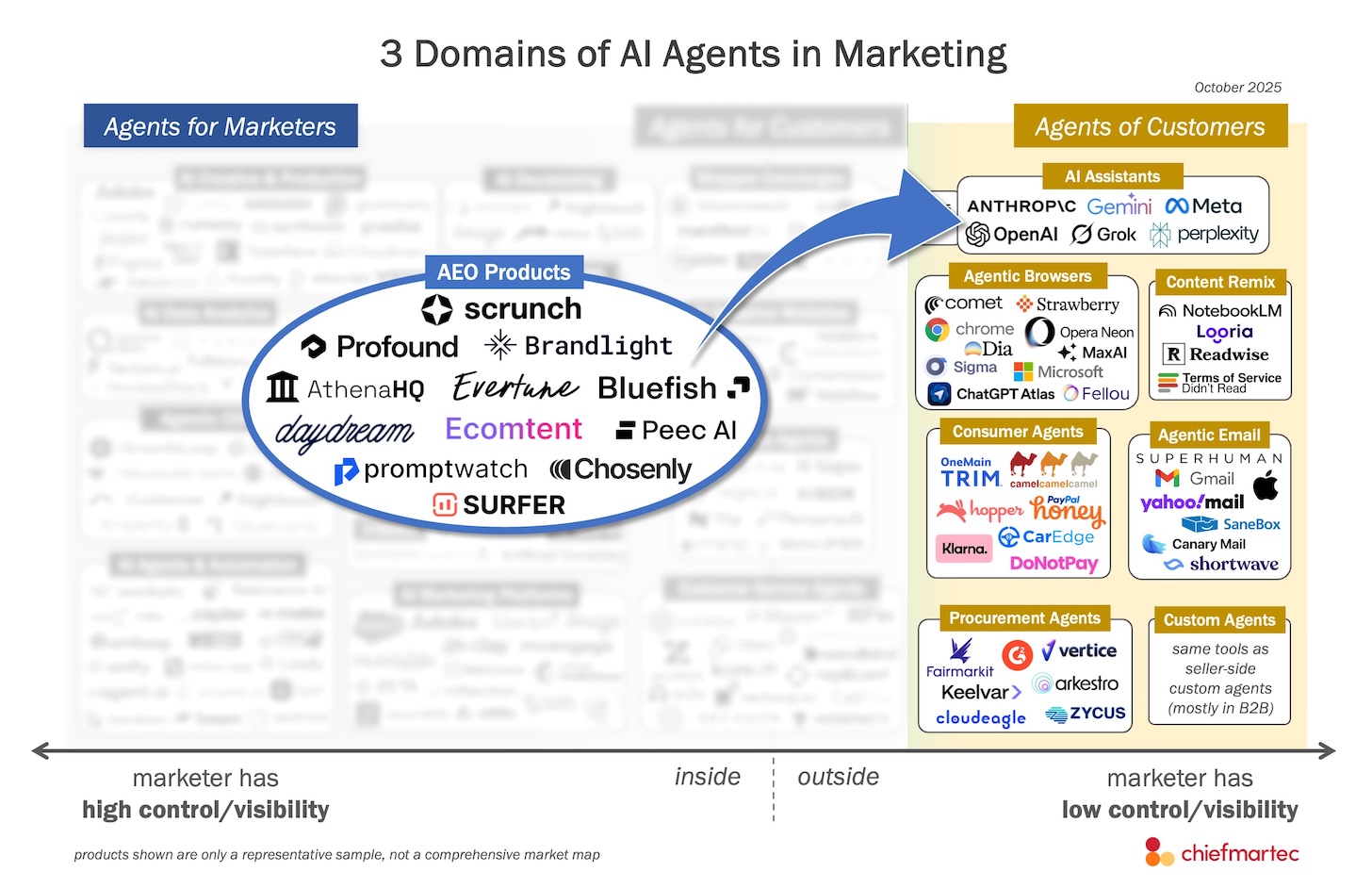
1. From SEO to AEO
Search Engine Optimization is being replaced by Agent Engine Optimization (AEO). Marketers must now ensure that their data, product information, and brand values are structured in a way that is easily consumable by AI agents. If your brand cannot be "read" or "interacted with" by a model like Claude, Perplexity, or Gemini, it effectively does not exist.
2. The Loss of the "Middle" Journey
Traditionally, marketers nurtured leads through a series of content touchpoints: whitepapers, webinars, and emails. Buyer-side agents are collapsing this journey. When an AI agent performs a deep-dive research task on behalf of a buyer, it extracts the value of your content without the buyer ever visiting your site, viewing your ads, or signing up for your newsletter.
3. The Need for "Agent-Readable" Architecture
Marketing operations (MOps) teams will need to pivot their focus from creating "customer experiences" to creating "machine experiences." This means investing in structured data, real-time API availability for inventory and pricing, and building brand-specific "System Prompts" that ensure an AI agent representing your brand acts according to company guidelines.
4. Re-evaluating Efficiency
The clichéd executive mandate to "do more with less" is finally finding a real solution, but it comes at the cost of the old guard’s playbook. The companies that succeed in 2026 will be those that stop trying to force the human buyer into a manual funnel and start facilitating the machine-to-machine exchange of value.
Conclusion: The Path Forward
The Martech for 2026 report concludes with a call to action for marketing leaders: the era of manual, human-to-human digital marketing is receding. The transition toward agentic commerce is not merely a technological upgrade—it is a change in the fundamental physics of the market.
As we move into 2026, the competitive advantage will go to those who can successfully navigate the "Great Rewiring." By joining the webinar on December 2, marketing professionals will gain access to the full scope of this research, including the specific, pragmatic steps necessary to transition from traditional demand generation to an agent-first strategy.
The future is not waiting for us to catch up; it is being written by the agents that are already scouring the web on behalf of our customers. The only question remains: is your brand prepared to speak their language?
The full report is available to all who register for the December 2 webinar. This research is made possible by the support of our sponsors: GrowthLoop, Hightouch, Intuit Mailchimp, MetaRouter, Progress, SAS, and Treasure Data.
