

Cracking the Code: How Global News Publishers Are Rewriting the Rules of Social Video Engagement
By the Global Media Insights Desk
Published: March 2026
Main Facts: The Algorithmic Battleground for Modern Newsrooms
In the modern media ecosystem, traditional news publishers are no longer just competing against rival outlets for the fleeting attention of audiences. Instead, they find themselves locked in a complex chess match against unseen algorithmic arbiters. Platform algorithms weigh relevance, timing, format precision, and user retention to determine which pieces of journalism break through the digital noise and which vanish into obscurity.
Recent cross-platform performance data reveals an undeniable reality: audience behavior within the News & Politics genre on social video is intensely nuanced. Success on these platforms is no longer a byproduct of luck or merely possessing a recognizable brand name. Rather, it depends entirely on aligning content strategy with how modern viewers actually consume, digest, and react to information.
Drawing on comprehensive cross-platform metrics from Tubular Intelligence spanning November 2025 through February 2026, media analysts have tracked video length, optimal posting windows, trending hashtags, and top-performing stories across the Asia-Pacific (APAC), Latin America (LATAM), Europe, Middle East, and Africa (EMEA), and North America. The findings offer a rare, data-driven blueprint for newsrooms striving to maximize both reach and engagement in an increasingly crowded digital landscape.
Chronology: The Evolution of Social Video Consumption (November 2025 – February 2026)
To understand how audience engagement has shifted, it is necessary to examine the timeline of consumer behavior across the recent winter publishing cycle:
- Late November 2025: As global political events intensified—including high-profile geopolitical flashes and major shifts in domestic policies—social media feeds saw a sudden surge in upload volume. Publishers across EMEA and North America flooded platforms like Instagram and TikTok with mid-length breaking news clips, attempting to capitalize on the news cycle.
- December 2025: Data analysis began to expose a critical disconnect between publisher output and consumer demand. While newsrooms continued to favor mid-length content (2 to 5 minutes) and afternoon posting slots, analytics showed that audiences were gravitating toward polar opposites: ultra-short clips or deep-dive explainers.
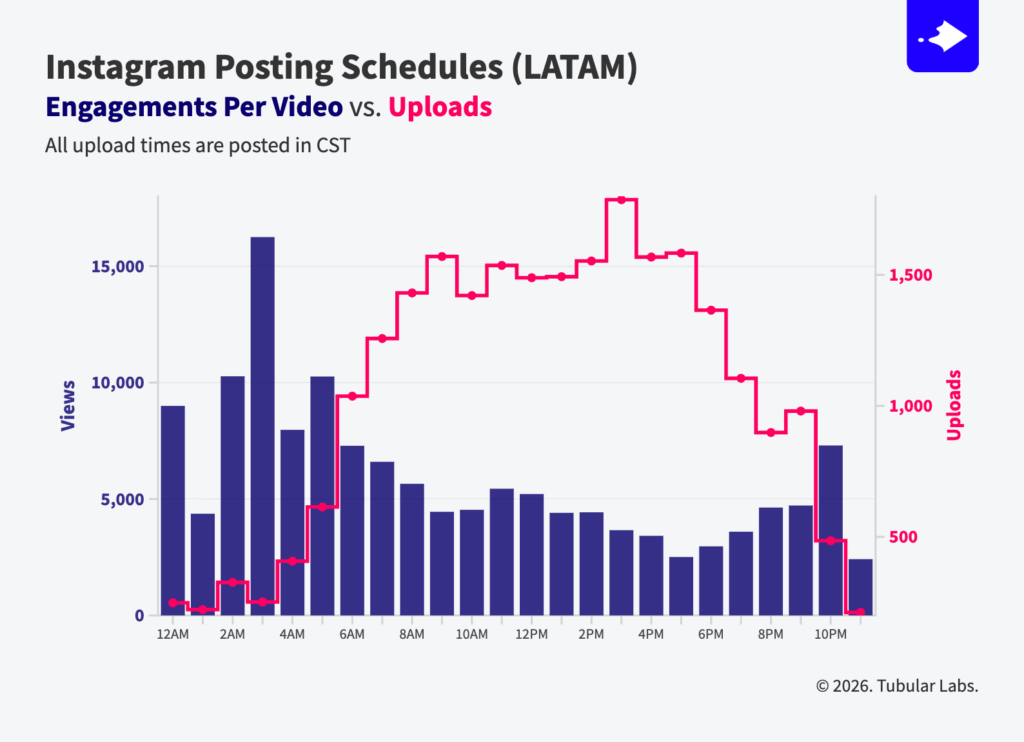
- January 2026: Regional anomalies came to light. In Latin America, a distinct timing mismatch was identified; publishers predominantly posted during the evening commute (around 3:00 PM to 3:59 PM CST), while actual per-video engagement peaked dramatically in the dead of the early morning (3:00 AM to 3:59 AM CST).
- February 2026: Viral moments on TikTok underscored a profound shift in consumer psychology. While hard news driving mass global viewership commanded hundreds of millions of views (such as updates on public figures and major accidents), engagement exploded whenever serious topics unexpectedly intersected with humor, cultural commentary, or emotional reactions.
Supporting Data: Regional Insights and Algorithmic Realities
The Tubular Intelligence dataset breaks down performance across distinct geographical markets, highlighting that a one-size-fits-all global distribution strategy is inherently flawed.
1. APAC: The Duration Dilemma
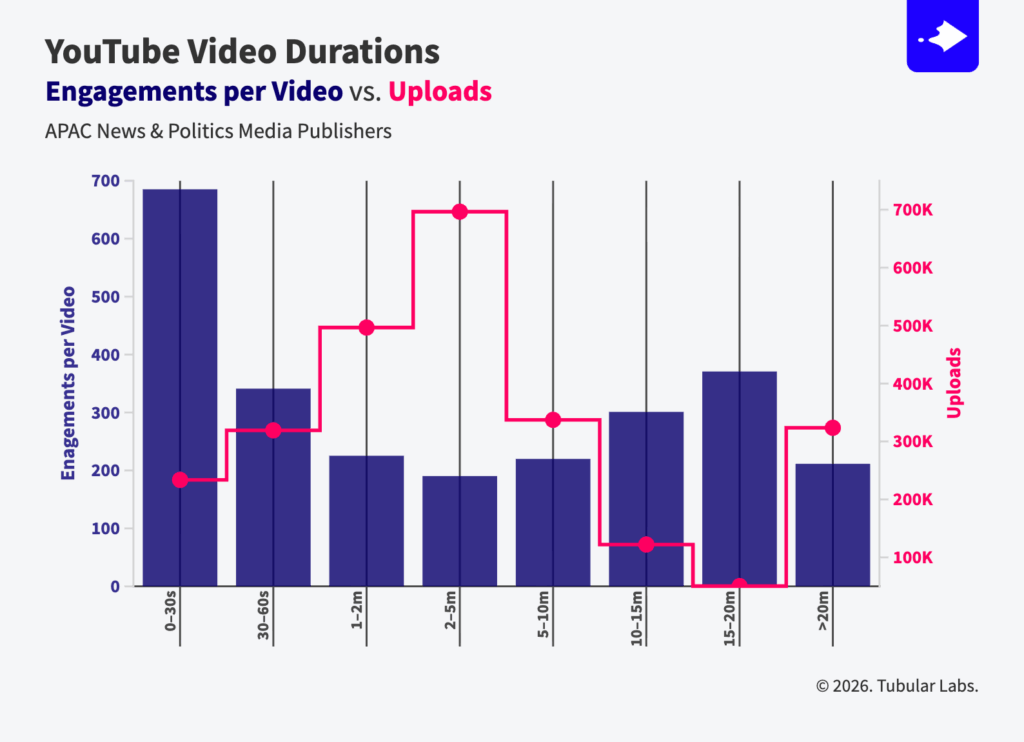
When analyzing News & Politics publishers in the Asia-Pacific region, a distinct polarization in viewer retention emerges. Audiences in APAC engage most heavily with two specific extremes:

- Ultra-short updates (0–30 seconds): Ideal for quick-hit context and immediate breaking news capture.
- Deep-dive long-form updates (15–20 minutes): Perfect for comprehensive context, investigative journalism, and nuanced political analysis.
Paradoxically, mid-length videos (ranging from 2 to 5 minutes) dominate total upload volume across APAC publishers. However, these mid-length uploads consistently underperform when it comes to maximizing engagement per video.
The Strategic Takeaway: Newsrooms relying heavily on mid-length content are likely optimizing for internal output quotas at the expense of true consumer impact. Streamlining content into either punchy shorts or immersive long-form features yields significantly better returns.
2. LATAM: Capitalizing on the Early-Morning Engagement Window
In Latin America, publishing habits run counter to optimal consumer behavior. LATAM media publishers post most frequently during the evening hours. However, performance data indicates that engagement per video peaks remarkably early in the morning—specifically between 3:00 AM and 3:59 AM CST.
By contrast, the majority of publisher uploads occur later in the day, around 3:00 PM to 3:59 PM CST.
The Strategic Takeaway: This timing mismatch represents a goldmine of untapped potential. Publishers willing to experiment with early-morning distribution windows can capture higher per-video engagement while facing significantly less competition from rival media outlets.
3. EMEA: Beyond Categorization—The Power of Strategic Hashtags
In Europe, the Middle East, and Africa, an examination of top-performing Instagram hashtags reveals a sophisticated approach to discoverability. EMEA publishers do not merely use tags for basic content categorization; they utilize a strategic blend of:
- Global Political Flashpoints: Tags such as
#trump,#ICE, and#venezuelacapture international search traffic. - Major Broadcaster Branding: Proprietary tags like
#bbcnewsreinforce institutional authority and trust. - Country-Specific Identifiers: Localized tags expand cross-border discoverability, allowing global audiences to track localized events seamlessly.
The Strategic Takeaway: Hashtags act as search engine optimization (SEO) tools on social platforms. When leveraged correctly, they build brand equity and expand a publisher’s footprint across international borders.
4. North America: Views vs. Engagement on TikTok
North American data on TikTok highlights a stark behavioral divide between passive viewership and active engagement. Mass reach is reliably generated by high-profile breaking news and global events—such as Reuters’ coverage of a major traffic accident in Nigeria involving British heavyweight boxing champion Anthony Joshua, which garnered 180 million views in 30 days.
Conversely, engagement explodes when content sparks unexpected emotional or cultural reactions. For instance, a crowd interview at an Immigration and Customs Enforcement (ICE) protest—where a participant casually mentioned buying their first AR-15 in response to the agency—generated 63.5 million engagements in just 7 days. Though the original interview was conducted with serious intent, online audiences widely mocked the interaction, driving unprecedented comment sections and algorithmic distribution.
The Strategic Takeaway: TikTok users do not consume hard news the way they consume it on legacy websites or television broadcasts. While breaking stories drive broad awareness, genuine community engagement surges when stories trigger conversation, debate, and cultural humor.
Official Industry Responses and Expert Perspectives
As media executives grapple with shifting platform mechanics, industry leaders are re-evaluating how newsrooms allocate resources.
"Publishers can no longer afford to throw content against the digital wall and hope something sticks," noted a digital strategy director familiar with the Tubular Intelligence findings. "The data proves that modern audiences have carved out very specific consumption habits. If you are serving a 4-minute mid-length video to an APAC audience that wants either a 15-second teaser or a 20-minute deep-dive, you are fighting the algorithm."
Furthermore, insights regarding scheduling anomalies in regions like Latin America have forced digital editors to reconsider automated publishing schedules. "We have been conditioned to post during peak waking hours," remarked a senior audience development manager based in the Americas. "Discovering that engagement spikes in the pre-dawn hours means we have to rethink not just what we write, but when our automated feeds wake up our readers."
Industry analysts emphasize that social video platforms are evolving into search engines in their own right. Younger demographics increasingly turn to TikTok and Instagram to search for breaking news and political commentary rather than traditional search engines. Consequently, newsroom SEO strategies must expand to encompass video metadata, caption optimization, and hashtag architecture.
Implications: The Future of Newsroom Strategy
The clear, overarching takeaway from the late 2025 and early 2026 data is that success in the News & Politics genre is no longer dictated solely by scoop access or editorial prestige. It is fundamentally governed by delivery mechanics.
For media publishers, digital brands, and newsrooms navigating this hyper-competitive era, the path forward involves several critical adaptations:
- Ditch the Middle Ground: Publishers must audit their video duration strategies. By trimming quick updates into ultra-short vertical formats and reserving complex topics for long-form explainers, newsrooms can prune underperforming mid-length clutter.
- Timing Discipline: International desks must respect regional nuances. LATAM’s early-morning engagement window proves that non-traditional scheduling can yield higher visibility and lower competition.
- Optimize for Conversation, Not Just Broadcast: Hard news secures initial views, but community engagement requires human elements, relatability, and cultural resonance.
- Harness Searchable Metadata: In regions like EMEA, hashtags and keywords function as vital discovery pipelines. Treating social metadata as an afterthought means forfeiting organic reach to more digitally agile competitors.
Ultimately, the mandate for the modern newsroom is clear: Do not publish more; publish smarter. By aligning content strategies with real audience behavior, platform mechanics, and regional nuances, publishers can transform social video from a volatile guessing game into a predictable engine of audience growth and authority.
To uncover deeper, custom News & Politics insights tailored to your specific region, publication type, or platform strategy, industry professionals can reach out to data analytics firms like Tubular Labs to request a specialized platform demonstration.
