
Beyond the Follower Count: Why Audience Intelligence is the New Currency of Influencer Marketing
In the high-stakes world of modern digital marketing, the traditional metrics of success—follower counts, vanity views, and broad-spectrum impressions—are increasingly being viewed as artifacts of a bygone era. Today, the organizations winning the battle for market share are not necessarily those with the most bloated budgets, but those employing a more surgical approach. They are moving beyond simple reach to ask smarter, deeper questions about their target demographics, uncovering which creators are actually driving tangible business outcomes versus those who are merely generating noise.
This shift in strategy serves as the bedrock of a new industry report, Redefining Influencer Value: How Audience Intelligence Transforms Reach into Revenue. Across diverse sectors, including healthcare, gaming, and consumer packaged goods (CPG), the data reveals a startling consistency: the creators generating the highest volume of views are frequently not the ones driving the most significant value for brands.
The Evolution of Influence: From Reach to Resonance
For years, the influencer marketing playbook was simple: find creators with the largest followings, pay for a placement, and hope for a conversion lift. However, the saturation of the creator economy has made this "spray and pray" approach inefficient and costly.
According to the latest research, the brands that are thriving in 2025 are those utilizing "audience intelligence"—a combination of search affinity, shopping behavior, and cultural alignment. This data-driven framework allows marketers to map the complex journeys consumers take across social platforms. By understanding not just who is watching a creator, but why they are watching and where they go next, brands can transition from reactive posting to proactive narrative building.
Healthcare: Navigating the Clinical and the Curious
Perhaps no industry illustrates the necessity of this shift more clearly than healthcare. In the digital space, the healthcare conversation is no longer confined to traditional clinical advice. It has become a fluid, multifaceted dialogue where medical professionals and alternative wellness advocates share the same screen.
The Duality of Digital Health
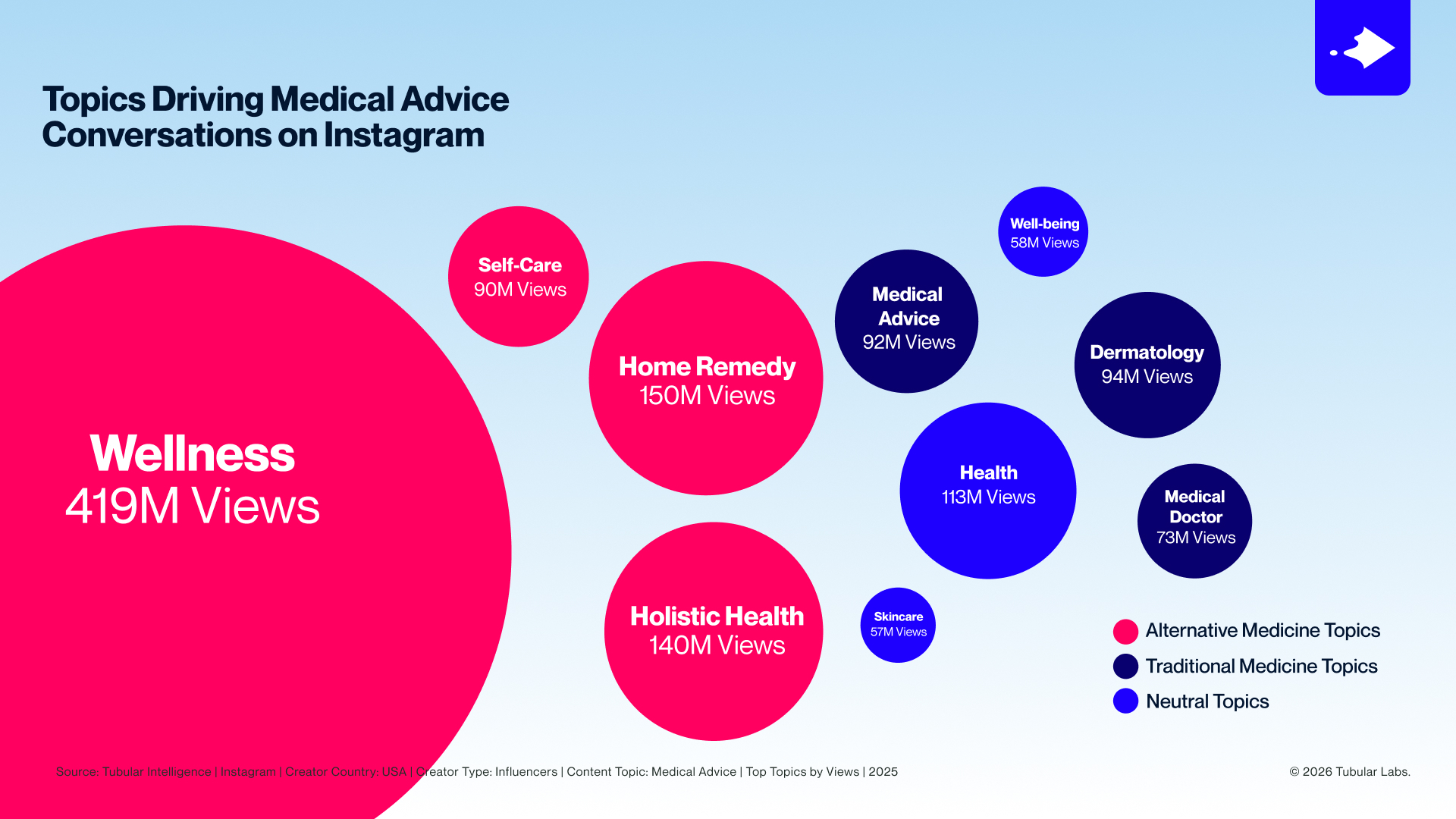
Our analysis of U.S. influencer content on Instagram throughout 2025 shows a striking overlap between traditional clinical narratives and alternative health trends. Consumers are not choosing one over the other; they are consuming both simultaneously. This creates a critical strategic opportunity for pharmaceutical, supplement, and skincare brands.
When a brand limits its visibility to purely clinical content, it inadvertently cuts itself off from the vast segment of the audience that is actively seeking "alternative" or holistic viewpoints. To reach the modern health-conscious consumer, brands must meet them where their curiosity is highest and where their intent is being formed. The data indicates that showing up exclusively in clinical settings means missing a significant portion of the total addressable market.
Case Study: Dr. Charles, MD vs. Dr. Neera Nathan
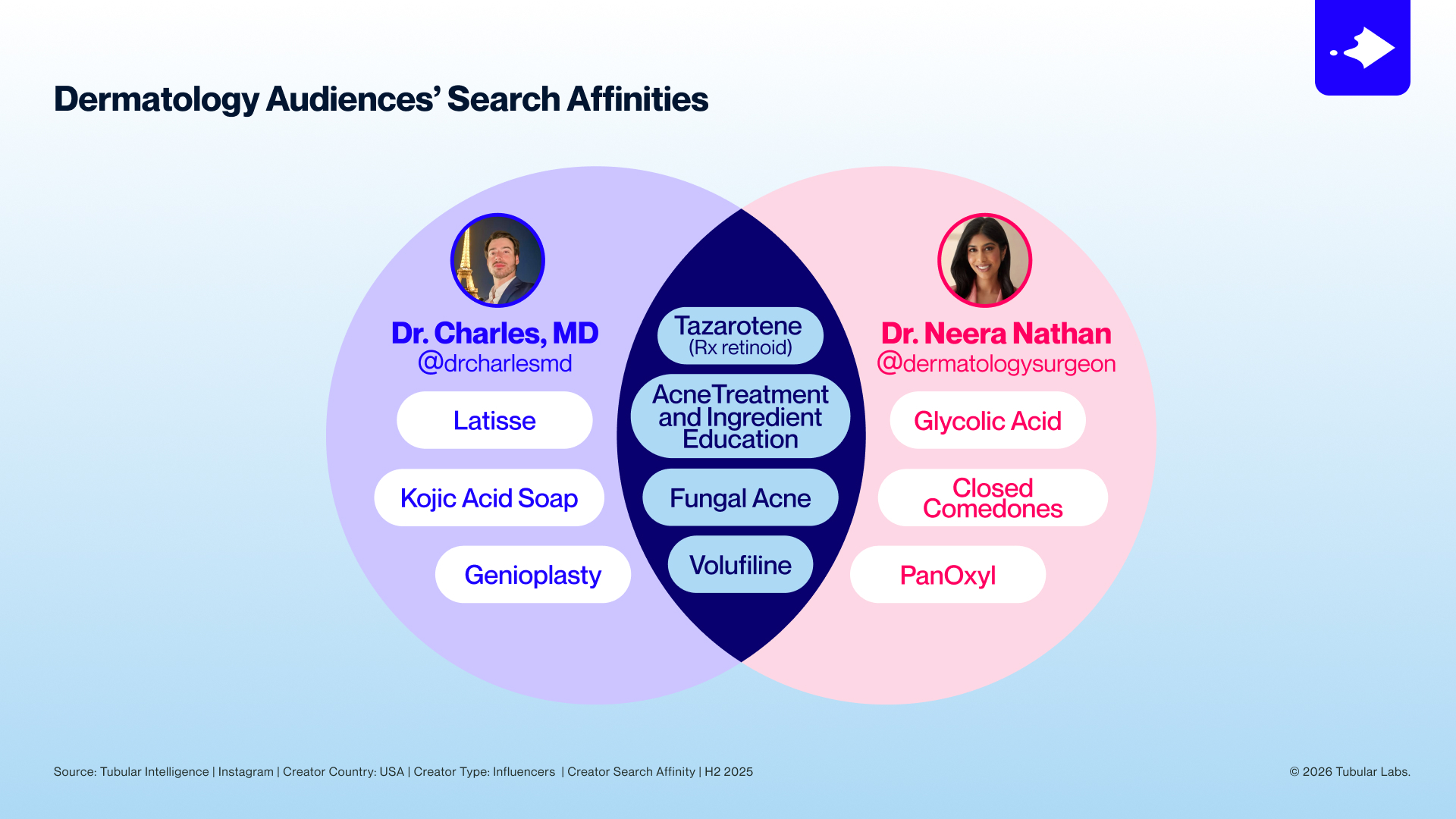
To demonstrate how audience intelligence dismantles the "follower count" myth, consider the dermatology space. A brand marketing a product like Latisse might naturally gravitate toward a creator like Dr. Neera Nathan, who commands an impressive 1.8 million followers. Her reach is broad and her content is medically sound.
However, when we layer in audience intelligence, a more nuanced picture emerges. By analyzing the search affinities of Dr. Nathan and her peer, Dr. Charles, MD, we uncover a fascinating asymmetry in their audiences.
While both creators command influence, their audiences move in different patterns. Our data shows that 17% of Dr. Charles’s audience also follows Dr. Neera Nathan, whereas only 2% of her audience follows him. This indicates that Dr. Charles acts as a bridge—a high-engagement entry point that offers clinical credibility before a user moves toward the broader, more mainstream educational content provided by Dr. Nathan. For a brand, this suggests that the "smaller" creator might actually be the superior choice for driving specific, high-intent conversions.
Gaming and CPG: Where Cultural Alignment Outperforms Category Fit
The principles identified in the healthcare sector are proving to be universal. Whether it is the hyper-active gaming communities of East Asia or the fast-moving CPG markets in Brazil, the story remains the same: data-driven identification outperforms intuition.
Gaming and Anime: The 18 Billion View Paradox
In 2025, YouTube anime influencers across East and Southeast Asia generated a staggering 18 billion views. While this number is visually impressive, it is an insufficient metric for ROI. The creators who are actually shaping fan behavior and driving purchase intent represent a small, specialized subset of that 18 billion. By parsing this data, brands can move away from the "billboard" style of marketing and toward authentic integration within the communities that actually move the needle.
The Brazilian Beverage Strategy
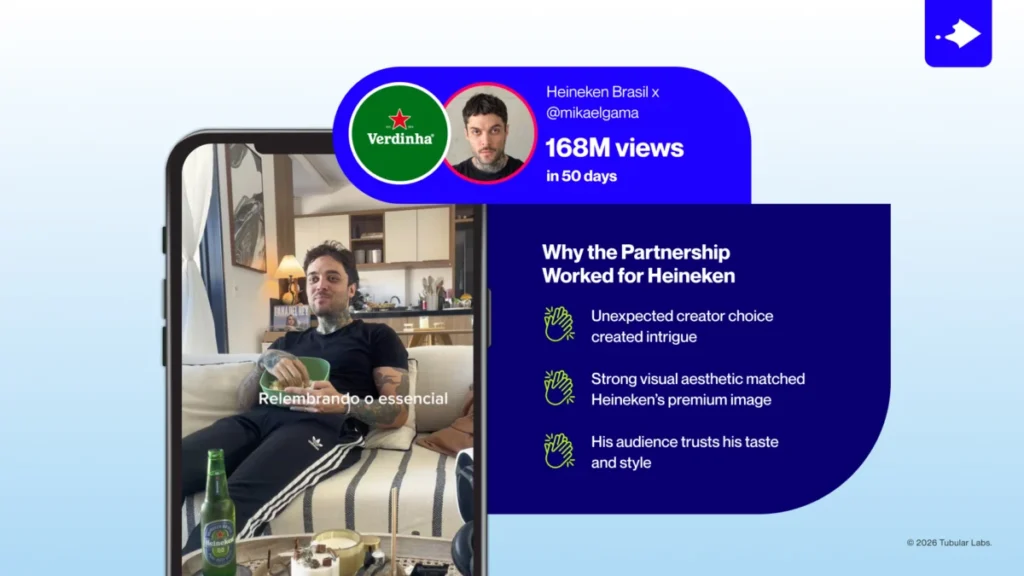
The power of cultural alignment was perhaps best demonstrated by a recent campaign in Brazil. In 2025, Brazil ranked second globally in influencer TikTok engagement. Heineken, looking to maximize its impact, bypassed the "expected" category influencers and partnered with a men’s fashion creator who boasted a relatively modest 136,000 followers.
The results were transformative: 168 million views and 1 million engagements in just 50 days. This success serves as a masterclass in why "cultural fit" frequently outperforms "category fit." The influencer’s audience, while not explicitly "beverage-focused," was perfectly aligned with the brand’s cultural ethos, leading to a level of authenticity that resonated far more effectively than a traditional endorsement from a larger, less-connected creator.
The Strategic Framework: How to Build Smarter Partnerships
For brands looking to replicate these successes, the path forward requires a move toward a more rigorous, intelligence-led framework. The following steps should guide any modern influencer strategy:
- Define Intent Over Reach: Before selecting an influencer, define the specific business outcome. Are you looking for brand awareness, educational shifts, or direct sales? Each requires a different type of influencer intelligence.
- Map Audience Overlap: Use data to see who your potential partners’ audiences are actually watching. The "bridge" creators—those who hold influence over a specific, high-intent niche—are often more valuable than those with broad, unsegmented reach.
- Prioritize Search Affinity: Look beyond what a creator says and look at what their audience searches for. If an audience’s search behavior aligns with your product’s value proposition, that is a high-probability conversion channel.
- Balance Clinical and Cultural Narratives: Don’t fear the "alternative." In sectors like health and beauty, the most effective strategy often involves positioning your brand within the white space between clinical expertise and cultural trend-following.
- Iterate via Data: Use the first 30 days of a campaign to measure the behavior of the audience rather than just the impressions. Adjust your partnership mix based on which creators are driving genuine engagement rather than just passive views.
Implications for the Future of Advertising
The transition from vanity metrics to audience intelligence signals a maturation of the influencer marketing industry. As platforms continue to evolve and algorithms become more sophisticated, the "middle class" of influencers—those with highly engaged, specialized audiences—will likely become the primary drivers of marketing ROI.
Furthermore, this shift forces a higher level of accountability on the creator economy. Influencers who can demonstrate that their audiences are not just numbers on a screen, but active, intent-driven consumers, will command higher premiums and longer-term partnerships.
Conversely, brands that persist in chasing high-follower counts without the backing of audience intelligence risk wasting significant portions of their budget on ghost audiences and unengaged impressions. The data is clear: reach is merely the starting point. The true strategy lies in understanding the complex web of interests, searches, and behaviors that turn a viewer into a customer.
Conclusion: The Bottom Line
The era of guessing is over. With the tools currently available, marketers have the ability to see exactly which influencer partnerships will drive impact and to invest their resources with confidence.
As we look toward the remainder of the decade, the winners will be the brands that treat audience intelligence as a foundational element of their marketing stack. They will be the ones that identify the "bridge" creators, respect the fluidity of consumer interests, and prioritize meaningful connection over superficial reach.
For those ready to dive deeper into the methodology and access the full breadth of data mentioned here, the Redefining Influencer Value report provides a roadmap for navigating this new, intelligence-first landscape. By aligning your brand with the creators who truly shape behavior, you move beyond being a participant in the noise and start becoming a leader in the conversation.
To explore the full data sets and discover how your brand can transition to an intelligence-led influencer strategy, download the full report here.
