

The Strategic Divide: Navigating the Shopify vs. Pirate Ship Ecosystem for E-commerce Success
In the rapidly evolving world of digital commerce, small and medium-sized business owners are often presented with a false dichotomy: the choice between a robust, all-encompassing storefront and a specialized, cost-efficient logistics utility. The frequent comparison between Shopify and Pirate Ship is a prime example of this professional confusion.
While both platforms intersect at the point of shipping, they are fundamentally different tools designed for distinct operational roles. Shopify is a comprehensive commerce operating system, while Pirate Ship is a lean, specialized shipping-label aggregator. To understand which tool deserves your budget and focus, it is essential to move beyond the surface-level comparisons and analyze the structural synergy that often makes using both, rather than one, the gold standard for modern online retailers.
Main Facts: Defining the Two Platforms
Shopify functions as the "digital storefront" for millions of businesses worldwide. It is a Software-as-a-Service (SaaS) platform that provides the infrastructure for building a website, managing inventory, processing payments through a secure checkout, and executing marketing campaigns. Shipping is a sub-feature of the Shopify ecosystem, designed to keep the merchant within a single, unified interface.
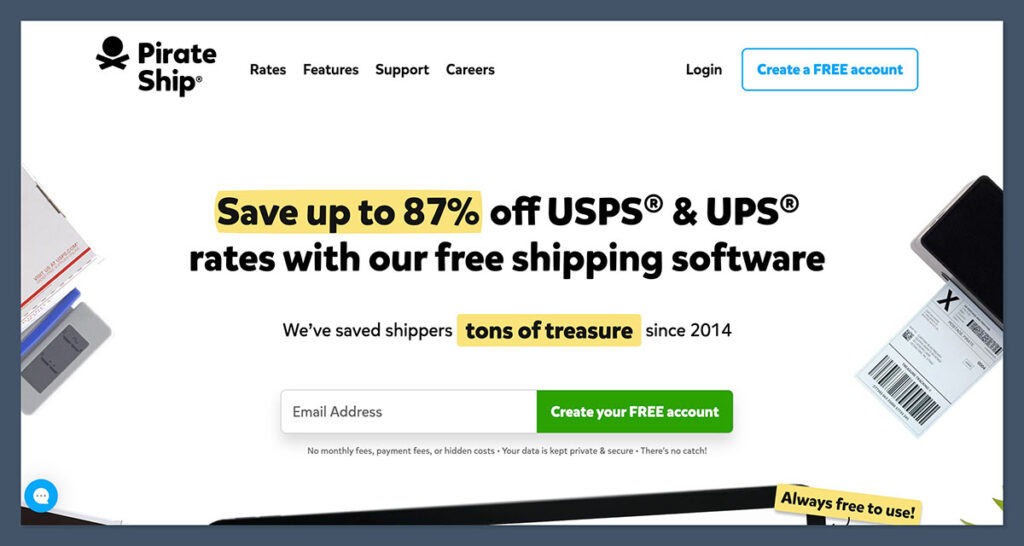
Conversely, Pirate Ship is a logistics-focused software utility. It does not provide a storefront, a payment processor, or a product catalog. Instead, it acts as a high-volume purchasing gateway for USPS and UPS postage. By aggregating the volume of thousands of small businesses, Pirate Ship secures deep discounts on shipping rates—often referred to as "Commercial Pricing"—and passes those savings directly to the user without charging a subscription fee.
The core reality for any US-based seller is that Shopify and Pirate Ship are not rivals; they are complementary assets. One provides the stage, and the other optimizes the delivery.

Chronology of Market Integration
The rise of "lean" logistics tools began in earnest around the mid-2010s, as e-commerce entrepreneurs became more sophisticated about their P&L (Profit and Loss) statements.
- The Early Era (2006–2014): Shopify focused on its core competency: building a beautiful, reliable checkout experience. Shipping was largely manual or handled by third-party integrations that were often clunky or expensive.
- The Emergence of Logistics Optimization (2014–2018): As Shopify grew, it introduced "Shopify Shipping" to keep merchants from leaving the platform to buy labels elsewhere. During this same window, Pirate Ship gained traction by offering a "freemium" model that focused on extreme ease of use and deeper USPS discounts than many platforms offered at the time.
- The Era of Interoperability (2019–Present): Recognition of the "best-of-breed" strategy led to the development of seamless API integrations. Today, Pirate Ship offers a dedicated Shopify app, effectively eliminating the friction that once existed between the two platforms. The integration allows for a "sync-and-print" workflow that satisfies the needs of both the storefront owner and the operations manager.
Supporting Data: Cost and Efficiency Metrics
When comparing the two, it is crucial to analyze the financial structure of each.
Pricing Structures
- Shopify: Operates on a tiered subscription model. Basic plans start at $29–$39 per month, scaling to enterprise-level Shopify Plus solutions ($2,300+ per month). These costs cover hosting, security, and the proprietary e-commerce engine.
- Pirate Ship: Operates on a zero-cost subscription model. The platform is entirely free to use. Pirate Ship generates its revenue through negotiated contracts with carriers like USPS and UPS, meaning the user pays only for the postage label itself.
Rate Comparisons
Data from merchant forums and industry benchmarks consistently demonstrate that while Shopify’s built-in shipping discounts are significant, they often fall slightly short of the "Commercial Cubic" and "Ground Saver" rates offered through Pirate Ship.
- USPS Priority Mail Cubic: This is arguably Pirate Ship’s greatest competitive advantage. By pricing based on dimensions rather than weight, it provides substantial savings for small, heavy items.
- UPS Ground Saver: Pirate Ship has aggressively integrated low-cost UPS tiers that are sometimes gated or unavailable in standard small-business Shopify shipping configurations.
Official Responses and Operational Philosophy
Shopify’s official stance is that simplicity is the ultimate feature. By centralizing shipping within the dashboard, they reduce the "context switching" that leads to human error. For a merchant shipping five packages a day, the time saved by never leaving the Shopify admin panel is worth more than the $0.50–$1.00 saved per label on Pirate Ship.
Pirate Ship’s philosophy, often communicated through their quirky, nautical-themed branding, is that the merchant’s margin is sacred. They emphasize that shipping should not be a profit center for the software provider. By removing the subscription barrier and the markup on postage, they empower the smallest home-based sellers to compete with larger retailers on shipping speed and cost.

Strategic Implications: How to Choose
The decision-making process for a business owner should be dictated by their current growth stage and operational complexity.
1. When to rely solely on Shopify Shipping
If your primary focus is on product development and marketing, and you ship fewer than 10–15 orders per day, stay within Shopify. The time you save by not having to sync external apps, manage another set of credentials, and reconcile data between two platforms is valuable. The "Shopify Shipping" experience is polished, reliable, and integrated directly into the customer’s order confirmation flow.
2. When to integrate Pirate Ship
Integration becomes a strategic imperative when:
- Shipping volume scales: If you are shipping 20+ packages a day, the difference in postage costs between Shopify’s rates and Pirate Ship’s rates can manifest as thousands of dollars in reclaimed margin annually.
- You require complex logistics: If your business frequently uses USPS Priority Mail Cubic or needs robust batch-printing and "End of Day" SCAN forms for high-volume pickups, Pirate Ship’s toolset is objectively more sophisticated.
- You handle specialized returns: Pirate Ship’s return label management is often more flexible and user-friendly for customers than standard native options.
The Future of E-commerce Logistics
As we look toward the future, the boundary between "storefront" and "logistics" will continue to blur. Shopify is increasingly investing in the "Shop Promise" and its own fulfillment network (SFN), aiming to compete with the speed of industry giants. Meanwhile, tools like Pirate Ship remain the "guerrilla" choice for entrepreneurs who want to maintain granular control over their shipping expenses.
Ultimately, the most successful merchants are those who treat their e-commerce stack as a collection of modular tools. By using Shopify to handle the customer-facing elements—the branding, the storytelling, and the checkout—and utilizing Pirate Ship to handle the back-end logistics, you create a system that is both scalable and highly cost-efficient.
Final Verdict: A Balanced Approach
- For the Store: Shopify is the undisputed leader. Its ecosystem of apps, themes, and global payment integrations is unmatched.
- For the Labels: Pirate Ship is the undisputed leader. Its specialized focus on USPS and UPS rates provides a clear economic advantage.
The recommendation for the modern merchant is clear: Do not view this as an "either-or" decision. Build your brand on Shopify, but optimize your margins on Pirate Ship. By connecting the two, you effectively bridge the gap between a high-conversion storefront and a high-efficiency shipping operation.
Summary Checklist for Sellers:
- Start with Shopify: Get your store live and focus on your first 100 sales.
- Audit your shipping: Once you hit consistent volume, compare your monthly postage spend on Shopify vs. what you would have spent on Pirate Ship.
- Integrate: If the savings exceed your internal value of time, install the Pirate Ship app.
- Monitor: Review your shipping workflow quarterly to ensure that your chosen tools are still providing the best balance of speed and cost.
By following this roadmap, you ensure that your business is built on a foundation of professional-grade software, while keeping your logistics costs lean enough to remain competitive in an increasingly crowded marketplace.
