
The Accelerated Hype Cycle: Decoding the Evolution of Generative AI in Marketing
The Gartner Hype Cycle has long served as the industry-standard barometer for gauging the maturity and adoption of emerging technologies. It is a framework both revered for its predictive power and reviled for its inherent subjectivity. Today, however, the rapid integration of Generative AI (GenAI) into the marketing technology (martech) stack is challenging the very structure of this model.
As we navigate the current landscape, it is becoming clear that GenAI is not a monolith moving along a single, predictable curve. Rather, it is a mosaic of applications, each hurtling through its own lifecycle at unprecedented speeds. A recent report from SAS, Marketers and AI: Navigating New Depths, offers a critical empirical look at how this technology is reshaping the marketing function, suggesting that we are witnessing a permanent shift in how organizations adopt, discard, and master new digital tools.
Main Facts: The Multi-Layered Reality of GenAI
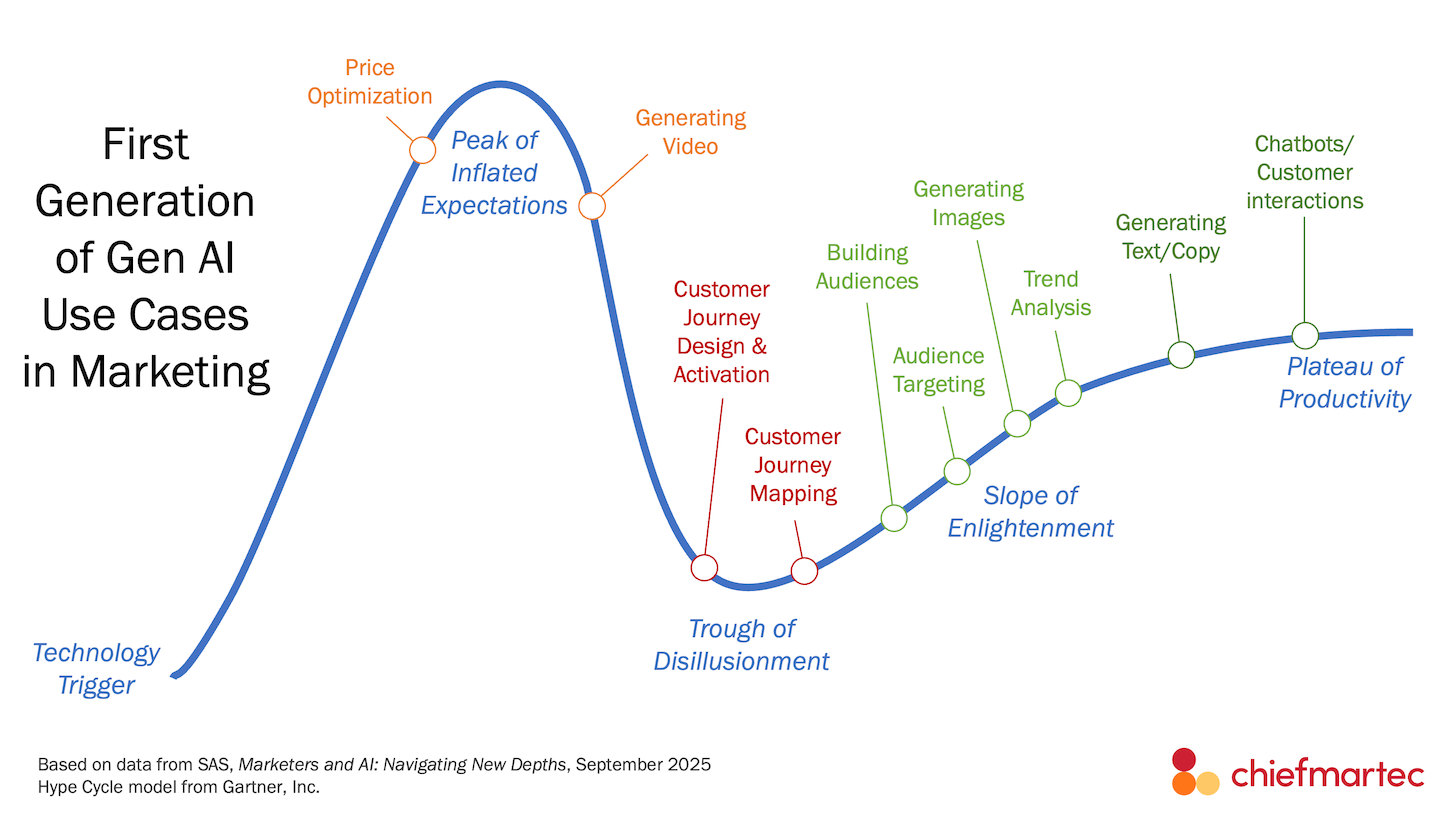
The fundamental misconception regarding GenAI in martech is that it exists at a single point on the Hype Cycle. In reality, it is everywhere at once.
When we observe the ecosystem, we see that "GenAI" is not a single product; it is a collection of use cases—from predictive content generation and customer service chatbots to sophisticated data analysis and real-time personalization. Consequently, while some applications have reached the Plateau of Productivity, others are still descending into the Trough of Disillusionment, and some are just beginning their climb toward the Peak of Inflated Expectations.
The primary challenge for CMOs and marketing technologists today is holding these opposing truths in their minds simultaneously. According to the philosophy often cited by Scott Brinker (ChiefMartec), the mark of a first-rate intelligence is the ability to maintain two contradictory ideas—such as the plateauing of one technology and the peak of another—at the same time.
Chronology: The Velocity of Modern Innovation
The traditional Hype Cycle journey from "Technology Trigger" to "Plateau of Productivity" once spanned a decade or more. In the age of GenAI, that timeline has been compressed into a handful of years, or in some cases, mere months.
The First-Generation Trap
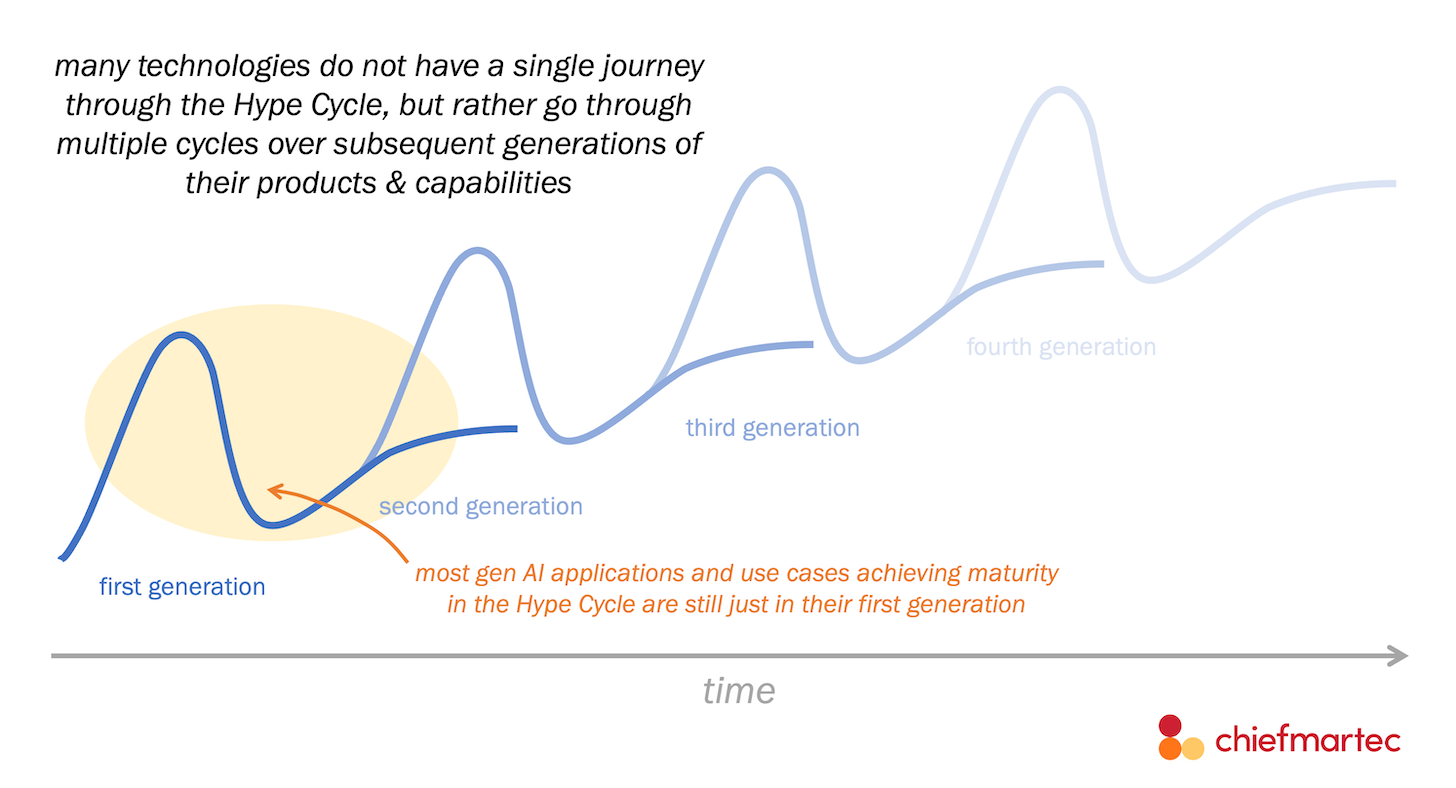
Most of the GenAI tools currently deployed in marketing departments are "first-generation" iterations. These tools are often primitive compared to what will be available in 24 to 60 months. For example, current customer service chatbots are adept at handling binary, linear queries. However, the next generation of these agents will possess autonomous agency—capable of executing complex cross-sell maneuvers and resolving intricate customer friction points without human intervention.
This creates a "nested" Hype Cycle. As the first generation of a tool hits the Plateau of Productivity and becomes a standard, commoditized utility, the next generation is already being announced, triggering a fresh wave of hype and inflated expectations. This creates a recursive loop of innovation that keeps marketers in a constant state of "early adoption."
Supporting Data: Insights from the SAS Report
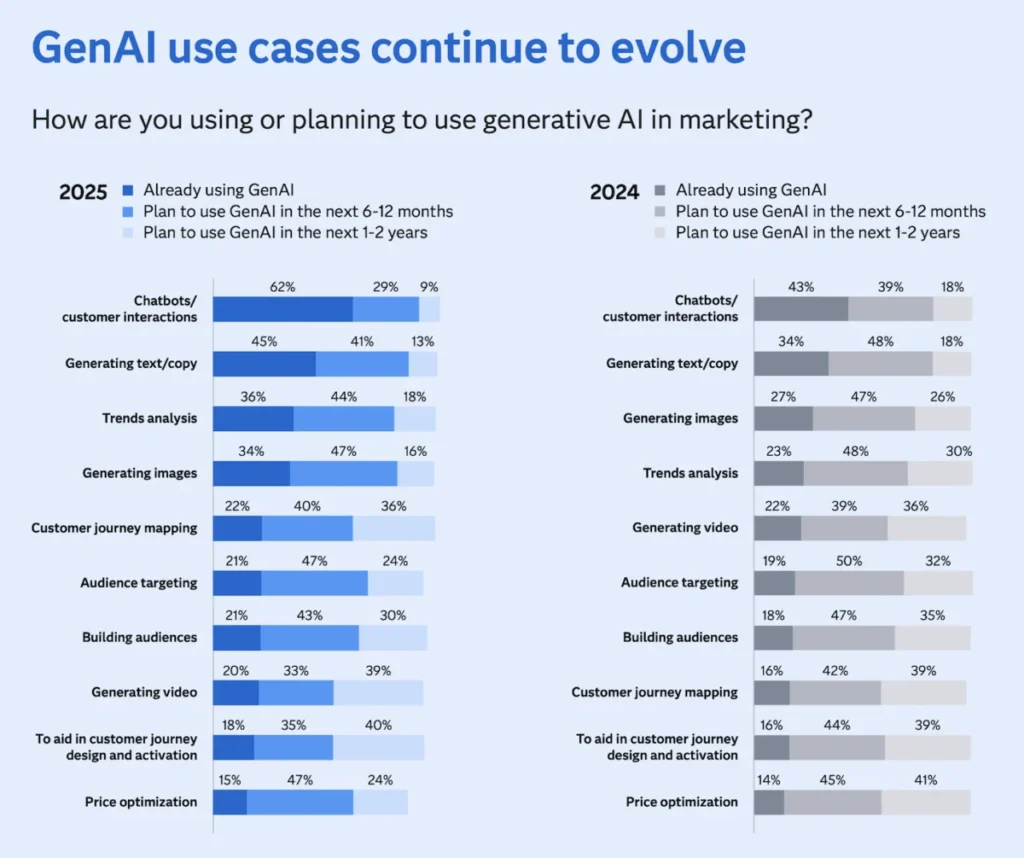
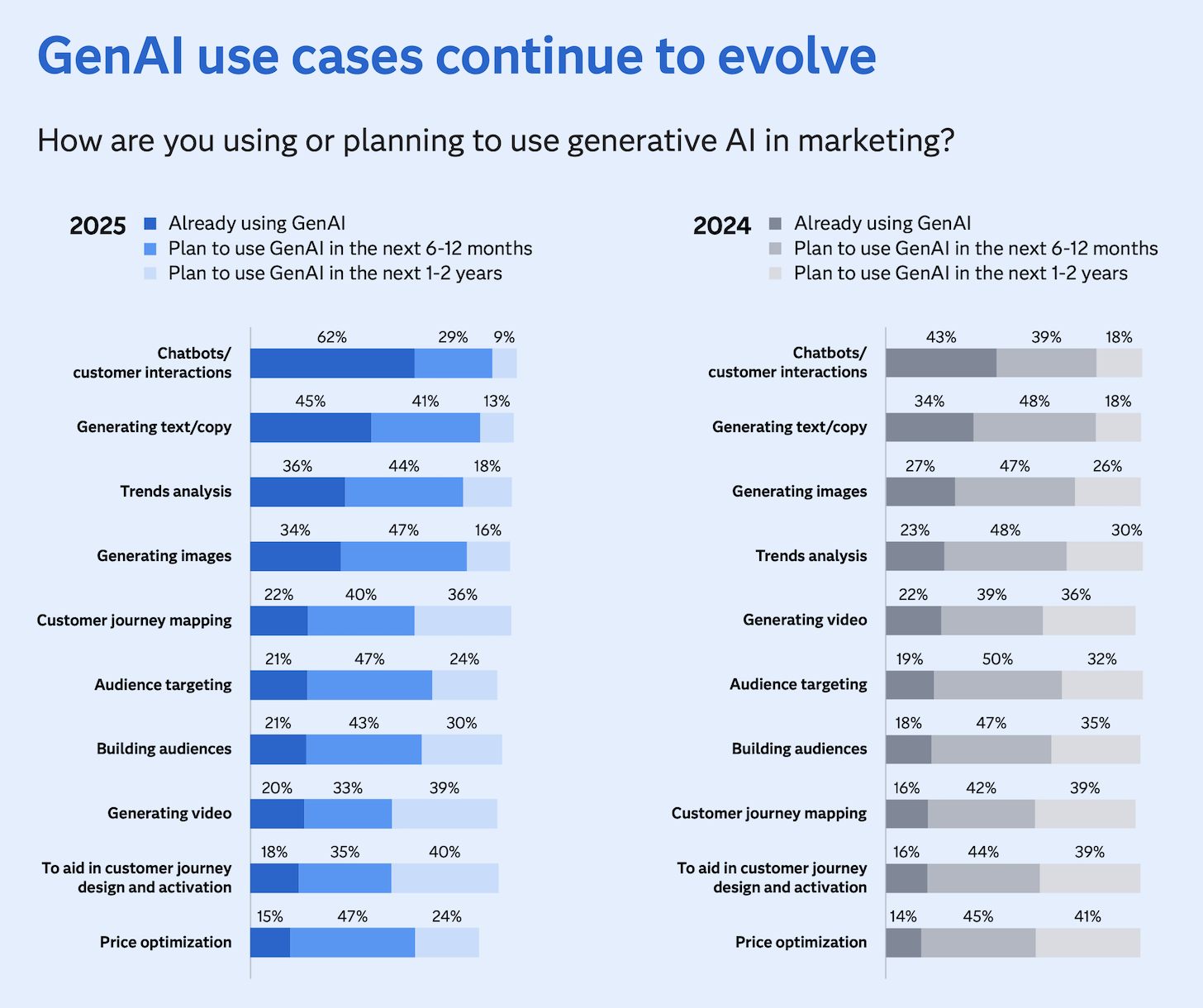
The SAS report, Marketers and AI: Navigating New Depths, provides the data necessary to move beyond anecdotal evidence. By surveying 300 professionals in 2024 and comparing those findings to 2025, the study reveals a clear acceleration in adoption.
The Rise of High-Utility Use Cases
The most impressive growth has occurred in practical, high-value areas. Data suggests that the following applications have seen the most significant 12-month acceleration:
- Automated Content Generation: Moving from creative experimentation to standard workflow integration.
- AI-Driven Customer Insights: Utilizing large language models (LLMs) to synthesize massive datasets into actionable marketing personas.
- Conversational Marketing Agents: Evolving from simple script-following bots to context-aware, empathetic digital assistants.
The Reality of "Reversed" Adoption
Not every GenAI experiment is a success. The SAS report highlights a fascinating phenomenon: certain use cases actually saw a reduction in reported adoption over the last year. This is a hallmark of the Trough of Disillusionment. When organizations realize that an AI solution requires more maintenance than it saves in labor, they prune it from their stack. This "culling" process is a necessary evolution; it signals that the industry is maturing, moving away from "AI-for-the-sake-of-AI" toward value-driven implementation.
Official Responses and Industry Perspectives
Industry experts view these findings as a sign of institutional maturation. "The speed at which AI applications are rocketing through the cycle is unprecedented," notes the analysis accompanying the SAS data.
For many firms, the initial frenzy of 2023 was driven by "FOMO" (fear of missing out). In 2025, the conversation has shifted. Stakeholders are no longer asking, "Are we using AI?" They are asking, "Are we using the right AI to drive measurable ROI?" This shift from breadth to depth is why some use cases are plateauing while others are being discarded.
The inclusion of quantum computing considerations in the SAS report serves as a stark reminder: the cycle will not stop with GenAI. As marketers settle into the Plateau of Productivity for LLMs, they must already begin preparing for the next disruption.
Implications for the Future of Martech
The implications of this rapid, multi-layered Hype Cycle are profound for marketing leadership.
1. The Death of the Long-Term Stack
The traditional five-year technology roadmap is essentially obsolete. CMOs must now adopt a "modular architecture" approach. By building stacks that can swap out AI engines as they move through their respective cycles, companies can avoid being tethered to a tool that is falling into the Trough of Disillusionment.
2. Talent as the Differentiator
As the technology itself becomes increasingly commoditized, the real competitive advantage lies in the talent that knows how to navigate the cycle. We need "AI Orchestrators"—professionals who can identify when a tool has crossed from hype to utility and know how to integrate that tool into the broader business context without disrupting the customer experience.
3. The Ethical and Practical Threshold
As we approach the Plateau of Productivity, the focus must turn to governance. When AI agents move from simple chatbots to autonomous actors with "agency," the risks regarding data privacy, brand voice consistency, and legal compliance rise exponentially. The next stage of the Hype Cycle will not be about "how to adopt" but "how to govern."
4. Continuous Learning
The feeling of "acceleration in the pit of your stomach" is not just a psychological response; it is a rational reaction to an environment where the half-life of a technological advantage is shrinking. Organizations must institutionalize continuous learning. Marketing teams can no longer afford to be static; they must become agile, research-driven hubs that treat the Hype Cycle not as a map of the future, but as a live, evolving dashboard of their own operational reality.
Conclusion: An Exhilarating Horizon
The journey of Generative AI in marketing is a testament to the sheer ingenuity of the martech community. By accepting that we are living in a world of multiple, overlapping Hype Cycles, we can better manage expectations and capital.
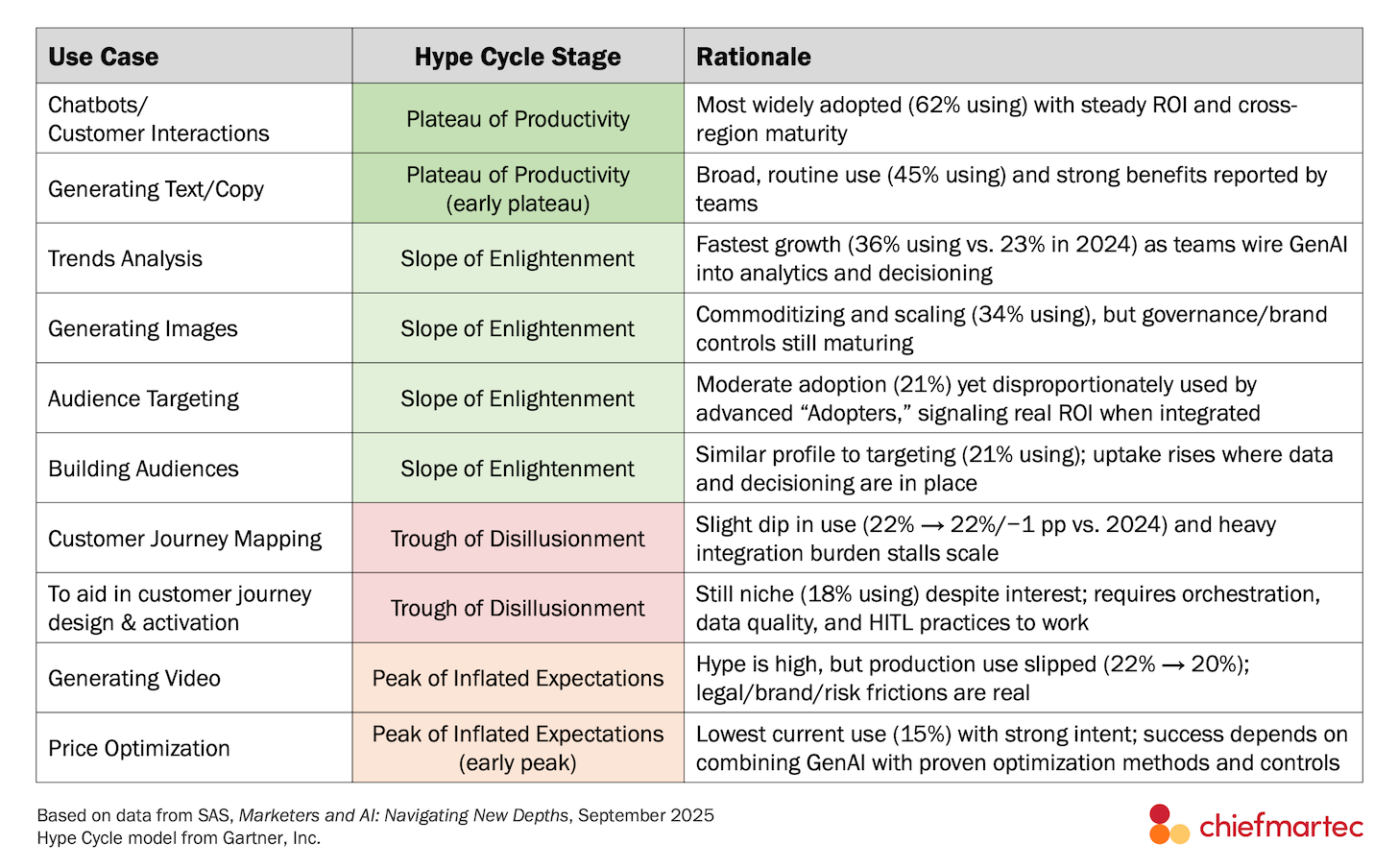
Whether we are currently in the Slope of Enlightenment or preparing for the next Peak of Inflated Expectations, the core objective remains unchanged: using technology to create more meaningful, personalized, and efficient connections with consumers. As we look toward the future—even as far as the early considerations of quantum computing—it is clear that the only constant in marketing is the rapid evolution of the tools we use to define it. It is, by all metrics, an exhilarating time to be in the business of growth.
