
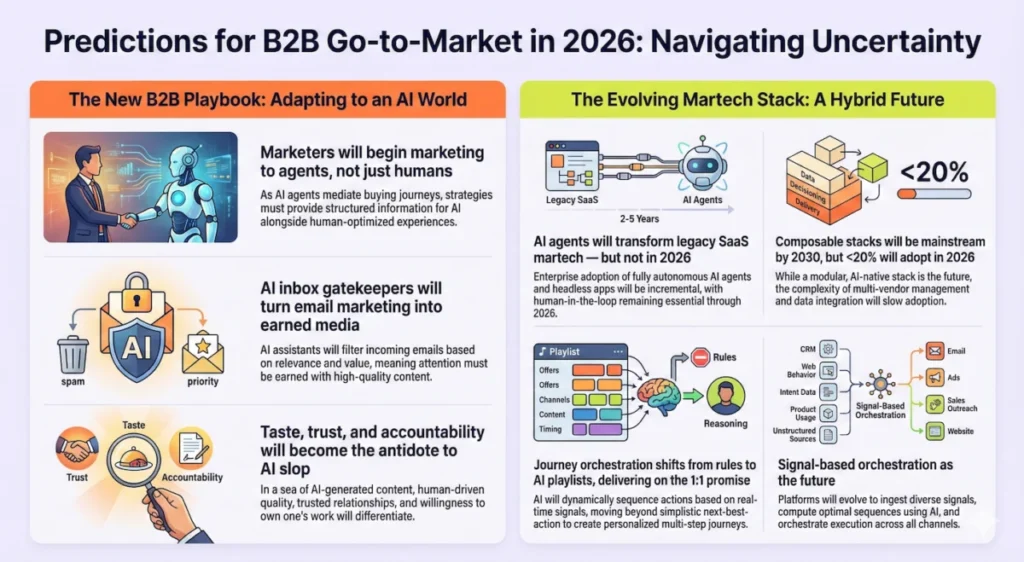
Navigating the Shift: Jon Miller’s B2B Go-To-Market Forecast for 2026
As the B2B landscape stands on the precipice of a radical transformation, few voices carry as much weight as Jon Miller. A foundational architect of modern marketing automation and the co-founder of Marketo, Miller has spent the last four years issuing annual "Go-To-Market" (GTM) predictions that serve as a litmus test for the industry. His latest analysis for 2026, published via Chiefmartech, paints a picture of a sector shifting from simple digital transformation to an era of agentic AI and signal-based orchestration.
For 2026, Miller argues that the vision of AI-powered marketing is finally moving from the abstract to the operational—even if widespread enterprise adoption remains an incremental, "hybrid" journey rather than an overnight revolution.
The Core Thesis: Marketing to Agents, Not Just Humans
The most significant shift identified by Miller is the emergence of AI agents as legitimate participants in the B2B buying committee. As buying journeys become increasingly mediated by AI—where research and vendor evaluation are performed by autonomous agents—marketers must pivot their strategies.
The Chronology of the Shift
- 2025: The rise of "Answer Engine Optimization" (AEO). Reports indicate that 90% of B2B buyers utilized generative AI for research, and over 60% of marketers began optimizing content for schema markup and structured FAQs.
- 2026: The transition from optimizing content for machines to managing interactions with agents. Miller predicts this will lead to "agent deanonymization," where site visits from AI agents are tracked and scored as Marketing Qualified Accounts (MQAs).
Supporting Data and Observations
Miller points to a stark divergence between traditional SEO and AEO. While traditional SEO focuses on human search intent, AEO focuses on providing the structured data AI models require to generate accurate summaries. According to data from The Digital Bloom, 51% of companies plan to prioritize AEO investment over traditional search optimization in the coming year, marking a fundamental change in how corporate knowledge is distributed.
The Martech Disruption: From SaaS to Service
The industry has been abuzz with the proclamation that "SaaS is dead." However, Miller offers a more nuanced, professional assessment. While AI will eventually reshape the entire martech stack, 2026 will be a year of "hybrid experimentation."
The Three Disruption Fronts
- Software vs. Labor: The industry is moving from selling "tools" to selling "outcomes." Instead of purchasing seats in a software platform, companies will increasingly "hire" AI agents to execute tasks.
- Headless Applications: The traditional user interface (UI) is losing its dominance. As users spend more time within chatbot environments, the functionality of platforms is moving "headless," accessible via API-first architectures.
- Composable Architecture: While a fully modular, composable stack is the long-term goal for 2030, Miller estimates that fewer than 20% of organizations will achieve full composability in 2026 due to the immense operational complexity involved in managing multi-vendor environments.
Official Industry Stance
Miller cites insights from analysts at Gartner and the Real Story Group, noting that while the dream of a "composable stack" is alluring, the reality is a "composable lite" model. Companies will likely keep their core marketing automation platforms (MAP) while slowly offloading data decisioning to cloud warehouses like Snowflake or Databricks.
Implications: The Rise of Context Engineering
A primary bottleneck for AI adoption is the lack of "operational context." Miller introduces the concept of Context Engineering as a formal discipline for GTM teams.
What is Context Engineering?
It is the systematic capture and structure of the tribal knowledge that makes a business unique. It includes:
- Standardized naming conventions for campaigns.
- Documented reasoning for Salesforce schemas.
- Explicit rules for segment exclusions that live outside of individual Slack threads.
Without this enablement layer, AI systems are limited to generic, often inaccurate responses. Miller posits that in 2026, the MOPs (Marketing Operations) professional’s primary value will not be in building complex rules, but in curating the context that allows AI to function as a high-level strategist.
Reasoning vs. Rules: The New Orchestration
For decades, B2B marketing has been tethered to brittle, rules-based engines: "If X, then Y." Miller argues that 2026 will mark the transition to Reasoning AI.
Unlike rules-based systems, reasoning models can infer relationships from data, weigh multiple signals simultaneously, and handle the ambiguity of real-world buyer behavior. This leads to the concept of "AI Playlists"—the dynamic sequencing of actions rather than the static "if-then" workflows that have plagued marketing automation for years.
- The Goal: To deliver true 1:1 personalization.
- The Method: AI curates a personalized sequence of interactions (the "playlist") based on real-time engagement signals, rather than forcing a buyer into a rigid, linear campaign flow.
The "Silent Freeze": Societal and Structural Impacts
Perhaps the most sobering aspect of Miller’s 2026 outlook is the impact on human labor. He highlights the phenomenon of the "Silent Freeze"—the tendency for companies to maintain productivity by not backfilling junior roles that are now easily handled by AI.
The Human Capital Crisis
- The On-Ramp Problem: As entry-level SDR and administrative roles are absorbed by AI, the pipeline for developing future senior leaders is being disrupted.
- The Barbell Economy: Miller expresses concern about a polarized labor market: high-demand "AI-proof" trades at one end, high-level strategists at the other, and a hollowed-out middle class.
Recommended Actions for Leaders
To navigate this uncertainty, Miller advises organizations to:
- Bank Efficiency: Use the productivity gains from AI to build a cash and resource cushion.
- Focus on "Taste and Trust": As the internet becomes flooded with AI-generated content (or "AI slop"), the primary competitive advantage becomes human trust. Brands must lean into founder-led marketing and executive influence.
- Upskilling: Treat AI as a personal coach. Use it to accelerate the development of existing team members rather than viewing it solely as a cost-cutting mechanism.
Conclusion: Navigation Over Prediction
Miller concludes his analysis with a humble acknowledgment: the ground is shifting too rapidly for traditional forecasting. 2026 is a year to be navigated rather than predicted.
For the modern B2B leader, the path forward is clear but demanding. It requires a shift toward signal-based orchestration, a commitment to the discipline of context engineering, and, most importantly, a steadfast focus on the human elements—trust, taste, and accountability—that AI cannot replicate. As Miller aptly puts it, "Today’s AI is the worst AI you will ever use." The responsibility for the coming year is to build the infrastructure that can adapt as these systems evolve.
