
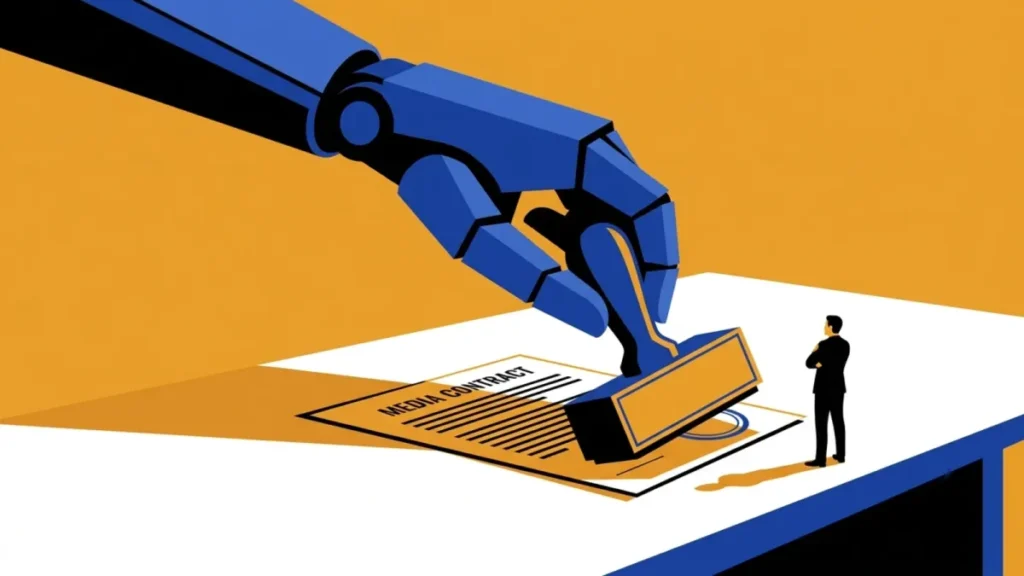
The Dawn of Autonomy: How Prague’s R2B2 Executed the Czech Republic’s First Fully Agentic Ad Buy
On June 24, 2026, the landscape of European media trading shifted from the manual, spreadsheet-heavy workflows of the past toward a future defined by autonomous machine intelligence. In a quiet office in Prague, a media buyer at Omnicom Media simply typed a campaign objective into a ChatGPT interface. Without a single email exchange, phone call, or manual data entry, a sophisticated chain of AI agents negotiated inventory, agreed upon terms, and executed a live advertising campaign for Skylink, a satellite pay-TV provider owned by Canal+.
This transaction, facilitated by Prague-based ad-tech firm R2B2, marks the first time a fully agentic ad purchase has been completed in the Czech Republic without human intervention at the transactional stage. While the scale of this pilot—one buyer, one publisher, one campaign—is modest, the architectural implications are seismic. It signals a move away from the traditional Demand-Side Platform (DSP) reliance toward a world where general-purpose Large Language Models (LLMs) act as the primary interface for complex media commerce.
Chronology of the Transaction
The journey to this milestone began long before the June 24 execution. It is the culmination of nearly two years of industry-wide movement toward standardized communication protocols for artificial intelligence.
- October 15, 2025: A coalition of six industry leaders, including PubMatic and Yahoo, launches the Ad Context Protocol (AdCP), a specification built atop the Model Context Protocol (MCP) to standardize how AI agents interact with ad-tech stacks.
- January 6, 2026: Yahoo DSP integrates agentic AI capabilities, signaling to the market that troubleshooting and campaign management are becoming automated.
- May 2026: Broadsign and Draft Digital execute the first fully agentic out-of-home campaign, proving the AdCP’s viability outside of digital display.
- June 24, 2026: The R2B2 pilot goes live in Prague. An Omnicom buyer triggers the system; R2B2’s proprietary MCP gateway connects the buying agent to MAFRA’s publisher ad server. By the end of the day, the campaign is fully booked and scheduled for launch.
The Architecture of "Agentic Advertising"
The success of the R2B2 pilot rests on its technical departure from traditional "client-side" advertising methods. Historically, inserting new advertising technologies into a publisher’s stack often required JavaScript tags, which inevitably created latency and compromised user experience.
R2B2’s solution, however, operates entirely via a server-to-server (S2S) architecture. By utilizing an internally developed MCP gateway, R2B2 allows the buying agent—in this case, ChatGPT—to communicate directly with the publisher’s infrastructure. This removes the need for browser-level code entirely, ensuring that the publisher, MAFRA, experiences zero impact on page load times or site performance.
The Role of Protocols
The backbone of this operation is the Ad Context Protocol (AdCP). As the industry has grappled with the fragmentation of programmatic advertising, AdCP has emerged as the "connective tissue." By providing a standardized language for AI agents to "understand" inventory availability, pricing, and campaign goals, it eliminates the need for bespoke integrations for every buyer-seller relationship.
R2B2’s implementation is particularly notable for its independence. While industry giants like Google and The Trade Desk have been slow to adopt these specific open-source standards, R2B2’s successful pilot demonstrates that the power of agentic advertising is not reserved solely for the world’s largest tech conglomerates. By building an agnostic gateway, they have effectively lowered the barrier to entry for mid-size publishers and agencies.
Official Responses and Strategic Perspectives
The stakeholders involved in this pilot are unanimous: this is not about replacing humans, but about evolving their role from "manual operators" to "strategic supervisors."
Lukáš Alexandr, CTO at R2B2, highlighted the necessity of this shift: "Artificial intelligence and autonomous, agentic purchasing are the clear future of digital advertising. Publishers and advertisers alike need to prepare, as this method of trading ad space is poised to become the new market standard."
For the buyer, the benefits are rooted in time-to-market. Jindrich Jiracek, Head of Performance at Omnicom Media, noted: "We view agentic buying as the natural evolution of digital advertising. This technology has the potential to dismantle long-standing barriers between campaign briefing, inventory selection, and execution. It opens new frontiers for automation and collaboration while preserving the human strategic oversight that is vital for our decision-making."
Tomas Jelinek, Acquisition Marketing Manager at Skylink, emphasized the importance of control: "What is crucial for us is that even when using advanced technology, we maintain control over where and how our brand is displayed."
The "Human-in-the-Loop" Consensus
A critical aspect of the R2B2 pilot is that it does not remove human judgment from the final decision-making process. While the negotiation and inventory matching were automated, the approval of the creative assets remained firmly in the hands of MAFRA’s editorial and commercial teams. This "human-in-the-loop" architecture is emerging as the industry standard for safe AI adoption. It allows firms to capture the speed of machine-led logistics while retaining the brand safety oversight required by major advertisers.
The Broader Implications for European Markets
European advertising faces unique pressures that distinguish it from the North American market, particularly regarding the GDPR and the fragmentation of regional media. The success of the R2B2 pilot in the Czech Republic provides a blueprint for how other European markets can modernize.
1. Regulatory Compliance
Because the integration is server-to-server and avoids client-side tracking, it is naturally more resilient to the evolving privacy landscape. It bypasses the "cookie-heavy" nature of traditional programmatic, offering a cleaner, more direct path to inventory that aligns well with EU data sovereignty standards.
2. Operational Efficiency
The gap between a brief and a live campaign is currently measured in days—or sometimes weeks—due to the back-and-forth of emails, proposals, and manual trafficking. Agentic buying compresses this timeline to minutes. In a market like CEE, where efficiency is paramount to competing with global platforms, this speed is a competitive advantage.
3. The End of the DSP-as-Gatekeeper?
Perhaps the most significant long-term implication is the threat to the traditional DSP business model. If a media planner can use a standard LLM to interface directly with a publisher’s MCP gateway, the value proposition of a proprietary, walled-garden DSP begins to diminish. The R2B2 pilot proves that the "plumbing" of the internet is shifting toward open, conversational, and autonomous standards.
Future Outlook: Scaling the Agentic Model
As we look toward the remainder of 2026 and into 2027, the focus for R2B2 will be scaling. The company intends to onboard additional publishers to its gateway, creating a network effect where more inventory becomes "agent-readable."
Industry experts tracking the movement—such as those following the IAB Europe’s recent programmatic guides—note that the Czech market is punching above its weight in terms of infrastructure adoption. The fact that an advertiser like Skylink and an agency like Omnicom are participating in such a high-stakes technical test suggests that the demand for "frictionless" advertising is reaching a tipping point.
The question for the broader market is no longer if agentic advertising will arrive, but how fast traditional agencies can adapt their staff to manage these agents rather than spreadsheets. As the industry moves forward, the "Prague Model" of server-to-server, human-approved, agentic execution will likely serve as the gold standard for regional publishers across the globe.
In conclusion, June 24, 2026, will likely be remembered as the day the "manual" era of digital advertising began its inevitable decline. With the infrastructure now proven, the transition to an automated, AI-first ecosystem is no longer a matter of technological feasibility—it is now a matter of commercial adoption.
