
The AI Copywriting Paradox: How Industry Titans Balance Technology with Human Intuition
The adoption of artificial intelligence as a primary tool for content generation has moved from a novel experiment to an industry standard. If you work in marketing, sales, or communications, the statistical probability that you have interacted with a Large Language Model (LLM) within the last twenty-four hours is exceptionally high. Yet, as the novelty wears off, a critical question remains: What does smart use of these tools actually look like, and where do they fall short?
To move past the hype and dissect the practical reality, I consulted five of the most respected figures in the copywriting world: Bob Bly, Kim Krause Schwalm, David Deutsch, Lorrie Morgan, and Anita Siek. These experts, each boasting decades of experience and documented, high-stakes client results, share a common consensus: AI is a powerful assistant, but a dangerous master.
The Evolution of AI in Copywriting: A Chronological Shift
The trajectory of AI in the creative sector has been rapid. Initially met with skepticism or outright dismissal, the tools underwent a "homogenization" phase where early adopters were briefly enamored by the speed of generation.
- The Early Phase (The Novelty): When tools like ChatGPT first surfaced, there was a rush to see if they could replace junior copywriters. The output was fast, grammatically sound, and seemingly impressive.
- The Backlash (The "Soulless" Phase): Within months, companies realized that while AI could produce text, it couldn’t produce resonance. The copy was described as "dry," "clinical," and "robotic." Many firms that had offloaded their writing to AI began rehiring human talent.
- The Current Era (Strategic Hybridization): Today, we are in a phase of sophisticated integration. Top-tier writers no longer treat AI as a replacement but as a "thinking partner" or a sophisticated research assistant. The focus has shifted from "Can AI write this?" to "How can AI support the human strategy behind this?"
The Five Rules of Engagement for AI-Assisted Copywriting
Before diving into expert perspectives, five core principles emerged from my interviews that every marketer should adopt to maintain quality and avoid the "AI trap."
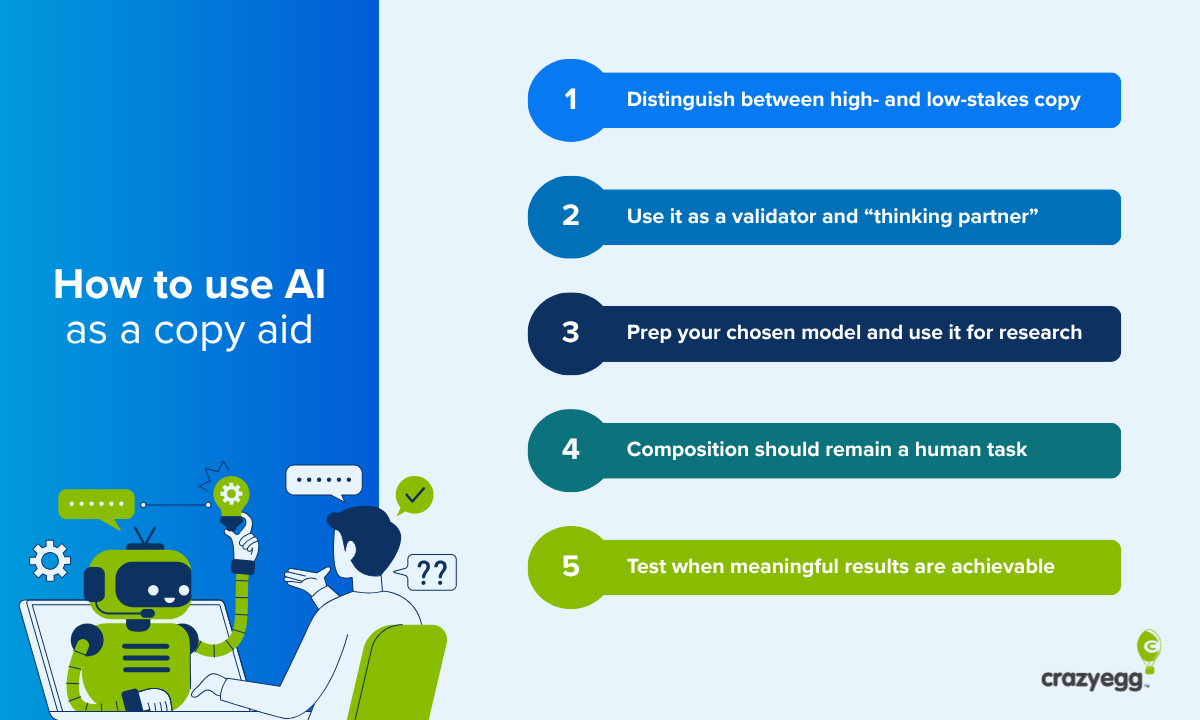
1. Distinguish Between High-Stakes and Low-Stakes Copy
Not all copy carries the same weight. A placeholder flyer for a local cafe does not require the same emotional rigor as a high-conversion, long-form sales letter for a financial firm. If your copy is directly tied to revenue, human input is non-negotiable. If the copy is tangential, or if you have the luxury of split-testing hundreds of variations, AI’s role can be significantly expanded.
2. AI as a Validator, Not a Creator
The experts all agreed: start with your own ideas. Use AI to challenge those ideas, identify potential blind spots, or suggest alternative angles. If you ask AI for the "big idea" from scratch, you will likely receive a derivative, average output. If you feed it your own breakthrough concept and ask it to critique or refine it, you enter a state of true collaboration.
3. Context is Currency
AI is only as good as the instructions it receives. A "prompt" is insufficient; you need a "brief." The most successful users are those who treat the AI as a junior assistant who knows nothing about their business. By providing transcripts, existing brand guidelines, and unique proprietary frameworks, you transform the tool from a generic generator into a specialized extension of your own workflow.
4. Human Composition is a Competitive Advantage
In an ocean of algorithmically generated content, human voice is becoming a scarce, high-value commodity. "Algorithm aversion"—where audiences reject content simply because it feels machine-made—is real. Human stories, personal anecdotes, and the ability to express vulnerability are things AI cannot replicate. As Lorrie Morgan notes, "I want to hear your voice, not C-3PO’s."
5. Prioritize Testing Over Perfection
When you cannot guarantee the quality of an AI draft, use the machine’s greatest strength: volume. If you can test 100 variants against each other, the AI’s "average" output becomes a massive data point. In this scenario, you stop caring about whether the prose is Pulitzer-worthy and focus on whether it converts.
Expert Insights: The Frontline of AI Integration
Bob Bly: The "Axiomatic Inferiority" of Machines
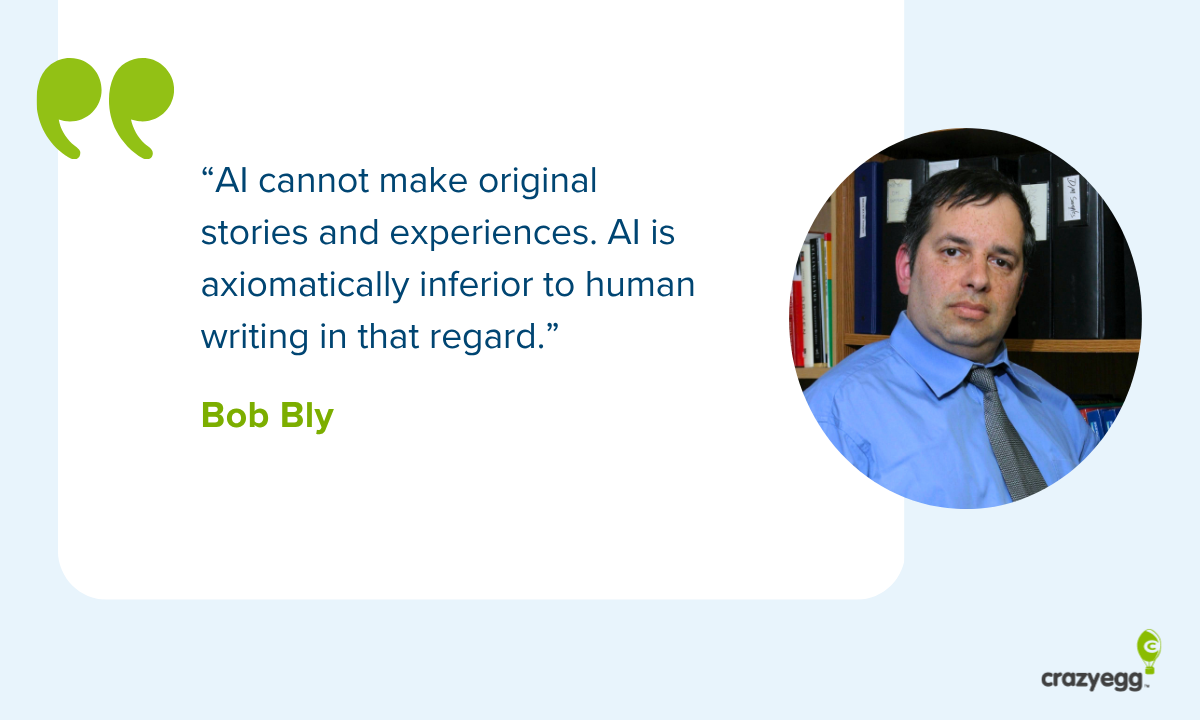
Bob Bly, author of The Copywriting Handbook, holds a firm line. He maintains that while AI can assist in the research phase, it is fundamentally inferior when it comes to storytelling. "AI cannot make original stories and experiences," he argues. "It can only regurgitate other stories that are not its own."
Bly uses AI primarily as a "big idea" validator. For instance, when researching complex financial topics, he uses AI to brainstorm the potential consequences of global economic shifts. He uses the tool to see if there is enough "meat on the bones" of an idea before he commits to writing a twenty-page sales letter.
Kim Krause Schwalm: The "Prism" Approach
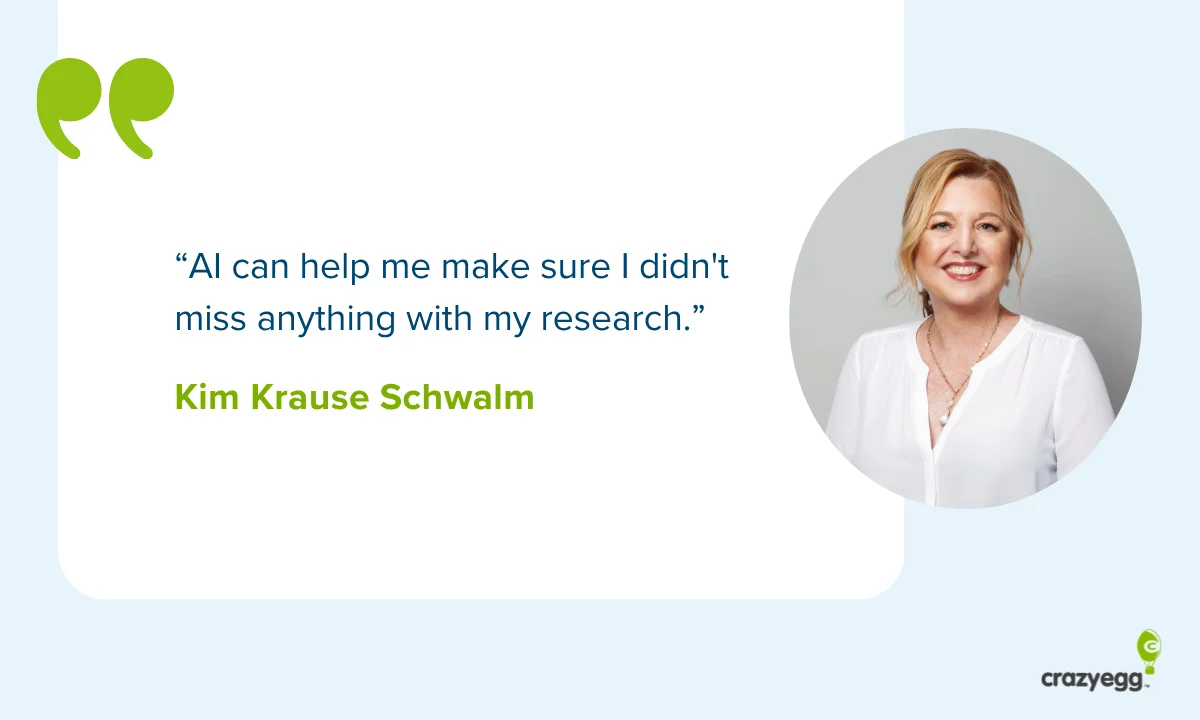
Kim Krause Schwalm treats AI as a research aide. Her favorite use case involves the "Prism exercise," a method of profiling a target prospect’s pain points and desires. While she performs the bulk of this research manually—extracting the raw, emotional language of customers from forums and surveys—she uses AI to cross-check her work. "It helps me make sure I didn’t miss anything," she explains, while warning that the AI’s output remains "clinical and devoid of emotion."
David Deutsch: Protecting the "Cognitive Muscle"
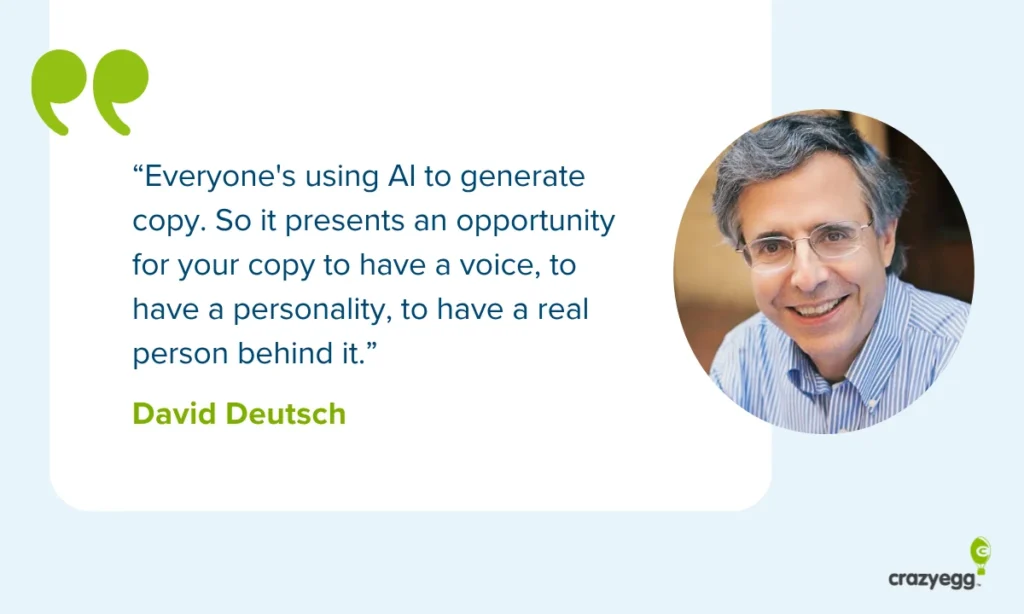
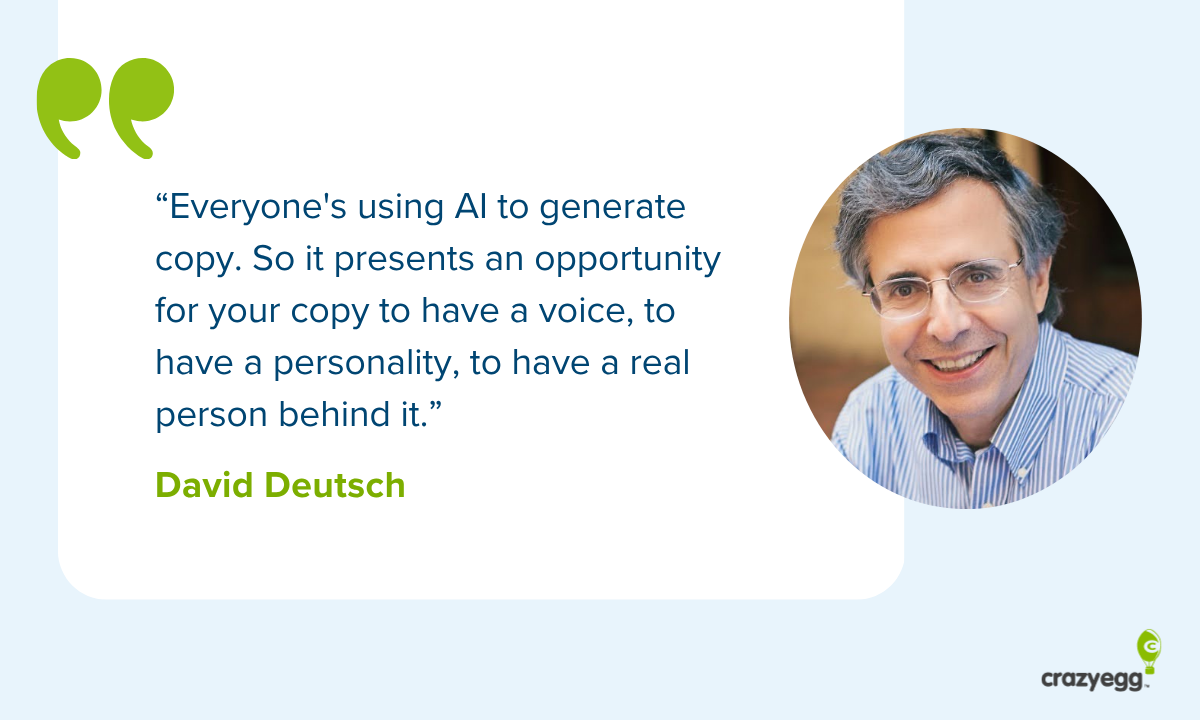
David Deutsch, who has generated over $1 billion in sales, offers a stark warning about over-reliance. He believes the most dangerous side effect of AI is the erosion of the copywriter’s own thinking ability. "People are losing the ability to think," he says. "That not only makes the output worse, but it also weakens your own muscles."
For his high-volume clients, Deutsch sets up rigid systems. He provides the AI with deep, human-researched briefs based on psychological frameworks like "Jobs to be Done" or Eugene Schwartz’s "Stages of Awareness." He views AI as a tool for testing: "I’d rather take 100 shots at the target than craft one thing that sounds great but doesn’t convert."
Lorrie Morgan: The Frictionless Optimization Trap
Lorrie Morgan, a protégée of legends like Gary Halbert, focuses on the "frictionless optimism" of AI. She points out that because AI never has a bad day, it never experiences the frustration or doubt that makes human writing relatable. "AI never gets frustrated, loses a client, or doubts itself," she notes. "That frictionless optimism is exactly what makes it feel inhuman." Her advice is blunt: use it to outline, but "be ready to get your hands dirty and clean that crap up."
Anita Siek: Teaching the AI Your IP
Anita Siek, founder of Wordfetti, takes the most proactive approach. She has built "FETTIBot," an AI trained specifically on nine years of her own firm’s proprietary copywriting and marketing frameworks. Her philosophy is that AI is an amplifier. "If you provide crappy input, you get crappy output," she says. By feeding the model her own unique intellectual property, she ensures the output remains aligned with her brand’s human-centered strategy.
Implications for the Future of Marketing
The consensus among these five experts suggests a fundamental shift in the role of the copywriter. The "writer" of the future is not merely a wordsmith; they are an editor, a strategist, and an architect of briefs.
The implications for businesses are twofold:
- Efficiency at Scale: For tasks that require high volume and rigorous A/B testing, AI-driven workflows are no longer optional. Companies that fail to leverage these tools will be outpaced by those who can test 100 variations to every one of their human-only iterations.
- The Premium on Humanity: As the internet becomes flooded with "AI slop," the value of authentic, human-led content will skyrocket. Brands that lean into storytelling, personal experience, and nuanced emotional intelligence will find it easier to cut through the noise than those who rely solely on generative tools.
The future of professional writing is not a binary choice between "human" and "AI." It is a hybrid model. The most successful practitioners will be those who guard their own creative "muscles" while utilizing the machine to do the heavy lifting in research, data analysis, and iterative testing.
As Anita Siek correctly identified: "The businesses that are winning in this era know how to critically and strategically think and teach their AI tools to follow that strategy." The machine can generate the words, but only the human can provide the meaning.
