
The Great Reset: How B2B Event Strategy is Evolving in a Data-Driven, AI-Powered Era
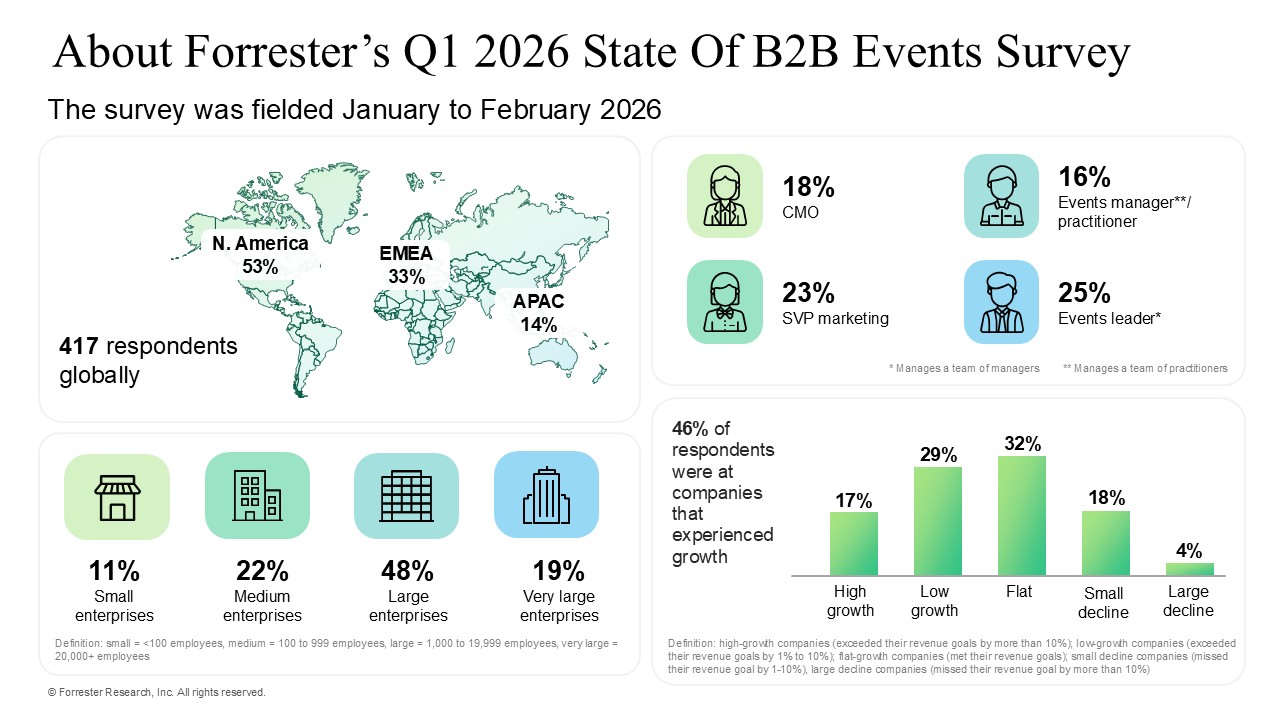
The landscape for business-to-business (B2B) events has reached a critical inflection point. According to the Forrester Q1 2026 State of B2B Events Survey, which synthesized insights from over 400 global decision-makers, the industry is moving away from the "volume-at-all-costs" mentality that dominated the post-pandemic recovery. Instead, organizations are embracing a leaner, more intentional approach driven by the necessity of budget austerity, the rise of sophisticated data integration, and the looming potential—and current limitations—of artificial intelligence.
However, a glaring "alignment gap" persists. While nearly half of the surveyed organizations report that their events are performing well, only 38% of Chief Marketing Officers (CMOs) share that sentiment. This disconnect signals that while event teams are working harder, the metrics they use to define "success" may no longer be resonating with the C-suite.
The Strategic Landscape: Budgets and Rationalization
The economic climate for B2B events remains fraught with complexity. While the percentage of organizations seeing budgets increase by more than 10% has doubled year-on-year, this statistic masks a stark reality: two-thirds of all B2B organizations are still grappling with flat or declining budgets.
This fiscal reality has forced a fundamental shift in how event portfolios are constructed. Rather than attempting to maintain a sprawling calendar of minor activations, leaders are adopting a "quality over quantity" mandate. Nearly 70% of organizations are actively reducing the total number of events they produce. The prevailing philosophy among leadership is one of concentrated investment: "We’ll do fewer events, but if we’re in, we’re in, and I want to deliver the right experience."
This move towards consolidation allows teams to protect the attendee experience despite tightening purse strings. By shedding underperforming or redundant activations, companies are redirecting resources toward high-impact engagements that prioritize brand differentiation and long-term relationship building.
The Evolution of Formats: Intimacy and Virtual Rebound
The shift in event strategy is perhaps most visible in the physical format of gatherings. Large-scale, "broadcast-style" events are seeing waning popularity, with only 18% of teams planning to increase their roster of large-hosted events. Instead, the industry is pivoting toward intimacy.
Small, repeatable formats—such as executive roundtables, specialized networking sessions, and in-person events capped at 200 attendees—are now the gold standard. These formats serve a dual purpose: they utilize fewer resources while providing a higher-quality, more targeted environment for meaningful peer-to-peer exchange.
Concurrently, a surprising trend has emerged: the rebound of the virtual event. After years of post-pandemic fatigue and decline, the number of organizations planning to increase their virtual event footprint has doubled. While geopolitical uncertainty and travel cost constraints have undoubtedly contributed to this, the shift is also rooted in a maturation of the medium. Organizations now recognize that virtual platforms offer a scalable, efficient engine for both global reach and high-volume content generation, provided they are executed with a "digital-first" mindset rather than as a poor substitute for in-person interaction.
Redefining Participation: The Death of the "Passive Attendee"
Perhaps the most significant shift in the 2026 event landscape is the rejection of the passive content model. Attendees are no longer willing to sit through day-long, presentation-heavy schedules that mirror the experience of watching television.
"If you go to an in-person event and feel like you’re watching TV, then what’s the point?" one industry leader noted in the survey.
In response, two-thirds of organizations are actively pivoting to interactive formats. Workshops, facilitated roundtables, and structured, objective-based networking sessions are replacing the traditional keynote-plus-breakout structure. This change recognizes that in a world where information is a commodity, the true value of an event lies in the interaction—the ability to connect with peers, solve specific business problems, and engage directly with subject matter experts.
The Measurement Mismatch: Revenue vs. Relationship
Despite these qualitative improvements, a persistent challenge remains in how events are evaluated. For over 50% of organizations, net-new lead generation remains the primary KPI. While the pressure to prove ROI is understandable, this narrow focus is arguably the root cause of the alignment gap between event teams and the C-suite.
By prioritizing lead volume, organizations often fall into a trap of simplistic measurement. This approach fails to account for the nuances of modern B2B buying cycles, which are rarely linear or triggered by a single interaction. When events are measured solely as lead-gen funnels, they risk being undervalued, as the broader benefits—such as brand sentiment, competitive intelligence, and account-based relationship deepening—are ignored. The industry is currently struggling to transition toward a more holistic measurement framework that mirrors the complexity of the modern customer journey.
The Data Imperative: Integration as a Catalyst
Data sits at the center of the 2026 event strategy. Over 90% of organizations cite audience acquisition, data value maximization, and proving impact as their top three priorities. To achieve these, the "siloed event" model is being aggressively dismantled.
The survey shows a 44% year-on-year increase in the integration of event platforms with the wider sales and marketing technology stack. This is a critical development. Organizations with deep integrations are not only better at capturing data; they are significantly more successful at activating it.
The data confirms the necessity of this integration: 62% of organizations with deep, enterprise-wide tech stack integration report high satisfaction with their event performance, compared to just 37% among those operating with disconnected or manual systems. These integrated teams are better equipped to personalize follow-ups, align event data with CRM insights, and ultimately demonstrate the true business value of their events to executive leadership.
The AI Frontier: Efficiency vs. Transformation
Artificial Intelligence (AI) has become a focal point of event strategy, with adoption rates doubling across multiple use cases. However, the current reality of AI in events is characterized by a "productivity-first" mindset rather than a transformational one.
Most organizations are currently leveraging AI to streamline operations—automating agenda building, optimizing scheduling, and assisting in basic content production. The more "magical" applications of AI, such as hyper-personalized attendee experiences or real-time predictive content delivery, remain out of reach for most.
The primary culprit? Data quality and accessibility. Sixty-three percent of survey respondents cited these as significant barriers to entry. To deploy AI effectively, an organization must first have clean, accessible, and structured data—a hurdle that many are still working to clear as they modernize their tech stacks.
Implications for Event Leaders: A New Mandate
The 2026 findings paint a clear picture of the future of B2B events. Leading organizations are no longer viewing events as peripheral marketing activities; they are treating them as integral components of the customer engagement ecosystem.
For event leaders, the path forward requires a three-pronged approach:
- Audience-Centric Portfolios: Shift away from volume-based scheduling toward high-touch, interactive, and smaller-scale events that prioritize the attendee’s experience and peer-to-peer engagement.
- Technological Integration: View event technology not as a standalone tool, but as a core node within the broader sales and marketing ecosystem. Deep integration is the prerequisite for data activation and, consequently, the ability to prove value to the C-suite.
- Strategic Alignment: Move beyond the "net-new lead" obsession. Work with stakeholders to define success metrics that reflect the full spectrum of an event’s impact—including relationship depth, brand equity, and account acceleration.
As the industry continues to navigate a landscape defined by fiscal restraint and rapid technological change, the organizations that succeed will be those that view events not as a series of disparate tasks, but as a strategic platform for driving meaningful, data-informed business outcomes.
For those seeking a deeper dive into these findings, the full report and the associated on-demand webinar are available to Forrester clients, offering a roadmap for navigating the complexities of the 2026 event environment.
