
Bridging the Chasm: Why Enterprise AI Strategy Needs a Fundamental Reset
The promise of artificial intelligence has permeated every corner of the corporate world, from boardroom agendas to IT infrastructure roadmaps. Yet, a widening chasm separates the feverish pace of AI experimentation from the tangible delivery of business value. While organizations are pouring capital into large language models (LLMs) and generative AI pilots, a sobering reality is setting in: costs are ballooning, customer experience (CX) scores remain stubbornly mediocre, and the anticipated leap in firm-level productivity remains largely elusive.
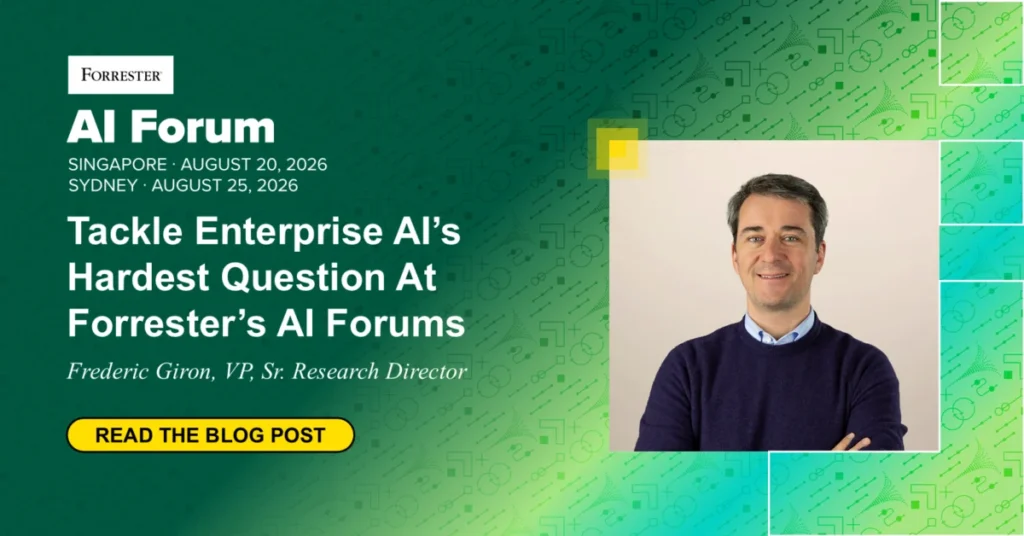
To address this disconnect, Forrester is convening its annual AI Forums in Singapore on August 20 and Sydney on August 25. The events aim to move the needle from "doing AI" to "achieving outcomes," providing a blueprint for leaders to architect systems that deliver real-world ROI.
The State of the Industry: The Productivity Paradox
Forrester’s latest analysis reveals a concerning trend: despite the ubiquity of AI investments, the expected compound effect on business performance is failing to materialize. The problem lies not in the quality of the models themselves, but in the traditional operating models that enterprises are attempting to force-fit onto agentic, cognitive technologies.
Current enterprise operating models were designed for the digital era—an age defined by human-only workforces, application-centric architectures, and process logic that relies on rigid, deterministic workflows. When organizations attempt to deploy AI agents within these legacy frameworks, the results are predictable: friction, compliance risk, and an inability to scale beyond isolated, "toy" use cases.
Chronology of the Shift: From Pilots to Structural Reinvention
The discourse around AI has undergone a rapid evolution over the past eighteen months. The initial phase was characterized by "pilot fever," where companies scrambled to deploy chatbots and code-generation tools to demonstrate technological agility. However, as these pilots hit the "scaling wall," the industry began to recognize the limitations of a use-case-driven approach.
The forthcoming Forrester AI Forums represent the next phase in this timeline: the shift toward architectural maturity. The forums are designed to help leaders pivot away from disconnected experimentation and toward a unified, cognitive operating model. By bringing together four distinct tracks—B2B go-to-market strategy, CX innovation, security, and technology architecture—Forrester is emphasizing that AI is no longer a siloed IT initiative; it is an enterprise-wide transformation.
Supporting Data: Why Current Models Fail
The "productivity gap" is a primary concern for CIOs, CTOs, and heads of AI. The fundamental challenge is that task-level AI productivity—such as summarizing a document or writing a block of code—does not automatically aggregate into firm-level value.
According to Forrester’s research, the trap lies in how organizations conceptualize the "unit of work." For years, the industry has focused on "use cases," which often result in fragmented, one-off deployments that become unmanageable as they grow in complexity. To transcend this, Forrester advocates for a shift toward a Skills-Oriented Agentic Architecture (SOAA).
Skills: The New Atomic Unit
If service-oriented architecture (SOA) provided the building blocks for the digital era, SOAA is the foundation for the cognitive era. By defining business tasks as "skills"—cognitive units of work that can be performed by either humans or AI agents—organizations can create reusable, modular products. This allows for:
- Composability: Orchestrating complex workflows by chaining together discrete, governed skills.
- Unified Governance: Establishing a shared language for both human and AI capabilities.
- Scalability: Moving away from bespoke, hard-coded processes toward flexible, agentic systems that can adapt to changing business needs.
Official Perspectives: Architecting for the Cognitive Era
The Forrester AI Forums will feature deep-dive sessions led by industry analysts, focusing on the tactical and strategic hurdles of this transition.
The Cognitive Operating Model
Leslie Joseph, a lead analyst at Forrester, will introduce a reference framework for organizational reinvention. The core premise is that the traditional "digital" operating model collapses when AI agents are introduced. "We are moving into an era where agents must act with purpose, side-by-side with humans, within specific guardrails and ethical standards," notes the Forrester team. The cognitive operating model provides the architectural blueprint to make this integration seamless rather than chaotic.
Context Engineering: The Foundation of Reliability
One of the most critical technical challenges is the "context gap." Even the most sophisticated AI agents will falter if they lack access to high-quality, trustworthy organizational data. Charlie Dai, another key voice at the upcoming forums, emphasizes that the industry must move beyond simple "prompt engineering" toward "context engineering."
This involves building robust semantic layers, utilizing knowledge graphs, and implementing governance frameworks that ensure agents are operating within the boundaries of the organization’s actual policies and data realities. "Context rot," noisy data retrieval, and semantic ambiguity are the primary culprits behind the hallucinations and compliance risks that currently erode executive confidence. Closing the gap between AI activity and AI success often comes down to the rigor applied to these underlying data architectures.
Implications for the Enterprise
The move toward an agentic architecture is not merely a technical upgrade; it is a structural mandate. Organizations that have invested heavily in use-case-driven AI may find this pivot the most difficult, as it requires dismantling existing governance structures and team shapes that were built for a static, software-based world.
The Four Modes of AI-Driven Work
During the concluding workshops in Singapore and Sydney, attendees will move from theory to application. The workshop will focus on four specific modes of AI work:
- Augmentation: Enhancing human capability with intelligent assistance.
- Automation: Offloading repetitive, deterministic tasks to AI agents.
- Enrichment: Using AI to derive deeper insights from existing data streams.
- Reinvention: Fundamentally redesigning business processes to exploit the unique capabilities of agentic systems.
The objective is to equip participants with a concrete method for connecting these modes of work to measurable business outcomes. By the end of the workshop, leaders are expected to have a clear roadmap for moving beyond the "experimental" phase and into an operational model where AI is a core driver of firm-level productivity.
Conclusion: A Call to Executive Ownership
The underlying message of the upcoming Forrester AI Forums is clear: the era of "AI as a curiosity" is over. To derive real value, AI must be treated as an enterprise commitment. This requires:
- Executive Ownership: Moving AI oversight out of the IT department and into the hands of cross-functional leadership teams.
- Cross-Functional Governance: Establishing rules of engagement that apply equally to human and agentic workforces.
- Outcome-Based Metrics: Replacing vanity metrics (such as the number of models deployed) with business-centric KPIs (such as cycle time reduction, cost-to-serve improvements, or revenue growth).
For technology leaders who have successfully navigated the initial pilot stages but are now hitting the scaling wall, the August forums in Singapore and Sydney offer a critical junction. They provide the necessary, albeit difficult, roadmap to transition from the hype-filled infancy of generative AI to a mature, sustainable, and highly effective cognitive operating model. As organizations look to 2025 and beyond, the ability to architect for context, intent, and modular skill sets will likely be the primary differentiator between market leaders and those left behind by the AI revolution.
