
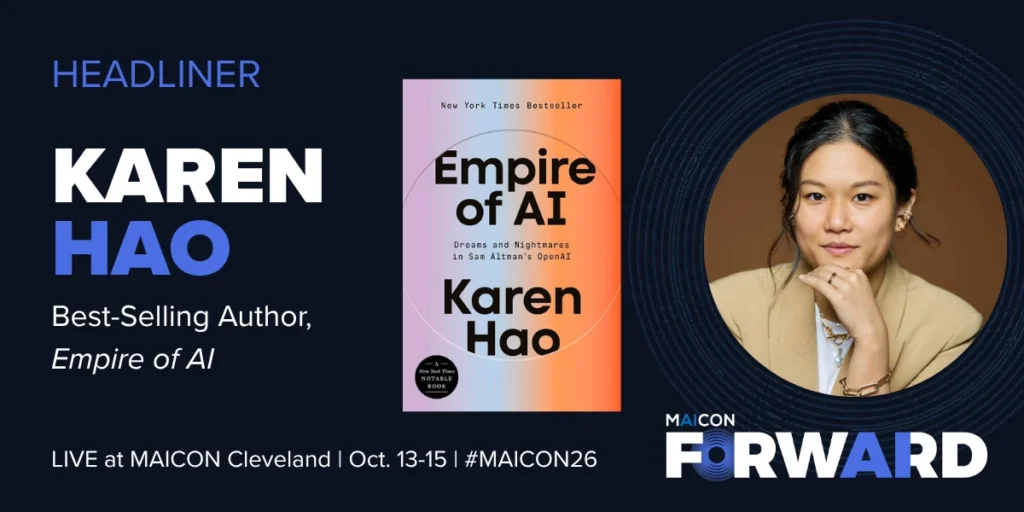
Beyond the Hype: Karen Hao to Challenge the AI Narrative at MAICON 2026
In the corporate boardrooms of the world, a singular mandate has taken root: scale artificial intelligence across every department, accelerate adoption timelines, and deliver measurable ROI. Marketing and AI leaders are under immense pressure to transform these abstract technologies into tangible business drivers. However, as organizations race to implement these tools, a critical question remains: are they following a strategic roadmap, or are they merely reacting to a powerful, industry-manufactured narrative?
At MAICON 2026, Karen Hao, the New York Times bestselling author of Empire of AI and one of the most influential voices in the field, will take the stage to challenge the industry’s status quo. Her keynote is designed to peel back the layers of the current AI boom, exposing the systemic incentives and power structures that dictate how technology is developed, deployed, and governed.
The Architect of the AI Narrative: A Profile of Karen Hao
Karen Hao’s return to the MAICON stage—having first appeared in 2019—marks a significant milestone for the conference. In the intervening years, Hao has established herself as the preeminent journalist investigating the mechanics of the AI industry. As the lead for the Pulitzer Center’s AI Spotlight Series and co-host of the BBC’s The Interface, her work has consistently bridged the gap between complex technical development and its societal impact.
Recognized by TIME and Business Insider as one of the most influential figures in the artificial intelligence sector, Hao brings a depth of investigative rigor that is rare in the rapidly evolving tech landscape. Her book, Empire of AI, has been hailed by Shoshana Zuboff, Professor Emerita at Harvard Business School, as a “heroic work” and “essential public education” regarding the forces currently shaping our digital future.
The Systems Shaping Today’s AI: A Chronology of Consolidation
To understand where AI is going, Hao argues that leaders must first understand how we arrived at this point. The narrative surrounding generative AI and Artificial General Intelligence (AGI) has not emerged in a vacuum; it is the result of years of strategic positioning by a small, concentrated group of tech giants.
The Rise of the AI Oligopoly
The trajectory of AI development in the early 2020s was marked by a shift from decentralized, academic-led research to a model defined by extreme capital intensity. Hao’s reporting tracks this consolidation of power:
- 2019-2021: The Research Transition. The era saw the transition of major AI breakthroughs from open-access labs to corporate-owned, proprietary environments.
- 2022-2023: The Generative Explosion. The public release of large language models (LLMs) served as a "Big Bang" moment, effectively hijacking the discourse and framing generative AI as the only legitimate path toward progress.
- 2024-2025: The Narrative Hegemony. By this stage, the dominant industry narrative successfully equated "AI" with "Generative AI," often obscuring the more practical, less headline-grabbing machine learning systems that have been effectively solving problems in healthcare, sustainability, and education for years.
Hao’s research highlights that the industry has successfully sold a vision of "abundance" through AGI, often distracting stakeholders from the structural, regulatory, and ethical realities of how these systems are built on the backs of precarious labor and massive, centralized data sets.
The Gap Between Reality and Hype: Supporting Data and Insights
For the modern executive, the disconnect between the "AI revolution" as marketed and the "AI implementation" as experienced is a primary source of frustration. Hao’s work investigates why this gap exists and what it means for organizational strategy.
The Misalignment of Objectives
Data suggests that while 90% of organizations have initiated AI pilots, only a fraction have successfully moved to large-scale production. Hao posits that this is not merely a technical failure, but a failure of alignment. Organizations are often trying to force-fit "generative" solutions into workflows where traditional, specialized machine learning—or even simple automation—would provide higher utility and lower risk.
The Cost of Narrative Influence
The influence of the "AI Elite"—a small cohort of companies that control the infrastructure, cloud compute, and foundational models—creates a "walled garden" effect. Leaders who do not critically analyze the motives of these providers risk:
![Karen Hao: Are We Betting on the Wrong AI Narrative? [MAICON 2026]](https://www.marketingaiinstitute.com/hubfs/Karen%20Hao-1.png)
- Vendor Lock-in: Becoming overly reliant on proprietary stacks that may pivot or increase pricing unexpectedly.
- Resource Misallocation: Investing heavily in "black box" generative models for tasks that require deterministic, explainable outcomes.
- Governance Blind Spots: Adopting tools without understanding the underlying provenance of the training data, leading to unforeseen legal and brand risks.
Official Perspectives: Why This Matters for Leaders
The implications for AI leadership are no longer theoretical. Every decision made today—from software procurement to data management policies—is a gamble on the future of the technology.
In her upcoming keynote, Hao will address the "broken" nature of technology development. She argues that the current, winner-take-all model of AI development is not an inevitability, but a choice. She challenges leaders to move from a posture of passive consumption to one of active stewardship.
The Core Questions for Organizations
- Strategic Autonomy: Are we building systems that serve our business goals, or are we simply becoming a testing ground for the products of big-tech labs?
- Governance vs. Speed: How do we balance the "move fast and break things" pressure of the market with the necessity of robust, ethical AI governance?
- The Role of Leadership: What responsibility do organizations have to demand transparency from their AI providers?
As Hao notes: "The way we develop technology is now fundamentally broken. But I truly believe that we can fix it."
The Path Forward: Implications for MAICON 2026 Attendees
The keynote at MAICON 2026 is not a forecast of future trends or a list of new AI tools. It is a structural critique designed to empower leaders. By dissecting the incentives that drive the industry, Hao provides a framework for decision-making that is resilient to hype.
Redefining Success
For the CMOs, CTOs, and strategists in attendance, the takeaway is clear: the most successful companies will be those that can cut through the noise. They will be the organizations that:
- Prioritize Utility: Selecting the right tool for the job, rather than the most "hyped" tool for the budget.
- Demand Provenance: Understanding the data supply chain behind their AI models.
- Cultivate Agency: Developing internal AI capabilities that reduce reliance on external narratives and proprietary black boxes.
Conclusion: Joining the Conversation
The urgency of this moment cannot be overstated. As AI becomes embedded in the fabric of global business, the leaders who define their own path will be the ones who thrive. Karen Hao’s appearance at MAICON 2026 offers an essential opportunity to gain the clarity needed to navigate this complex landscape.
This keynote is designed for those who recognize that "AI strategy" is no longer just about IT—it is about the power dynamics, ethics, and long-term sustainability of the organization itself.
Join us at MAICON 2026 to hear Karen Hao and over 50 other AI and business leaders as we collectively work to shape a more thoughtful, effective, and responsible future for artificial intelligence.
For more information on registration and to stay updated on the speaker lineup, visit the official Marketing AI Institute website.
